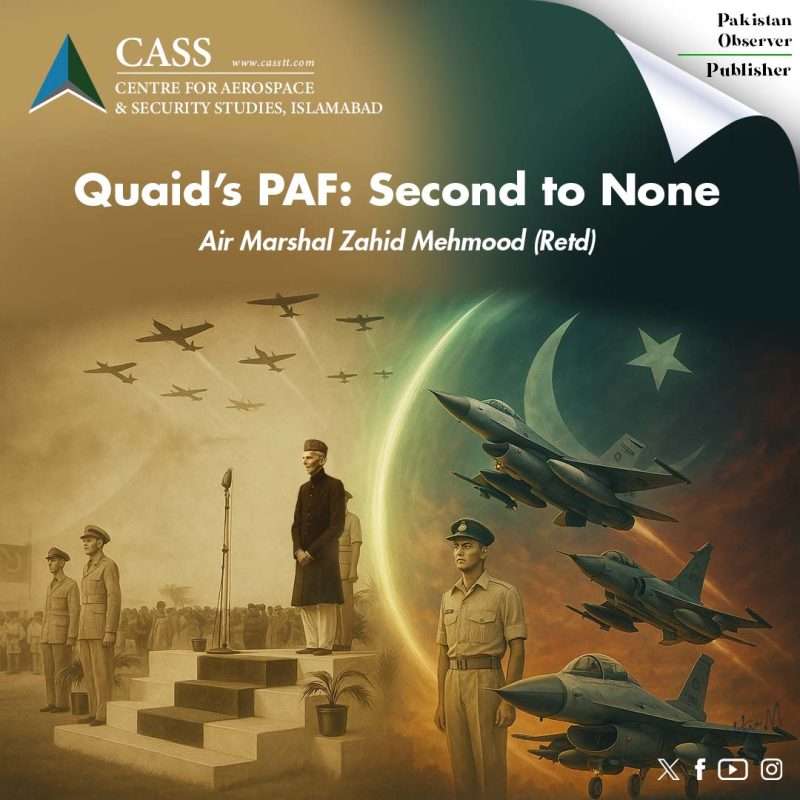
Having transformed Iqbal’s idea into reality, the great leader Quaid-e-Azam Muhammad Ali Jinnah set forth visiting various organs of the nascent state. On 13 April 1948, ailing yet resolute, he visited the fledging Pakistan Air Force at Risalpur and spoke for a few minutes. He said and I quote the following:
“It gives me great pleasure to pay my first visit to a unit of the Royal Pakistan Air Force. There is no doubt that any country without a strong Air Force is at the Mercy of any aggressor. Pakistan must build up her Air Force as quickly as possible. It must be an efficient Air Force second to none and must take its right place with the Army and the Navy in securing Pakistan’s defence. I am well aware of the air developments in other countries, and my government is determined that the Royal Pakistan Air Force will not be behind. The Royal Pakistan Air Force has started with very few assets, except loyalty and determination, to succeed. But the Royal Pakistan Air Force is taking shape, this school formed only 7 months ago is a worthy example of this. I know also that you are short of aircraft and equipment, but efforts are being made to procure the necessary equipment and orders for modern aircraft have also been placed. But aircraft and personnel in any numbers are of little use, unless there is a team spirit within the Air Force and a strict sense of discipline prevails. I charge you to remember that only with discipline and self-reliance can the Royal Pakistan Air Force be worthy of Pakistan. I am pleased to learn of the progress which this school has made and as desired by the commander and yourselves, I name it from today “The Royal Pakistan Air Force College”. I thank you all and wish your school and yourselves all success”
Quaid’s address, though short, laid down a roadmap for the nation and the Pakistan Air force, the address touched strategic, operational and tactical level aims for the nascent Air Force. If we read his address carefully, we learn a lot about the man and his vision.
A statesman par excellence, he had a deep understanding of Air Power’s role in the recently concluded WW-II and he had also observed PAF’s contribution in October 1947 during the Kashmir conflict. Firstly, he commands the Nation State of Pakistan to empower the Air Force quickly and sets a high aim for the Air Force to achieve professional excellence better than rest of the world. At the individual level, he urges PAF personnel to nurture “loyalty and determination”, both key attributes for a fighting force.
At the time of partition, PAF received very little resources in the form of aircraft and maintenance equipment. Few of these assets were deliberately sabotaged before they were handed over. Quaid-e-Azam was well aware of these difficulties and asks PAF personnel to overcome these difficulties through sheer determination and team spirit.
Lastly, in a remarkable display of foresightedness, he stressed the need for “discipline and self-reliance”. Undoubtedly, he could foresee the tremendous advancement of military technology and dominance of the west, with possible denial of advanced technology to Pakistan. His words were proved to be true decades later and remain valid to this date. In a sense he forewarned PAF and gave the recipe of “Self-reliance” as a solution to overcome these difficulties.
How has his address shaped PAF’s outlook and performance over the years is manifested through PAF’s performance over the last seven decades. This address got ingrained into PAF’s institutional memory. From the first “Eid Day Kill” (10 April 1959), through two wars of 1965 and 1971, PAF repeatedly outperformed the adversary. Independent military observers and even Indian military experts could not help but admire PAF’s performance. Post 1971, PAF had to defend its western border region during the Afghan War (1979-1989). The intruding Soviet aircraft were challenged, engaged and shot down repeatedly. At least eight confirmed kills were attributed to PAF pilots without any loss of own.
After 1989, there has been a series of contingency operations and in all of these operations PAF proved equal to the task. During “Operation Swift Retort” in 2019 and the recently concluded “Four day War”, PAF’s stellar performance remains unparalleled and would be studied by air power enthusiasts and practitioners for times to come.
The dais from where he delivered his address still stands tall and every graduating officer takes an oath in front of the same dais. Every graduation, that oath strengthens PAF’s commitment to the Quaid’s vision for Pakistan. For those who have ever attended a parade, would understand that, when the parade commander calls the parade to “Attention” (“Hoshyar” in Urdu), the parade stands tall as one, resolute and firm. After that command one cannot move, scratch or swipe the sweat off one’s brow, regardless of the heat, cold or fatigue. That very day “The Quaid” called PAF to “Attention”, PAF obeyed that command and still stands tall as a testimony to the commitment made to the great leader of being “Second to None”.
Air Marshal Zahid Mehmood (Retd) is Senior Director at the Centre for Aerospace & Security Studies (CASS), Islamabad. The article was first published in Pakistan Observer. He can be reached at: [email protected]