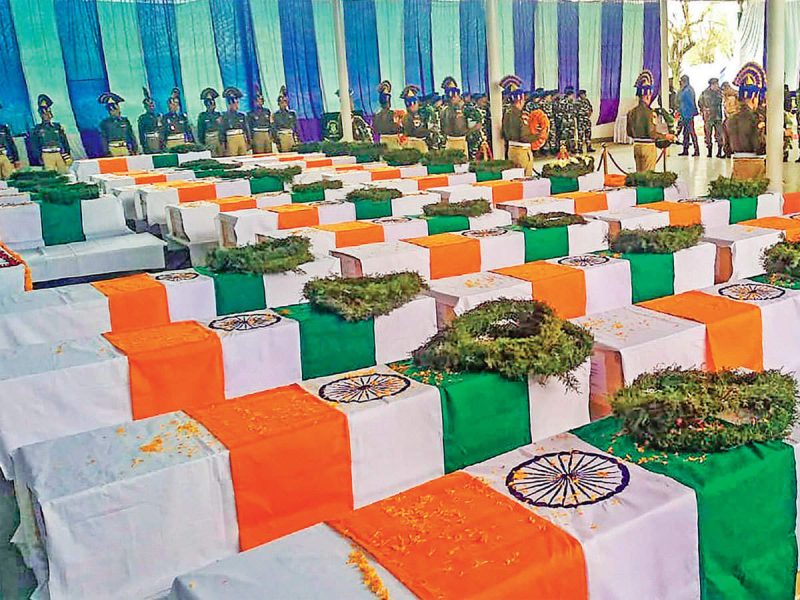
The Pulwama attack was a false-flag operation ostensibly designed to blame and corner Pakistan with an end objective to enable Mr. Modi to get re-elected. It was also planned to smear the opposition parties in India by showing fake pictures of Congress Leaders celebrating the Palwama suicide attack. The move was a serious setback for the moderates in India, who were sucked in to support a ridiculous military action against Pakistan. The main objective was to “teach Pakistan a lesson”. Accordingly, the ineffective and senseless aerial strike was conducted on the morning of 26th February, 2019. The Indian “vengeance strike” not only reflects the madness prevailing amongst the Indian politicians, but also on the perils of leaving strategic national response decisions to military commanders. Violating international borders and dropping bombs on a nuclear-capable country, advocating peace was sure to elicit response. That the Indians failed to respect international norms and Pakistan’s red lines, is just one element in this bizarre story painted by the Indian government. It was also a surprise to look at the disastrous planning of the fourth largest Air force of an ‘emerging world power’. This also seriously puts into question the future of India as a responsible member of the world community and its aspirations for being a global power.
While the strike did corner Pakistan but not in the manner that the Indians wished. Pakistan was forced to respond in a befitting manner at a time and place of its own choosing. That response was delivered on the morning of 27thFebruary, in broad day light. Not only were multiple ground targets engaged but also two Indian air force fighters were shot down in aerial engagements. The PAF has drawn first blood and acquitted itself well in the process. The aura and the might of the IAF have received a rude shock. The most prominent outcome of this engagement was baptizing of JF-17, an indigenous product. The ingressing package that was constituted comprised suitable combination of ground attack Mirages and JF-17s for aerial protection.
The PAF, with its professional approach managed to carry the day. Shooting down the two Indian aircraft and capturing the pilots is a very rare bonus. No amount of bollywoodish projection by Indian media can now hide the truth.
From the Pakistani perspective, though the battle has been won, the war still goes on unless Indians revert to sanity. Under the current situation there are only two choices – to escalate or de-escalate. Pakistan has shown maturity all along by inviting India for a dialogue to resolve all issues. However, the Indians had always refused this good-faith offer. Pakistan as a peace-loving country realizes the fact that extended full-scale war will end up badly for both the protagonists. After having this initial exchange it is time for introspection for both sides. Pakistan has already demonstrated its desire to de-escalate. The restraint and maturity displayed by the Pakistani political leadership, the Army and the PAF is indeed praise worthy. In a planned professional manner, the PAF chose to respond across the sector of Line of Control and not the international border, on legitimate targets and demonstrated unprecedented grace of breaking lock with the targets to avoid casualties, collateral damage and escalation. The message was clear; don’t mess with Pakistan, its forces and the PAF.
All through the past seven decades, India has not reconciled to Pakistan’s existence and employed a hybrid strategy persistently to weaken Pakistan, which despite multifarious problems refuses to accept Indian hegemony in the region. The latest Indian attempt to brow-beat Pakistan will go down in history as a farce which has blown in its face. It’s high time that the Indians have are look at their policies towards Pakistan. It is now for the responsible world and the national leadership of both sides to take charge. Pakistan is not escalation shy but at times, when the world community sleeps, it has shown to exercise restraint. The steps beyond the current situation are a dangerous game and an unknown territory. Political mileage by duping the Indian public has limits.
When the world is moving away from war-mongering, it is time for Mr. Modi to wake up and back off- the fate of 1.5 billion people of the sub-continent depends on it.
This article is written by Air Marshal Waseem ud din (Retd). He is working as Director National Security Outlook and Academic Coord at Centre for Aerospace and Security Studies. He can be reached at [email protected]