
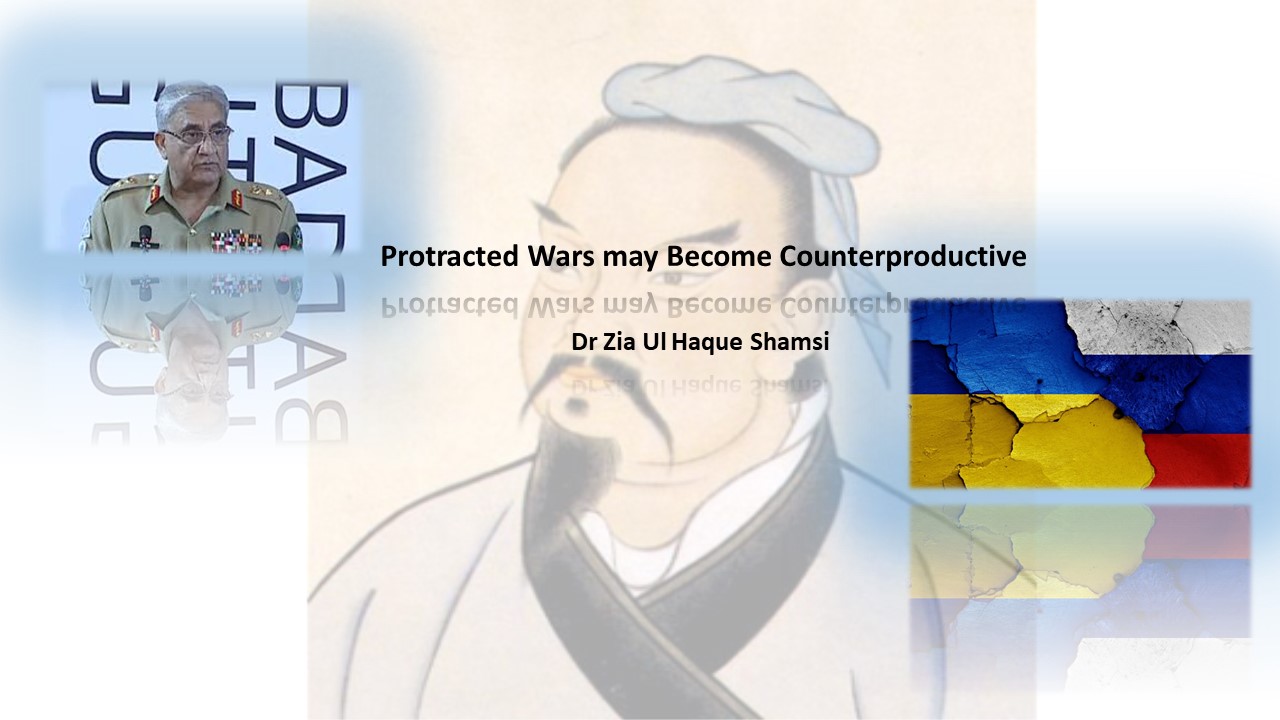
2500 years ago, the Chinese sage Sun Tzu laid certain strategic precepts which not only remain valid but are widely practised across the globe. Sun Tzu’s masterpiece The Art of War has been translated into more than 100 languages, including Urdu, and forms part of the curriculum of major defence universities, colleges, and other institutions of repute. This article is aimed at highlighting the significance of his particular dictum about protracted wars and conflicts. Several states have violated this dictum at different times in history with similar results: destruction, stalemate, ruined economies, and prolonged human suffering. The Twentieth Century is replete with such wars and conflicts starting with World War I (1914-18), after which nearly the whole of Europe needed to be rebuilt. The Treaty of Versailles signed between the victors and losers was meant to ensure that the Germans would never be able to stand on their feet, and therefore, the world would be a safer place to live. The formation of the League of Nations on 10 January 1920, was also for the same purpose. However, under Adolf Hitler, Germany was ready to storm Europe within two decades.
Prolonged wars, as prophesied by Sun Tzu, bring no benefit to any of the stakeholders. History is replete with examples of wars and conflicts which lasted years. However, without going too far back into history, this article will only review the ongoing war between Russia and Ukraine, which has the potential to expand horizontally as well as vertically.
While recognising the genuine security concerns of Russia due to North Atlantic Treaty Organization’s (NATO) eastward expansion, Pakistan’s Chief of Army Staff (COAS) General Qamar Javed Bajwa did not endorse Russia’s Ukrainian campaign. He was speaking at the Second Islamabad Security Dialogue on 2 April 2022. General Bajwa categorically stated that Pakistan is against ‘camp politics’ and urged the Russian government to cease hostilities to save precious lives.
While NATO has been expanding its frontiers since the demise of the erstwhile Soviet Union on December 31, 1991, successive Russian leadership had been warning about the consequences if its “red line” was crossed. Since Ukraine was Russia’s red line and as the narrative goes, Ukrainian leadership was keen to join the European Union (EU) as well as NATO, the Kremlin could not remain silent and ordered its forces to cross the international border on February 24, 2022.
The Russia-Ukraine war is now at least six weeks old and cannot be categorised as a protracted war as yet. However, the ongoing hostilities are a consequence of the protracted conflict between Cold War rivals. NATO countries were providing arms and equipment to Ukraine and in a way preparing it to oppose Russia’s insistence that Kyiv must not join NATO due to its legitimate security concerns.
Ukraine, though much smaller and relatively weaker than its much larger and militarily stronger opponent Russia, has been able to withstand the pressures of Russian forces with more advanced weapon systems provided by her Western neighbours. This particular aspect was highlighted by Pakistan’s COAS General Bajwa as well that the lesson one can draw from the ongoing war is that relatively weaker armed forces can put up a reasonable resistance with modern weapons. He called for the need to modernise the Armed Forces with state-of-the-art equipment to cater to numerical strengths in an evolving geostrategic environment.
On the other hand, the Russian campaign has not progressed as planned. Russia’s foremost political objective was to ensure that Ukraine accepts the latter’s supremacy in the region and the condition of not joining NATO in times to come. Moreover, Kyiv must not resist Russian forces’ ingress and accept its prescription of peace in the region. Hence, Moscow’s campaign has started to expand and is not likely to end anytime soon due to Western support for the Ukrainian resistance.
While Russian security concerns are well supported, the probability of resolving the issue through a short and swift kinetic action seems a far cry. Russia seems to have violated Sun Tzu’s precepts of avoiding a prolonged war to achieve certain political objectives. With every passing day on the battlefield, global anger against Moscow will increase, for which US-led Western powers are constantly working. Images of dead bodies and destroyed infrastructure would further raise concerns among the neutrals. Moreover, the harsh sanctions imposed on Russia by the US-led Western powers would further lead to increase in energy prices and hurt the country’s economy.
In my opinion, Russia must make an effort to quickly achieve its politico-military objectives in Ukraine and avoid getting into the syndrome of mission creep, which may raise the likelihood of a larger conflict in the region.
Dr Zia Ul Haque Shamsi is the author of ‘Nuclear Deterrence and Conflict Management Between India and Pakistan’ and ‘South Asia Needs Hybrid Peace.’ He is presently working as Director (Peace and Conflict Studies) at the Centre for Aerospace & Security Studies (CASS), Islamabad, Pakistan. The article was first published in Daily Times.He can be contacted at: [email protected]
Image Source: Etfa Khurshid Mirza



