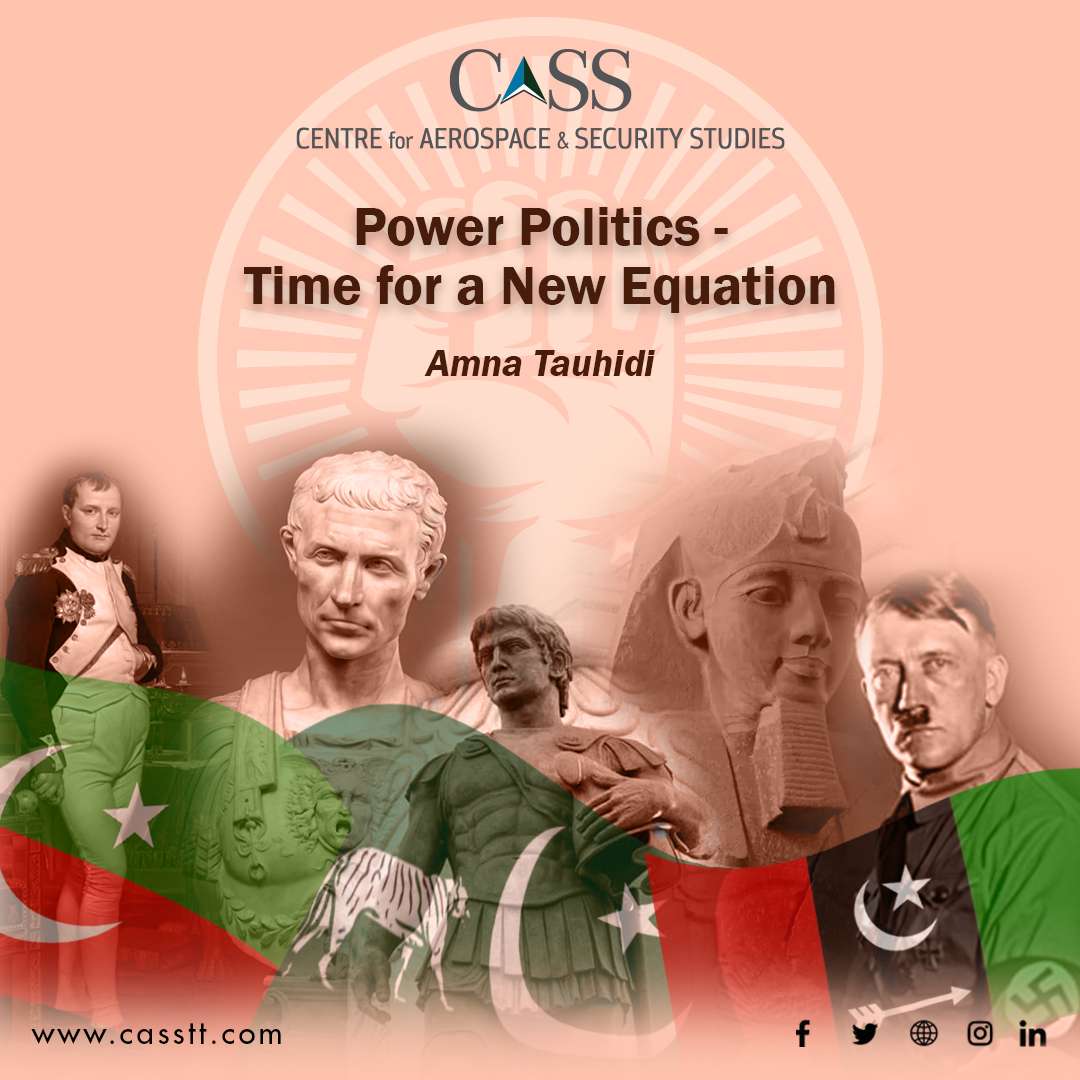
Greed and power are the defining features of human nature. This has also been alluded to in Classical Realism that the desire for power and conflict are inherent features of human nature. This inbuilt desire for power, when comes into play with politics, gives rise to ‘power politics.’ Ramesses, Alexander, Caesar, Napoleon, Hitler, and Laquan are just a few examples of historical figures who sought absolute power. Its undesired consequences include corruption, power abuse, friction between state institutions, competition for limited resources, maintenance of the status quo, blame game, factionalism, rigging, clientelism, etc. This article attempts to examine the concept of ‘power politics’ at the domestic level and its consequences in the context of misgoverned and inequitable societies like Pakistan.
According to Professor Martin Wight, ‘power politics’ is the relationship between independent powers. Independent powers are synonymous with major/dominating powers in the international arena. At the international level, ‘power politics’ – realpolitik foreign policy – refers to using moral persuasion, economic sanctions, and military pressures to achieve desired objectives. While in domestic politics, ‘power politics’ refers to the means upon which state actors rely to obtain their ends locally. According to Keith Dowding and James Bernard Murphy, ‘power is intimately associated with agency, flowing from individual actors’ conscious intentions and choices.’ Another powerful explanation of ‘power politics’ can be found in Marxism. Marxists associate power primarily with control over state resources, decision-making processes, and exercising control over the hearts and minds of the public. In short, ‘power politics’ is the exercise of powerful wills on the weak, as also reiterated by Thomas Hobbes, ‘power simply is no more, but the excess of the power of one above that of other.’
Alan James, in his article ‘Power Politics’, is of the view that power politics is equally dominating in the conduct of domestic politics, especially in representative democracies. According to James’ analysis, the opposition in democratic societies tries its best to avert the government from its course of action, using electoral displeasure as a trump card to get their demands accommodated and fulfilled by the ruling elite. Side by side, they make continuous endeavours to demonstrate the government’s incapability to rule while maximising voter base. This is the source of power that the political parties use in the political course of action. Though this power is not precise, it is thought to be effective and result oriented.
Considering the above theoretical background, let us have a look at Pakistan’s political outlook. Pakistan’s political history is replete with examples which prove that political parties have been competing to strengthen their foothold rather than working toward a collective national goal. Pakistan is still lagging in democratisation as its political elite has been wrangling and conspiring against each other to take control of the government – a cult for power. It is also evident from the fact that out of 157 registered political parties, only two or three parties have dominated Pakistan’s political stage. Power has been oscillating between civil and military leadership. However, none has been successful in meeting and fulfilling the public mandate. The political tussle for power has also created rifts between the other tiers of government that no one is ready to co-exist and bear the burden of accountability while wishing to retain the power status quo.
The domestic political landscape of Pakistan is the perfect illustration of power politics. The current political landscape is dominated by blame game tactics and moulding decisions and institutions to safeguard the political elite’s interests/mandate over national interests. State institutions are being criticised and ridiculed by the ruling elite and the opposition. They only hold regard for the institutions that favour them; otherwise, they are criticised for overreach. Unfortunately, state institutions are also getting highly politicised due to their keen desire to remain relevant in the political system of Pakistan, such as the politicisation of civil service and judiciary, etc. This has resulted in making Pakistan a polarised and unstable society. Such conduct of political leadership poses severe threats to the security and stability of the country and is inimical to the long-term national interests of the state.
Quaid-i-Azam Muhammad Ali Jinnah, the founder of Pakistan, was a staunch advocate of a democratic state. However, his early death and lack of desire in his successors to carry his vision led to the power politics we see in play today. Such attitude on the part of his successors tarnished not only the image of Pakistan but has also become one of the constants behind the current political instability in the country.
Pakistan, as a nation, has tried and assessed both civil and military rule. Unfortunately, both executed agendas that fanned power politics and neglected their social contract with the people. It is time for a new equation. A new equation minus dynastic politics that focuses more on the principle of division/decentralisation of power, defined roles and responsibilities, introduction of political and institutional reforms to bring them at par with democratic functioning, establishing a neutral base for the conduct of civil-military relations, limiting authority to curtail power abuse, and drafting of a mutual national mandate to be meticulously and religiously followed by all the state institutions and whoever comes into power. This process of political overhaul requires momentous efforts and time on the part of the political elite, state institutions, and the public to make Pakistan more stable, prosperous and a better living place for future generations.
Amna Tauhidi is a Researcher at the Centre for Aerospace & Security Studies (CASS). Complete responsibility for the factual accuracy of the data presented and hyperlinked citations lies entirely with the author and not CASS.