
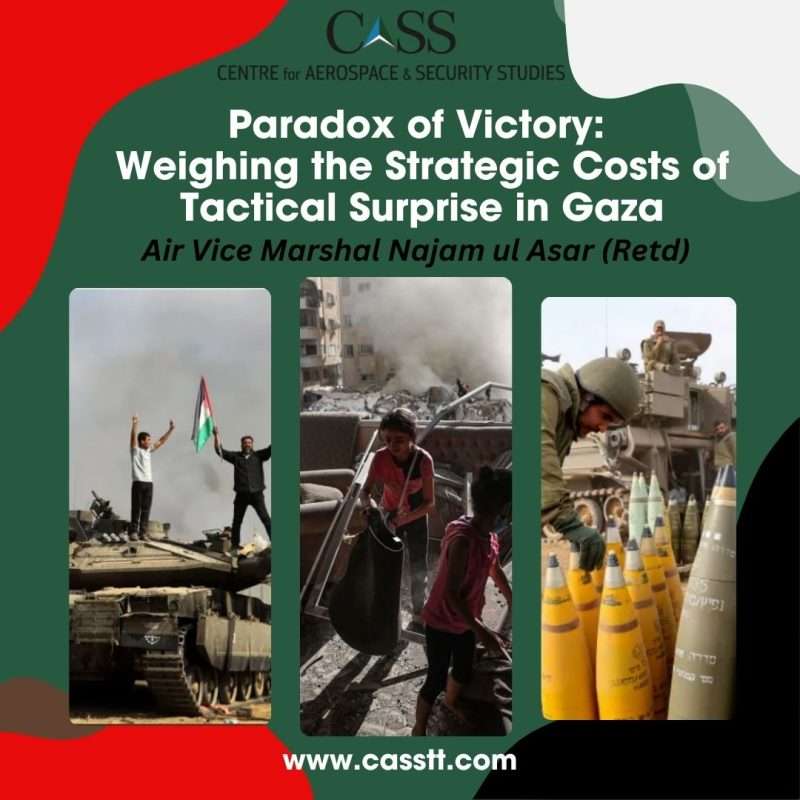
It is a genocide by all definitions. As of 6th November, Reuters, New York Times, AP News and New Arab news website have quoted the Ministry of Health in Gaza. According to these sources, a total of 10,022 Palestinians, including 4800 children and 2550 women have been killed and 25,408 wounded by the Israel’s indiscriminate aerial bombardment of Gaza. In contrast, Israeli death toll stands at 1400. Out of 1950 human souls still under the rubbles of destroyed and damaged buildings, 1050 are children of various ages, including infants. The UN Office for Coordination of Humanitarian Affairs (OCHA) estimates that 15,100 housing units have been destroyed with additional 10,656 units rendered uninhabitable. The New Arab news website quoting Gaza’s authorities has posted that 42% of housing units are either destroyed or damaged rendering 1.4 million Palestinians internally displaced, including 5,66000 living in precarious conditions at 148 emergency shelters. In 2014, the conflict in Gaza which lasted for 50 days (8 July-26 August), a total of 2251 Palestinians lost their lives; out of which 1462 were civilians, 551 children and 299 women, in the Israeli operation. During those 50 days, Israel lost 66 soldiers and five civilians.
The United Nations (UN) has announced that so far 88 members of its staff in the area have lost their lives, the highest UN deaths ever in a single conflict. As per media reports, four hospitals and 246 schools have been bombed and destroyed. There is no water, electricity, food and medicine to the desperate population of Gaza. All communications have been severed by Israel. Dead are being buried in mass graves. Israel is conducting its operations with impunity. It has already commenced its ground assault in Gaza. As in previous conflicts, it has resorted to collective punishment of Palestinians with indiscriminate and disproportionate use of force against civilian targets. A child is being killed and two injured every 10 minutes in Gaza.
In complete disregard of global public outrage, Western patronage of Israel continues unabated. This has further damaged brand America, which was already under tremendous stress after illegal military interventions in Muslim countries during the last decade. To thwart any likely military action in favour of Hamas by any state or non-state actor, a US aircraft carrier is anchored in the Mediterranean followed by British warships. Besides, the US President and a number of European leaders paid a quick visit to Tel Aviv to overtly express their solidarity with the state which came into being as a result of their machinations. Furthermore, immediately after 7th October, the US Secretary of State launched on a whirlwind tour of the region to ensure that neighbouring Arab states remain militarily neutral in this conflict. As usual, Hamas is being condemned by Western countries as a terrorist organisation which must be eliminated at all costs.
Meanwhile, Israel amassed over 300,000 troops at the border of Gaza prior to launching a ground offensive; and its aerial strikes continue. No Western government is concerned about the disproportionate use of force by Israel even as every international humanitarian organisation and aid agency is expressing grave concerns about the situation, which is being declared ‘catastrophic.’
Notwithstanding the strong public sentiment, Muslim ruling elite is as usual in a state of strategic paralysis with only verbal condemnation and calls for a ceasefire. Out of 57 Muslim countries, at the outset of the conflict, only Iran and Turkey strongly condemned Israel’s disproportionate response. Although Iran issued warnings to Israel of grave consequences, these largely amounted to rhetoric, as its own economic and security concerns force it to consciously avoid any direct involvement. However, as a gesture of solidarity, Iranian Foreign Minister visited Lebanon and met with Hezbollah leaders. Saudi Arabia has put US-sponsored peace negotiations with Israel on the backburner. In the meantime, a UN Security Council resolution proposed by Russia for a ceasefire was vetoed by the US. As a matter of state policy, Pakistan has always stood with Palestinians.
Hence, the bombardments on Gaza continue. Such deliberate targeting and killing of the elderly, sick, wounded, women, and children represent a harrowing act of ethnic cleansing, unparalleled in its scale and severity in modern history.
On the other hand, Hamas is being credited by its friends (and foes) for hitting an effective blow and catching Israel off guard. The initial success of Hamas fighters infiltrating Israeli territory via air, sea, and land was indeed a tactical surprise. Their clandestine and well-coordinated planning, training, and execution enabled an almost undetectable entry into Israel, signalling a profound intelligence failure on the part of the latter’s renowned security agencies and defence systems. In fact, ‘Operation Al-Aqsa Flood’ not only caught Israel off guard but also shocked the international community. Despite this, the lack of sustained action following their initial success is both intriguing and concerning. Once the element of surprise was overcome, Israel reclaimed the initiative, countering with overwhelming force – a development that Hamas might have underestimated and should have anticipated.
As Israel persists in its heavy bombardment of Gaza, issuing ultimatums to Palestinians to evacuate or face dire consequences, the situation remains grim. Despite Hamas’s resistance following Israel’s ground assault, there is a distinct lack of substantial follow-up actions to their earlier successful infiltration into Israeli territory. This inaction has left room for Israel to continue its military operations unchecked, casting a shadow of despair over the Palestinians with little to no respite in sight.
An unbiased observer might pose several critical questions regarding the conflict. One wonders whether Hamas considered the expected Israeli retaliation, historically characterised by overwhelming force and alleged disregard for international law, especially concerning the protection of civilians and non-military infrastructure. Furthermore, the impact on the most vulnerable, women, and children, is undeniable and prompts the question of whether such outcomes were factored into Hamas’ strategy. One is also forced to question the logic behind Hamas’ response plan, whether they miscalculated the scale of Western support for Israel, and how they interpreted the geopolitical landscape, including Russia’s involvement in Ukraine, China’s cautious approach, and Iran’s economic and security challenges. Lastly, considering past alliances and regional dynamics, what assistance did Hamas anticipate from Arab and Muslim states, and at what stage of the conflict?
As Israel persists with its military campaign in Gaza, such questions concerning Hamas’ strategic calculus remain at the forefront. As of now, there is a palpable sense that Hamas’ strategy was not fully thought through beyond the initial tactical surprise, which, while successful, did not translate into a comprehensive plan towards some desired outcome. This apparent oversight has resulted in a dire situation on the ground, as reflected by the painful images broadcasted daily, depicting the suffering of the most innocent of innocents. Such scenes underscore the potential strategic costs of a surprise that, while tactically sound, may not have been anchored in a long-term vision. Hence, one is left wondering: Did the tactical surprise carry a strategic price tag too heavy to bear?
Air Vice Marshal Najam ul Asar (Retd) is Director at the Centre for Aerospace & Security Studies (CASS), Islamabad, Pakistan. The article was first published in the Islamabad Post. He can be reached at: [email protected]
Design Credit: Mysha Dua Salman



