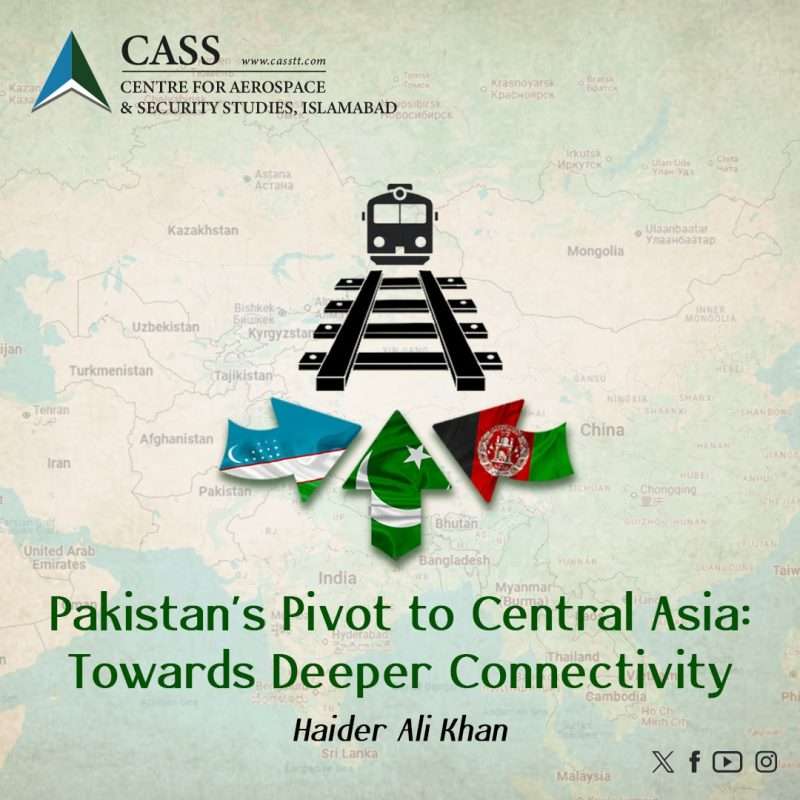
From the ancient silk routes to modern trade corridors, Pakistan and Uzbekistan are forging a new path for regional connectivity – one strategic handshake at a time. Prime Minister Shahbaz Sharif’s recent visit to Uzbekistan was characterised by a landmark trade agreement signed by both nations to expand bilateral trade to USD 2 billion. This development builds on earlier engagements and is expected to unlock new opportunities for cooperation in trade and connectivity. It follows the ratification of the Preferential Trade Agreement (PTA) in 2023, which seeks to increase annual bilateral trade to USD 1 billion by reducing tariff and non-tariff barriers on specified goods.
Leaders from both nations reaffirmed their commitment to advancing the Trans-Afghan Connectivity Project, which aims to establish vital trade links between South and Central Asia via Afghanistan. As part of this broader initiative, the Uzbekistan-Afghanistan-Pakistan (UAP) railway project was finalised in July 2023 to strengthen regional multilateral trade. The proposed rail corridor, spanning 760 kilometres, will begin in Termez, Uzbekistan, pass through Mazar-i-Sharif, and terminate at Kharlachi in Pakistan’s Kurram District.
International collaborators such as Qatar have expressed willingness to provide financial to the project, where as, China has proposed to finance the initiative as part of its Belt and Road Initiative. Nevertheless, the undertaking faces financial constraints with projected costs estimated between USD 4 to 6 billion. Despite all the cost, outcomes of the PTA seem promising as bilateral trade has expanded elevenfold since 2017. Although modest, the total trade volume between the countries now stands at USD 400 million, a significant jump from USD 66 million in 2018. The Intergovernmental Commission on Economic Cooperation meeting, held in Tashkent last year, increased the number of agreed items under the PTA from 17 to 100, aiming to boost bilateral commerce.
The recent trade agreements and connectivity projects align closely with Uzbekistan’s strategic vision to diversify its trade portfolio. While growth with traditional partners remains important, Tashkent is actively seeking to expand its export horizons beyond established markets. Geopolitical imperatives further compel Uzbekistan to invest in broader regional linkages, and deeper trade integration with South Asia represents a mutually beneficial opportunity. Recognising this, Uzbekistan spearheaded a United Nations resolution on connectivity between South and Central Asia, which was unanimously adopted by the UN General Assembly and co-authored by Pakistan and other Central Asian republics. For Uzbekistan, these initiatives are not merely diplomatic gestures: they signal a deliberate shift towards reshaping the regional trade architecture.
Pakistan has long been viewed as the most suitable route to Central Asia, and its viability is undeniable. Moreover, it provides a window for Pakistan to tap into the Eurasian trade corridors, an opportunity the country had not been able to undertake thus far. The lack of regional security has eroded Pakistan’s geostrategic advantage. Alongside fiscal limitations, the prevailing security environment, particularly in Afghanistan, which serves as a central transit corridor, continues to pose challenges to the advancement of regional connectivity initiatives. At the same time, a strategic window has opened for Pakistan to strengthen ties with Central Asia, especially as India’s investment in the Chabahar Port faces uncertainty following renewed US sanctions under President Trump. In this context, both Pakistan and Uzbekistan have called on the Taliban to take decisive action against terrorism to ensure a secure environment for trade and commerce. Cross-border militancy has already led to sporadic disruptions in inter-state transit, including the suspension of key border crossings, undermining emerging trade relations. For Pakistan, this moment presents a rare opportunity to expand its regional trade footprint. However, if the initiative falters, there is a real risk that evolving trade routes may bypass Pakistan altogether, leaving it isolated from the region’s economic realignment.
Uzbekistan’s reliance on Afghanistan as a transit route makes peace in the country both a regional imperative and an economic opportunity. Pakistan’s offer of access to Gwadar and Karachi ports presents the shortest path to the sea for Central Asia, but this potential hinges on stability in Afghanistan. This moment offers a rare chance for economic convergence beyond great power politics, one that requires aligning security and trade through bilateral and multilateral cooperation, recognising that the two are inseparable.
Haider Ali Khan is a Research Assistant at the Centre for Aerospace & Security Studies (CASS), Islamabad, Pakistan. He can be reached at [email protected].