States are at risk of losing sovereignty more than territorial integrity when they expose their weaknesses to friends and foes alike because, in the realm of international relations, there are no permanent friends or permanent enemies. Lord Palmerston’s centuries-old dictum holds good even now and perhaps forever.
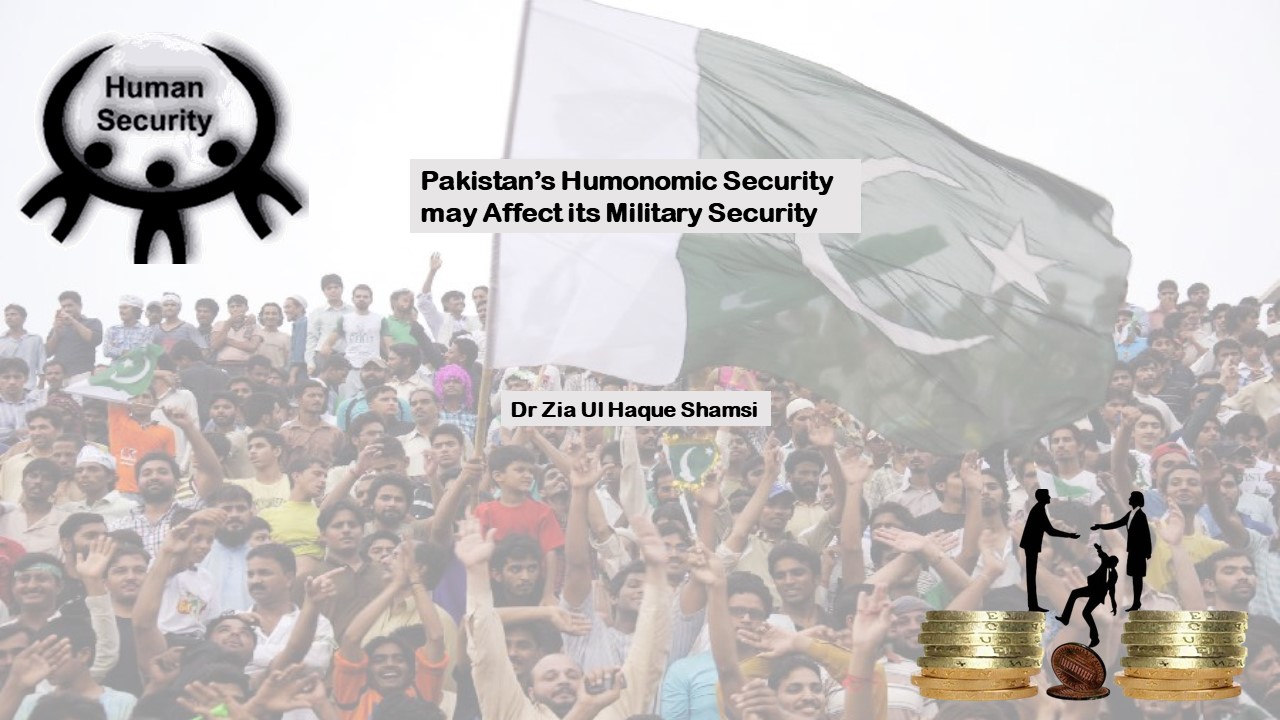
The three pillars of Pakistan’s recently released National Security Policy (NSP 2022-2026) include human security, military security, and economic security. Whereas economic security is a vital element of human security or non-traditional security, to put more emphasis on the former, it has been dubbed ‘geo-economics’ and discussed separately also.
While Pakistan’s military security is considered theoretically secure due to its nuclear capability, and practically secure due to the professional competence of its Armed Forces, it is the other two pillars: economic security and human security which are fully exposed at this time. It is necessary to remember that the military preparedness of any state largely depends on the unflinching support of its people and country’s economy.
Pakistan is in dire need of an economic bailout package from international donor agencies as well as friendly countries, primarily because of its obligatory payments. However, the International Monetary Fund (IMF) is twisting the arm of the present government and insisting on imposing extremely harsh economic conditions on the people of Pakistan before the release of much needed foreign currency. IMF has laid a mandatory condition for the government to withdraw all subsidies on petroleum products as well as electricity tariffs immediately, which the previous government had extended until 30 June 2022. Perhaps, the present government did not have any choice or an alternate plan and succumbed to IMF pressure, thereby immediately raising the prices of petroleum products to new heights, which are the single largest increases in Pakistan’s history. The same is happening to electricity tariffs.
On the other hand, the currency market and the stock exchanges are in a free fall, primarily due to the uncertain political situation. Friendly countries are not coming to the rescue, perhaps until the IMF deal is finalised with the government. While the government is tight-lipped about its preparations for the forthcoming budget, the people are preparing themselves for extremely harsh budgetary proposals, primarily owing to tough IMF conditions.
There is little doubt that the forthcoming budget will be tough due to above mentioned IMF conditions and will lead to inflation adding to the economic difficulties for the people of Pakistan. That would mean putting at least two elements of NSP: economic security and human security, under stress – perhaps under serious threat. And, if people are feeling the pain due to rising inflation, poverty, and hunger, the government may be forced to divert certain public funds to give relief. At that stage, the defence budget might also come under pressure and have an adverse impact on future development plans of the Armed Forces of Pakistan.
The entire situation needs to be viewed amid the current global and regional environment. Europe is at war as Russian intervention in Ukraine has entered its fourth month. The momentum and intensity of this Russo-Ukrainian war are increasing with every passing day. According to a Reuters report, the estimated deaths in the ongoing war have reached 46,000, whereas non-fatal injuries stand around 13,000. CNN has reported Ukrainian President Volodymyr Zelensky, who was being interviewed by Newsmax that Ukraine is losing 60-100 soldiers every day.
Afghanistan’s Taliban government remains unrecognised even though it assumed authority on 15 August 2021, after the hasty withdrawal of US-led NATO forces. The people of Afghanistan continue to suffer due to this lack of international recognition because the donor agencies are not forthcoming in support of the Taliban regime in governing the war-torn country.
On the other hand, Chief of Air Staff, Indian Air Force (CAS, IAF) Air Chief Marshal Vivek Ram Chaudhari has recently asked its air force to remain prepared for a short and intense war which may last for about one week. He is of the view that IAF must be prepared for both: short and intense war and a long-drawn stand-off that may or may not culminate in a military conflict.
At this time, Pakistan’s economy is under stress, and people are feeling the pain of rising inflation. Concurrently, the international, and regional environment is extremely volatile, therefore, we need to be careful with regard to our military security more than before. While I am confident of the professional competence and operational preparedness of Pakistan’s Armed Forces, the issues related to our economic sovereignty are certainly a serious cause of concern that needs to be taken care of through emergency measures.
Dr Zia Ul Haque Shamsi is the author of ‘Nuclear Deterrence and Conflict Management Between India and Pakistan’ and ‘South Asia Needs Hybrid Peace.’ He is presently working as Director (Peace and Conflict Studies) at the Centre for Aerospace & Security Studies (CASS), Islamabad, Pakistan. He can be contacted at: [email protected]