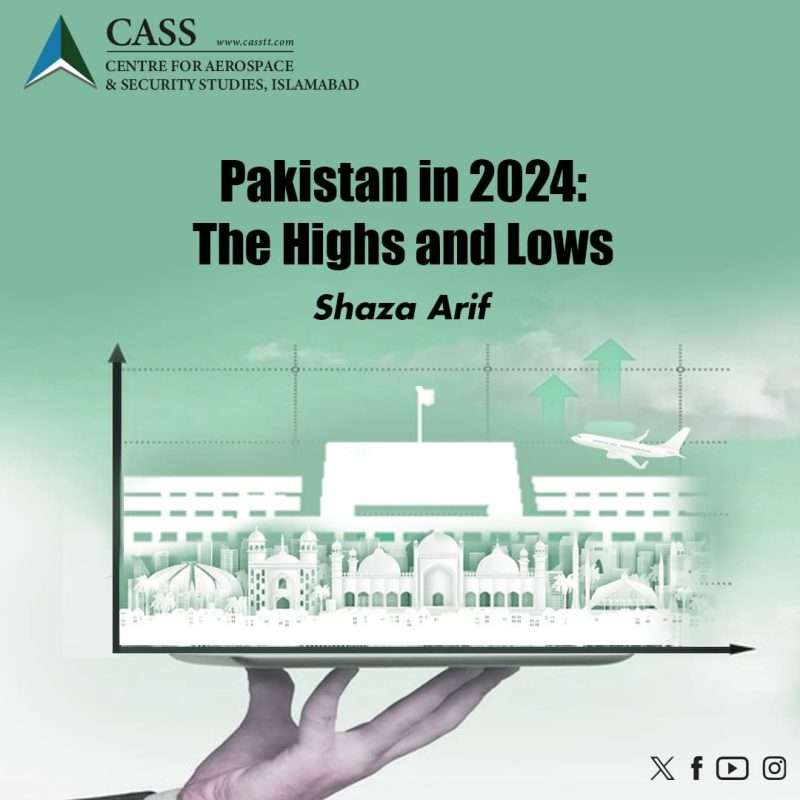
The Georgian calendar is not the most ideal litmus test of progress. However, it does provide a meaningful scale to analyse the highs and lows of a state’s journey. As we wrap up 2024, we need to look back and reflect on the events that have shaped the passing year. Like every year, 2024 brought along challenges and opportunities.
On the economic front, the concluding months of 2023 showed improvements in overall economic indicators. This trend continued in 2024. Inflation figures witnessed a relative decline, dropping to 4.9%, signaling a slight relief after grappling with towering statistics last year. The Pakistani rupee has also remained stable against the US Dollar, leading to consumer confidence in the market. Fiscal surplus for the first time in 24 years also marked a milestone. Similarly, in April, the inflow of Foreign Direct Investments (FDI) increased by 172% on a year-on-year basis – the highest monthly FDI inflow in 51 months.
In the defence, aerospace and technology realm, there were noteworthy advancements. The early part of the year witnessed induction of the J-10C series, accompanied by indications of potential acquisitions of J-31 and J-35 aircraft. Pakistan achieved a milestone in space exploration by launching its first lunar satellite, i-Cube-Qamar, and the multi-mission communication satellite, PakSAT-MM1, in collaboration with China. Moreover, Pakistan also emerged as the ‘Tech Destination of the Year’ at GITEX Global 2024, Dubai, highlighting its advancements in digital services and innovation. This year’s International Defence Exhibition and Seminar (IDEAS) showcased its advancements in land, sea, and air defence equipment, highlighting the country’s self-sufficiency in various defence sectors.
On the diplomatic front, Pakistan hosted the Shanghai Cooperation Organisation (SCO) in October, a diplomatic success for the state. Earlier this year, border tensions with Iran made headlines but thankfully eased over time. The de-escalation paved the way for the Iranian President’s visit in April, marking a positive step forward in bilateral relations.
In the sports arena, 2024 brought notable moments of celebration. Arshad Nadeem secured Pakistan’s first-ever individual gold medal in the 2024 Summer Olympics, setting a new record of 92.97 metres in javelin throw. In cricket, Pakistan secured historic win in the test series against England after nine years and in the One-Day International series against Australia after 22 years. What’s more, our blind cricket team emerged victorious at the Blind T20 Cricket World Cup beating Bangladesh in the finals.
2024 brought plenty of achievements for the country, but some issues still linger.
The political landscape continues to face challenges. Likewise, on the security front, the number of terrorist attacks saw a massive surge, becoming a critical national security threat. Majority of the attacks were concentrated in Balochistan and Khyber Pakhtunkhwa, regions that remain hotspots for insurgency. Despite ongoing counterterrorism efforts, the numbers remain alarmingly high. According to a report by the Pakistan Institute for Conflict and Security Studies (PICSS), by November, the country experienced 785 terrorist attacks, resulting in 951 deaths and 966 injuries. Notably, November was the deadliest month, with 68 security personnel embracing martyrdom. The country also encountered several environmental catastrophes due to climate change. In the initial months, a severe flood led to the loss of 35 lives in Khyber Pakhtunkhwa and extensive damage to infrastructure in Balochistan. With summer came the heatwave, which impacted Sindh, leading to more than 500 deaths – with 141 deaths on 25th June alone. While floods and heatwaves had a profound impact, winter came with its own difficulties. Smog impacted several parts of the country, disrupting daily life and becoming a critical health hazard with Air Quality Index crossing 1000 and 2000 multiple times.
This year brought moments of triumph, but was also a test in many ways. As the saying goes, ‘Anything that can go wrong, will go wrong.’ If nothing else, it is a reminder to stay ahead of the curve – anticipate risks, learn from setbacks and focus on what truly matters. Pareto’s Principle teaches us that a small fraction of causes often drives a majority of outcomes. For Pakistan, identifying these critical factors behind our struggles is key. By honing these, we can make smarter decisions and set meaningful priorities for 2025, moving from merely reacting to shaping our future.
In 2025, Pakistan must focus on steady progress in the areas that matter most. Tackling terrorism, in particular, calls for fresh thinking with technology-embedded solutions that not only address immediate threats but also dig deep into the root causes of extremism. Innovation and adaptability will be key to overcoming this persistent challenge. Amid shifting geopolitical dynamics, Pakistan must take proactive stance on the political, economic and diplomatic fronts in 2025, ensuring it remains engaged with key partners and forums in an ever-evolving global landscape. Similarly, the pace of technological developments and breakthroughs around the world should serve as a motivation for the state to accelerate advancements in AI, quantum computing, and cyber security. The impact of climate change is already evident, making it crucial for Pakistan to embrace sustainable, environment-friendly solutions in 2025. Equally important is tapping into the immense talent and potential within the country. Achieving this will require a combined top-down and bottom-up effort to ensure meaningful and lasting results.
As we gear up for the New Year, it is time to show gratitude for the blessings this year bestowed upon us – individually and collectively. In parallel, we must remain steadfast against potential challenges that we are confronted with, drawing inspiration from the Quranic verse: ‘So verily, with the hardship, there is relief. Verily, with the hardship, there is relief.’ (94:5-6)
Shaza Arif is a Research Associate at the Centre for Aerospace & Security Studies (CASS), Islamabad. The article was first published in The News International. She can be reached at [email protected].