“Superiority in numbers does not decide air battles; better training, morale, and above all, fighting spirit are the deciding factors.”
Air Marshal Nur Khan
The Indo-Pakistan War of 1965 was one of the major tests of the Pakistan Air Force (PAF) to defend the country’s airspace against an adversary who was superior quantitatively. It was a test of leadership, professionalism, and spirit, requiring the force to act swiftly and effectively against an act of aggression intended to “capture Lahore and enjoy a cocktail party at the Gymkhana.” The PAF was instrumental in stopping the advance of Indian forces towards Lahore; the tables were turned as fighter pilots of the PAF rewrote history by achieving and maintaining air superiority against the Indian Air Force (IAF), which outnumbered Pakistani fighter jets and had a qualitative edge in the sophistication of aircraft as well.
By confronting the intruders with great valor and professionalism, the PAF officers responded to the call of duty on 6th September by clearing the skies over Pakistan of the IAF fighter jets. The day was marked by the heroic efforts of Squadron Leaders like Sarfaraz Ahmed Rafiqui, who, due to a technical defect causing guns to be jammed, gave protection to his formation by an unarmed aircraft until he embraced martyrdom after being shot down. The courage of officers like Sarfaraz on the first day of the war made an Indian Defense analyst Ravi Rikhye in his book The Psyche of the Pakistan Air Force to remember the 1965 War as “the representation of the zenith of the Pakistan Air Force.”
The aerial warfare after the first day was marked by intense combat with Indian jets attacking the PAF’s central fort in the city of Sargodha. The counterattack from the Pakistani side resulted in heavy losses, which India suffered at the hands of fighter pilots like MM Alam; the Squadron Leader shot five Hunters aircraft in less than one minute – setting a record in the history of air warfare and becoming a ‘flying ace’ (credited with shooting more than four enemy aircraft during an aerial combat). Ground troops enjoyed massive air protection as Pakistani Air warriors demonstrated enormous aerial strength illustrated by statistics as well: the PAF destroyed a far greater number of enemy jets in the aerial combat despite facing a far superior enemy arsenal; the PAF’s full-scale operations on the first two days of war destroyed 50 Indian aircrafts.
The PAF’s unbreakable shield for the country’s airspace is equally attributable to the courageous and wise leadership of Air Marshal Nur Khan and his predecessor Air Marshal Asghar Khan. The latter successfully transformed the PAF into a well-organized professional and devoted force of professionals, ready to undertake the adversary with competence and strength. Asghar Khan’s legacy was furthered by his successor Air Marshal Nur Khan. “Superiority in numbers does not decide air battles; better training, morale, and above all, fighting spirit are the deciding factors,” Nur Khan reminded during a press conference on 4th September (two days prior to the war). He was proven right as he anticipated the war early, marshaled an offensive strategy, and crippled the opponent with his outstanding leadership in tough times.
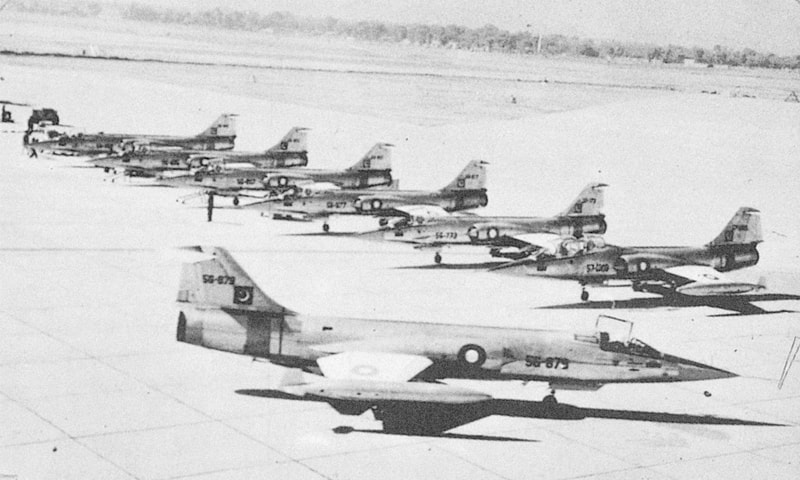
Moreover, war-fighting abilities were demonstrated with complete efficiency and professionalism in deploying available fighter aircraft in aerial engagements. Sabre jets placed to ward off the Indians were in the lead against the IAF Mystere fighters; Canberra aircraft – a slow and cumbersome bomber force – of the IAF, too, was warded off by the PAF’s night interceptor fleet; and India’s Gnat aircraft fighter (brought to replace Mystere aircraft due to Sabre’s outmaneuvering) was also undermined in aerial combat by Pakistani Starfighter, which flew at twice the speed of sound. The employment of assets during the war was well planned and innovative, thanks to the high standard of leadership and management throughout the war. As Pakistani fighting fleets in air neutralized the enemy’s aerial strength, the PAF performed more than its potential.
Unsurprisingly, the PAF received three Hilal-e-Jurat awards, 45 Sitara-e-Jurat and 05 Tamgha-e-Jurat; making a total of 54 gallantry awards earned during the episode of the 1965 war. Due to the incredible contribution made by the PAF in 1965, it was often said that three As – Allah, Artillery, and the Air Force – saved Pakistan. The country’s air force was able to play such a crucial role in defying the enemy due to its professional excellence, highest traditions of leadership, and matchless commitment to duty. This is why the battle for Pakistan was fought with valor to accomplish the task of protecting airspace against the adversary – the task which was performed by a marvelous blend of strategic clarity, innovative leadership, extraordinary courage, and unbreakable spirit demonstrated in one of the finest hours the PAF had in its history.
Asad Ullah Khan is a senior researcher at Centre for Aerospace & Security Studies (CASS) Islamabad. He can be reached at [email protected]
Image Source: Haider, S. Sajjad. “Straight Shooting on 1965 War.”Dawn. September 6th, 1965