‘Old Space coasts on the glory of the Apollo era and isn’t entirely sure what to do next. NewSpace is the opposite of all that: it’s wild, it’s commercial, bootstrapping, imaginative – right up to the point of being delusional.’ – Joel Achenbach
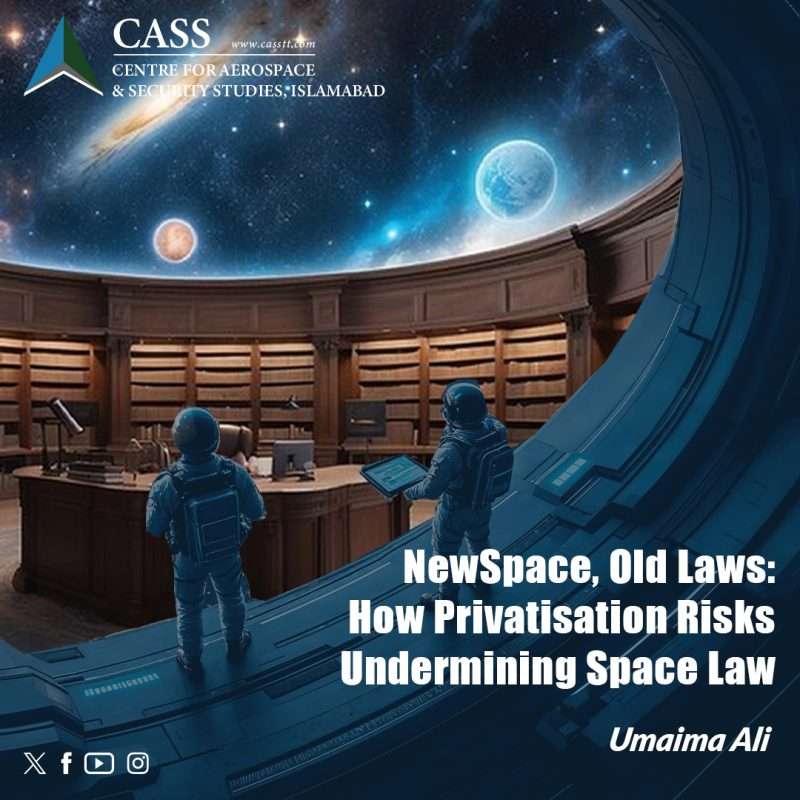
When a framework no longer aligns with contemporary realities, its continued use becomes problematic. International space treaties were drafted when space activities were under state control. However, the rise of commercial space industry, NewSpace, represents a contemporary reality that was not anticipated during the formulation of space law. In 2010, researchers at McGill University predicted that as space transportation systems evolve, existing legal frameworks would eventually become inadequate. While their observation focused on aerospace transportation, it is equally applicable to the privatisation of space.
Five key international space treaties govern space activities. Among these, the 1967 Outer Space Treaty (OST), often referred to as the ‘Magna Carta’ of outer space, serves as the foundational legal framework. The treaty forbids national appropriation of space but does not explicitly address private appropriation. This creates a legal grey area. Space operations of private companies may cause ‘irreversible harm’ to outer space even though the OST forbids ‘harmful contamination of space’. Article 1 of the OST, which affirms the ‘freedom of use’ in space, has enabled a few states to pursue unilateral space policies without considering the legitimate interests of other nations.
The rise of NewSpace presents an anomaly as it enables states to indirectly claim portions of space for themselves. This undermines the ‘non-appropriation’ principle of the OST. For example, domestic legislation in the United States, Luxembourg, and the United Arab Emirates grants private companies rights to own, transfer, and sell resources extracted from space. Similarly, Japan has also passed legislation that enables private companies to maintain a continuous presence on the Moon for mining and extraction activities. A study concludes that customary international law could evolve to interpret the ‘non-appropriation’ principle as permitting private appropriation of space. These spacefaring nations argue that their domestic legislation aligns with the OST while other parties disagree. Domestic legislation challenges both the spirit and language of the OST. These developments indicate a misinterpretation or ‘convenient application’ of space law.
The ‘non-appropriation’ principle is also challenged by the rise of Public-Private Partnerships (PPPs), where private companies offer services to governments. In 2024, 14 out of 263 orbital launch attempts were carried out by private companies under government contracts, and 169 out of 263 launches were performed by private companies for private customers, including foreign governments. This blurs the lines between private and state-driven space operations. Commercial satellite operators like Eutelsat and Inmarsat sell their services to the U.S. Department of Defense on annual contracts. Furthermore, the Indian Armed Forces has signed five contracts with private companies to develop space capability. Similarly, SpaceX, a monopolistic private power in space, also takes funds from NASA. Co-dependence between the state and private sector makes private activity in space a state-driven activity. Therefore, a state effectively ‘piggybacks’ on the private sector, gaining indirect control over space activities in a manner that conflicts with the principles of the OST.
An international licensing system is required to regulate private activities in space. Criminal penalties in domestic space law can be necessary enforcement mechanisms for such a system. While UAE, Luxembourg, and Japan’s domestic laws have incorporated these penalties, the US has not. For example, Swarm, a private company registered in the US, demonstrated that, at times, the benefits of breaking the law can outweigh the consequences. In 2017, it carried out illegal space activities and broke domestic law, however, the penalties were only marginally greater than the public grants the company had received. On the other hand, private spacewalking missions by companies like SpaceX and Blue Origin are not supervised by the government. According to the U.S. Federal Aviation Agency, there is no regulatory oversight for SpaceX’s Polaris Dawn mission. The state’s on-and-off supervision, selective enforcement of licensing, and reliance on services provided by the private sector constitutes overt state practice.
Similarly, with the Artemis Accords, the US is promoting a (re)interpretation of the principles that permit commercial and domestic use of natural resources extracted from outer space. The Accords have drawn criticism for undercutting attempts to find answers through United Nations institutions and for being a flimsy attempt to legitimise private takeover of space.
There is a need to revise space laws to prevent monopolistic practices masked as ‘privatisation of space’. A few spacefaring nations are interpreting the OST principles to best serve their own interests. The language in the OST must be made more precise to prevent state and non-state actors from misusing the ‘freedom of use’ principle. Since states use domestic legislation to regulate private activity according to their interests, the OST should incorporate binding rules for private companies. To ensure compliance, the OST must impose criminal penalties with deterrent effects on violators. Support from powerful nations is essential for enforcing these penalties.
Umaima Ali is a Research Assistant at the Centre for Aerospace & Security Studies (CASS), Islamabad. She can be reached at [email protected].