The Russian invasion of Ukraine has triggered a humanitarian crisis. Thousands of Ukrainians are fleeing from their towns and cities as urban warfare is massively damaging critical civilian infrastructure. With government institutions unable to function properly, the risk of starvation, infection, and physical and mental health issues for the Ukrainian population has increased manifold. Response from Washington, London, Berlin, Paris, Brussels, and other European capitals was quick. They condemned Russian aggression and enforced economic sanctions on Moscow. Since the beginning of the crisis, the West provided military and financial aid as well as political backing to Ukraine. Moreover, Western media continues to broadcast unprecedented praise for the Ukrainian resistance and highlighting the sufferings of Ukrainians. Neighbouring countries are accommodating/hosting refugees and making all-out efforts to scuttle the Russian advance.
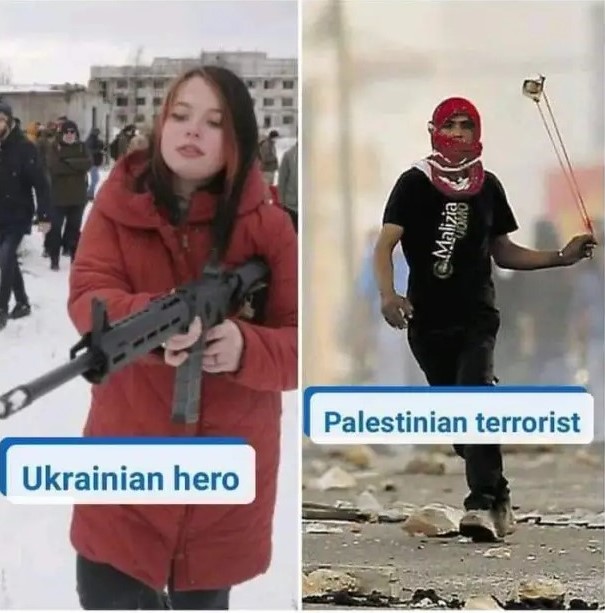
While witnessing such a swift response to the sufferings and human rights violations of Ukrainians, one wonders why the Kashmiri and Palestinian cause has not elicited the same favourable and supportive response from Western governments and media. For the last 70 years, people of Illegally Indian Occupied Jammu and Kashmir (IIOJ&K) have been resisting forced occupation. And yet, those calling for the immediate halt of Russian advancement in Ukraine and deeply concerned about the gross human rights violations and alleged atrocities committed by Russian troops, are tight-lipped when asked about the atrocities committed by India in IIOJ&K. For the last 67 years, every day, the state of Palestine has been shrinking, its territory is being encroached by the Israeli government and illegal Jewish settlers, but those, whose eyes flared with anger and outrage over Russian annexation of Crimea and the recent advances in Ukraine, have been indifferent or complicit in this brutal occupation.
In 1947, when the United Nations called for the partitioning of Palestine, Palestinians outrightly rejected the proposal. However, in 1948, the Jewish community of Palestine unilaterally declared the state of Israel by forcefully consolidating occupation of Palestinian territory and massacring unarmed men, women, and children, destroying more than 500 villages, and vigorously deporting 700,000 Palestinians from their homes. This was illegal, but the claimants of human rights imposed no sanctions on the illegal state of Israel, nor was anyone threatened with a military response to this grave violation of international law. Similarly, the powerful West ignored the unlawful annexation of East Jerusalem and Golan Heights by Israel in 1967 and 1981, respectively. To date, Israel continues its illegal annexation of Palestinian territory, with Zionist organisations like the Jewish National Fund (JNF) supporting this annexation and illegal settlements. Interestingly, JNF fund collection is exempted from tax in countries like the US, UK, Australia, and Canada.
Kashmir is another classic example of the West’s duplicity and inhuman indifference to the miseries of Kashmiris who are struggling for their inalienable right to self-determination, which was guaranteed to them by the comity of nations (United Nations) in 1948. While referring to the issue of Jammu and Kashmir, Western leaders elusively restrict themselves to the ‘hope of an end to violence in the region’ and nothing more, with no condemnation of state-sponsored brutalities and human-rights violations.
Although the history of Indian atrocities in IIOJ&K, including forced disappearances, staged encounters, extended curfews, limited access to the outside world, use of pellet guns etc., is long enough for the world to open its eyes, yet there is no meaningful response from Western capitals and the self-proclaimed champions of human rights. The revocation of Articles 370 and 35A of the Indian constitution which granted special status to the IIOJ&K is analogous to the annexation of the disputed territory. Article 35A barred all outsiders, including Indian nationals from other states, from settling and claiming government jobs to maintain demographic balance in the region. However, since its revocation in August 2019, many non-Kashmiri Indians have been granted domicile to increase the Hindu population in the Valley and snatch the demographic advantage from the Muslim community. This is again a blatant violation of international law and universal human rights in an internationally acknowledged disputed territory. But since the people of IIOJ&K are held captive by a country that is a large market for exports and considered a ‘strategic ally’ for curtailing China’s rise; therefore, the powerful West continues to tolerate its atrocious activities.
The overt but illegal annexation of Kashmiri and Palestinian territories by India and Israel, respectively, and the muted Western response vis-à-vis their hullabaloo in case of the Ukraine war highlights the contradictory standards of the sanctimonious West towards upholding international law. This proves that when international law aligns with Western interests, upholding so-called ‘international law and human rights’ in their true spirit becomes necessary, otherwise, it is business as usual.
The writer is a Researcher at the Centre for Aerospace & Security Studies (CASS), Islamabad, Pakistan. He can be reached at [email protected].
Image Source: Social media users draw parallels to expose West’s hypocrisy. Kashmir Media Service. (2022). Retrieved 13 June 2022, from https://www.kmsnews.org/kms/2022/03/03/social-media-users-draw-parallels-to-expose-wests-hypocrisy.html.