
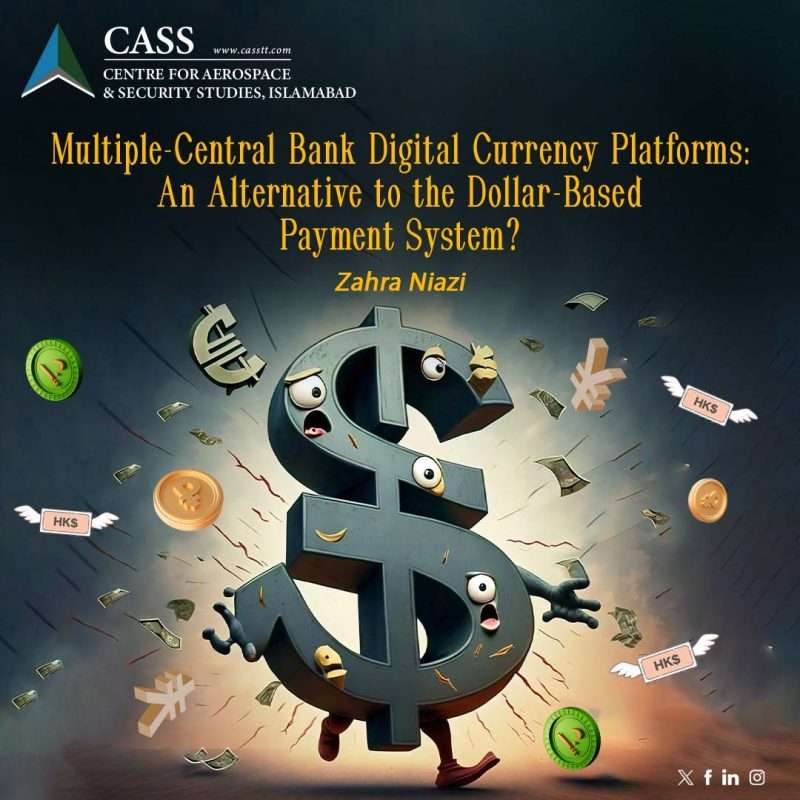
The United States Dollar (USD) has long enjoyed the ‘exorbitant privilege’ of being at the centre of the international financial and trade system, serving as the dominant currency for holding financial assets and facilitating cross-border payments. The dollar-based international payment system has three major components: the US dollar as the official medium of exchange; a private corporation called the Society for Worldwide Interbank Financial Telecommunication (SWIFT) as the financial messaging platform; and the Clearing House Interbank Payments System (CHIPS) as the correspondent banking network.
To illustrate this, consider a large-value dollar-based international transaction for goods purchased from a foreign market. The importer’s local bank that does not hold an account with the exporter’s bank will send a payment message via SWIFT to a third-party institution with which both the banks hold correspondent accounts. This third-party institution, acting as a CHIPS correspondent bank, will then debit the importer’s bank and credit the exporter’s bank, which will subsequently credit the exporter’s account.
For much of the world, the dollar system has been a source of facilitating seamless cross-border transfers for decades, but for the targets of Washington’s sanctions, the dominance of this system has come with many financial consequences. In response, states have been developing alternatives. Of these, the Chinese version of the US-dominated CHIPS payment system – the Cross-border Interbank Payment System (CIPS), and the Russian version of SWIFT – the System for Transfer of Financial Messages (SPFS), remain the most cited. These alternatives, however, have some major limitations. The SPFS, for instance, supports Russian ruble-based transactions, which is unattractive for foreign entities, especially in the present environment where Russia remains sanctioned by the West. As for CIPS, it offers services for renminbi-based payments, but the renminbi is not yet fully convertible, which is to say that it cannot be easily exchanged for other currencies on the foreign exchange market due to government controls. CIPS’ messaging functionality is also nascent, so most transactions rely on the SWIFT network.
Amidst this, wholesale Central Bank Digital Currencies (CBDCs) are being hyped as a promising solution, especially now as experiments with multiple central bank digital currency (multi-CBDC) platforms for cross-border transactions are gaining momentum and manifesting forward-looking results. Wholesale CBDCs include digital currencies issued by central banks for settling large-value (wholesale) transactions between banks and other financial institutions. A multi-CBDC platform connects wholesale CBDCs from different jurisdictions through a common technical infrastructure. Notably, one such blockchain-enabled project, i.e., mBridge – a collaboration between the Bank for International Settlements (BIS) innovation hub and the central banks of Hong Kong, China, the United Arab Emirates (UAE), and Thailand – has reached the minimum viable stage where it can be released with enough features to attract early customers. It recently welcomed the Saudi central bank as a full participant.
A multi-CBDC platform, like mBridge, facilitates transactions without the need for a financial messaging platform or the services of a correspondent bank. Take, for instance, an international transaction for goods imported from China by a company in the UAE – two mBridge participants. The importing company’s bank in UAE would go onto the mBridge platform, buy the Chinese wholesale CBDC issued on the platform, and transfer it to the exporter’s bank directly.
However, the large-scale viability of multi-CBDC arrangements has its fair share of challenges. For geopolitical reasons, several multi-CBDC platforms will likely emerge with their own participation requirements, supporting infrastructure, and a rulebook. Integration into multiple platforms could also be challenging for countries, preventing them from engaging with various jurisdictions through wholesale CBDC-based transactions. Getting central banks to agree on a single common platform will be difficult, not least due to technological challenges. According to analysts, central banks are already reluctant to allow their money to circulate on platforms they do not own or operate. More essentially, according to an Atlantic Council’s Tracker, of the 134 countries worldwide exploring CBDCs, 44, including Pakistan, are still in the research phase, 17 have inactive projects, and two have cancelled exploration. 68 countries, such as China, Nigeria, and Russia, are in the advanced exploration stage – launch, pilot, or development. However, here, too, the projects for retail CBDCs, which are for the general public’s utility, have attracted relatively more attention.
The challenges are far greater than these alone, suggesting it could take years for multi-CBDC platforms to be able to disrupt the global dominance of the dollar-based international payment system. Nonetheless, the achievement of significant milestones by project mBridge and progress on experiments with other multi-CBDC arrangements, such as project Dunbar, suggests that more than one of such platforms will likely emerge in the near future for utility in wholesale cross-border transactions – the potential implications of which cannot be understated.
In the geopolitical sphere, these systems could be leveraged by countries in great power competition to exert economic influence and strengthen political alliances. Economically, while these arrangements may promote global financial fragmentation, pilot cases have also demonstrated their ability to reduce settlement times, lower overhead costs, and deliver more transparency in cross-border payments, which can help drive capital flows for trade, investment, and business production. It is these promises of delivering efficiency in the financial system that make these arrangements worth exploring.
Zahra Niazi is a Research Assistant at the Centre for Aerospace & Security Studies (CASS), Islamabad, Pakistan. The article was first published in Modern Diplomacy. She can be reached at [email protected].



