
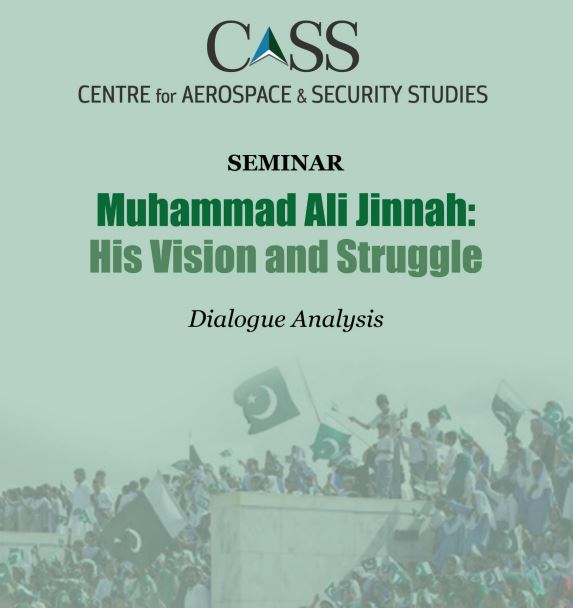
Muhammad Ali Jinnah: His Vision and Struggle

In continuation of the tradition of holding debates on subjects of national importance through conferences, seminars, webinars, guest lectures, and publications by leading experts, the Centre for Aerospace & Security Studies (CASS), Islamabad organised a seminar on ‘Muhammad Ali Jinnah: His Vision And Struggle’ on 22 December 2022. The seminar was attended by people belonging to different backgrounds.

The key aspects which were covered during this seminar included the following:
• Jinnah’s Vision of Pakistan and its Future Trajectory
• Jinnah’s Struggle: Brief Account of his Political Journey and his Case for Pakistan
• Pakistan’s Current Challenges and Jinnah’s Relevance

The speakers at the seminar included Senator Javed Jabbar, Former Federal Minister for Information & Broadcasting, government of Pakistan; Prof. Dr Riaz Ahmad, President Anjuman Faiz-ul-Islam, Islamabad; and Prof. Dr Iqbal Chawla, Former Dean Faculty of Arts & Humanities, University of Punjab, Lahore. The Concluding Remarks were delivered by President CASS Air Marshal (Retd) Farhat Hussain Khan. Ms Shaza Arif, Research Assistant at CASS, organised and moderated the seminar.

Share this article

Facebook
Twitter
LinkedIn

Recent Publications

Browse through the list of recent publications.

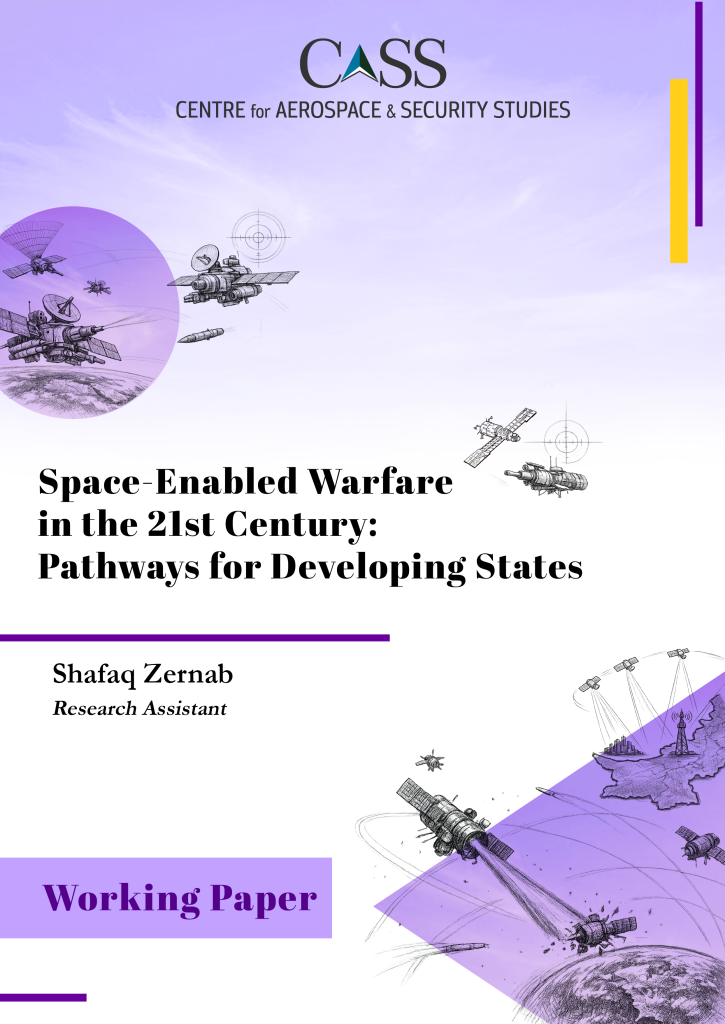
Space-Enabled Warfare in the 21st Century: Pathways for Developing States

Space has emerged as a distinct domain of warfare alongside land, sea, air, and cyber. Developed countries like the United States, Russia, and China possess offensive and support capabilities in space. In the shadowed expanse of Low Earth Orbit (LEO), where satellites operate like silent custodians, the 2022 Russian invasion of Ukraine transformed the nature of modern conflict. As Russian troops marched forward, the commercial satellites like Maxar and Planet, which are operated by Western firms, captured high-resolution imagery of Russian troops, providing real-time intelligence to Ukrainian commanders, unlike ever before.

Read More »

The US-Israel War on Iran: Objectives, Strategy, and Escalation Management

Zahra Niazi
‘States tend to overestimate themselves or the benefits and swiftness of war, and to underestimate their opponents’ capabilities, intentions, or the costs and duration of war.’ If anything, the 2026 war initiated by the United States and Israel against Iran shall be remembered in the annals of warfare among the most visible manifestations of this dynamic.
The war, immediately preceded by the January mass protests in Iran, did not represent a sudden rupture but rather the continuation of a 47-year-long confrontation and a more intense phase of the June 2025 war.
The US Secretary of War, Pete Hegseth, defined the war’s objectives as being laser-focused: to destroy Iran’s missile capabilities and its security infrastructure, while ensuring that it could never develop nuclear weapons. Beyond these stated objectives, among the priorities on the continuum also lay the objective of regime change, with both President Trump and Prime Minister Netanyahu explicitly calling on the Iranian population to take over the government at the outset of the war.

Read More »

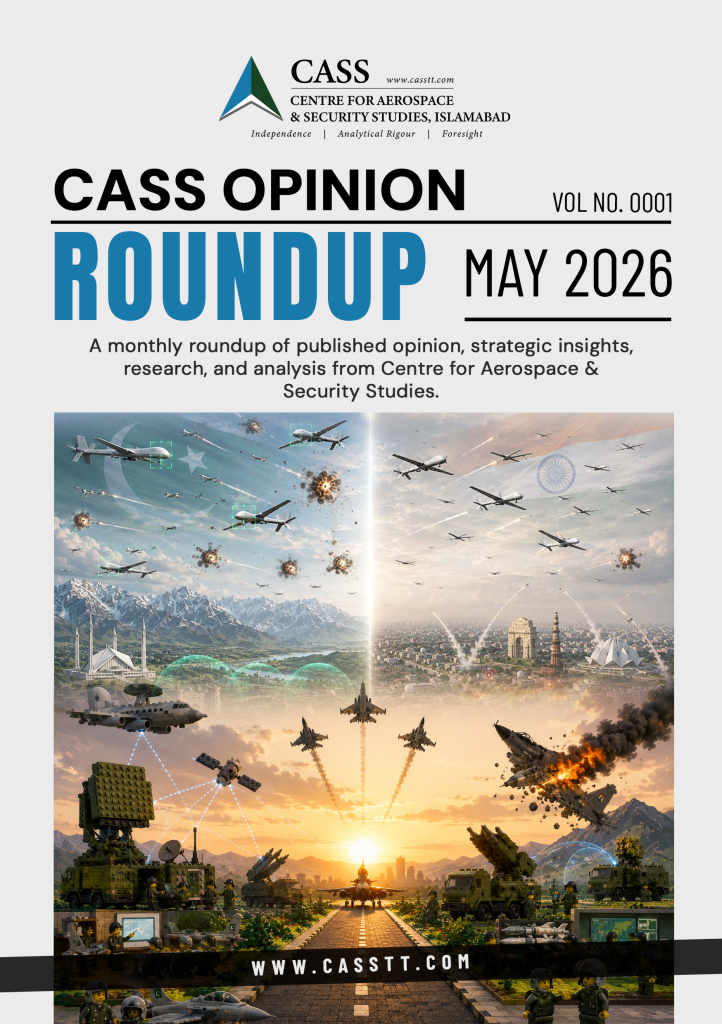
Marka-e-Haq to the Peace Talks: Pakistan’s Middle Power Status

On 7th May 2025, Pakistan’s military forces took the international security community by surprise when it demonstrated operational superiority against its larger belligerent adversary India with its rapid and coordinated response. The Four-Day conflict proved to be a watershed moment for Pakistan, marking its rapid emergence as an important player in the region. In recent years, amidst the ongoing global competition between the United States and China, Islamabad has adopted a position of ’Strategic Balancing,’ where it maintains ties of cooperation with both Beijing and Washington. Deft diplomacy, emphasis on geo-economics, and credible conventional and strategic deterrence have remained the foundational pillars for Pakistan’s ambition as a rising middle power

Read More »