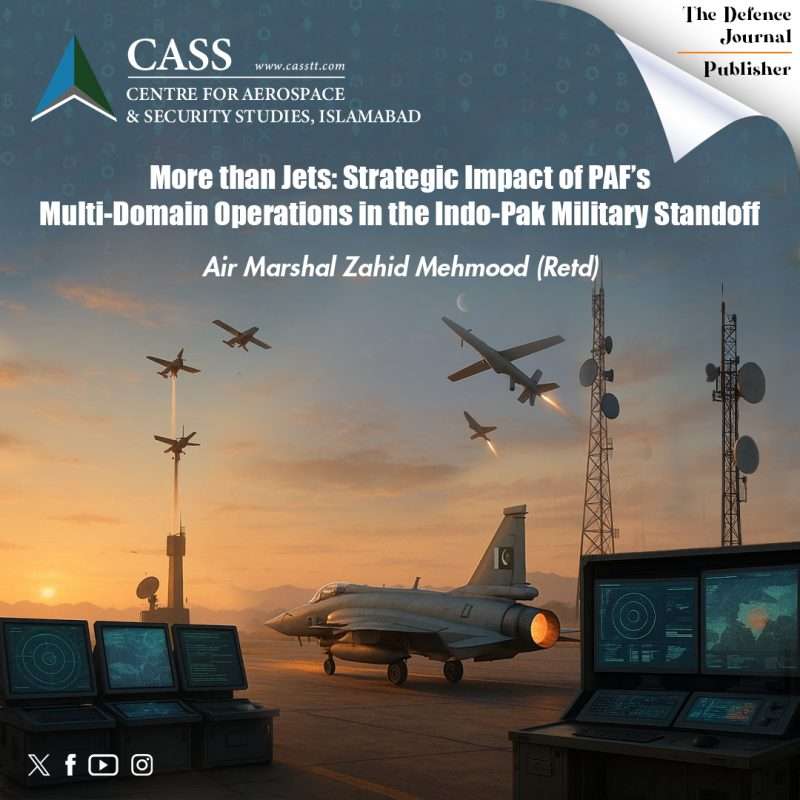
Multi-Domain Operations (MDO) represent a modern, integrated approach to military strategy, developed to counter evolving global threats that transcend the boundaries of traditional warfare. The concept of MDO is driven by the increasing complexity and interconnectivity of different domains of warfare i.e. land, sea, air, space, and cyberspace. In a world where threats are multifaceted, MDO allows military forces to operate seamlessly across all domains to achieve decisive outcomes. While modern Air Forces are still grappling with the concept, PAF demonstrated true manifestation of the concept on the night between 6th and 7th May.
Over the years PAF’s operational doctrine had been evolving to keep pace with the emerging treats and challenges of the future. It appears that Post Balakot, PAF was quick to realise that linear approach to the erstwhile Air-Land Battle, has been largely replaced with Multi Domain Operations. This transformational shift in doctrine is the hall mark of an agile and dynamic Air Force. Critical analysis of the last four years of PAF acquisitions and exercises reveals that PAF had embraced the idea of MDOs in its essence and applied it to perfection.
During Operation Bunyan-Um-Marsoos, PAF demonstrated seamless integration of capabilities across all domains. Rather than operating in isolation, capabilities in different domains were brought to work in harmony, enhancing their combined effects. This integration was facilitated by advanced technologies, such as command-and-control systems, AI and Autonomous systems that can process and disseminate information across all domains in real time. Thus PAF was able to create capability overmatch by leveraging and connecting current and newly acquired technologies to overwhelm IAF. The resultant operational effects were there for the entire world to observe.
During the operation, Information Warfare and Media Manipulation remained at the forefront. The ability to confuse or mislead the enemy through various means—whether through cyber-attacks, electronic warfare, or misinformation—can be just as effective as direct military action. Information operations are integral to MDO because they shape the adversary’s decision-making process across all domains. Lastly, these are aimed at specific audience, in case of IAF, these were aimed at feeding the domestic audience. PAF’s effective counter narrative was not only based on facts but captured the interest of global players. This greatly trumped the false Indian narrative and IAF’s efforts proved to be counterproductive.
This doctrinal transformation and its application in real world scenario had impacts at various levels. Tactically, IAF was defeated comprehensively, operationally, it proved PAF’s complete and utter dominance of the theatre and strategically, it created far reaching effects. PAF’s flawless application of the MDOs was the instrument of re-establishing deterrence. Secondly, it proved that a numerically superior IAF cannot achieve strategic surprise. Lastly, disconnect between politico-military objective and military strategy can prove disastrous.
Deterrence has been the cornerstone of Pakistan’s military thought, hence the idea that there is no space for war between two nuclear armed neighbours. Indian side has always attempted to negate this idea and has repeated tried to create space for war below the nuclear threshold. This idea stems from India’s conventional military superiority in the numerical sense. In case of IAF’s misadventure on the night between 6th and 7th May, the same idea appears to have the motivating factor. PAF’s resolute and unwavering response not only nullified the offensive, it also put IAF on ground for the next 72 hours. Having failed in the Airpower domain, Indian side switched to info ops, drones and SSMs. Indian offensive on all these domains were met with similar fate. Thus the idea of “War below the Nuclear Threshold” fell on its face, and deterrence was re-established.
Post Pulwama/Balakot incident, IAF desperately campaigned for induction of state of the art Rafale fighter jets. The rhetoric then was, “had we Rafale on our inventory we would have defeated PAF”. History proved otherwise, IAF did induct Rafales and having employed them en mass was doled an even more humiliating defeat. This episodes proved that on the strategic plane, superiority in numbers alone cannot be a recipe for success.
Other than the failing mantra of labelling Pakistan as a terror sponsoring state and seeking retribution for any violent act inside IIOJK, the BJP regime had no tangible politico-mil objective. Creating war hysteria among the Indian populace through almost rabid Indian media, the Modi regime forced IAF to launch its offensive. Again PAF’s superior application methodology not only gave IAF a bloody nose, it also left the global spectators in a state of awe. Post war analyses, therefore question not only the politico-mil objectives but also the strategy adopted by IAF.
In conclusion, PAFs transformational approach to employment was revolutionary in approach, it re-defined the traditional role-based employment of air power and created strategic effects. From doctrine to employment strategy, PAF’s response in the operation proved that jets win battles, but domains win wars.
Air Marshal Zahid Mehmood (Retd) is Senior Director at the Centre for Aerospace & Security Studies (CASS), Islamabad Email: [email protected]. The article was first published in The Defence Journal