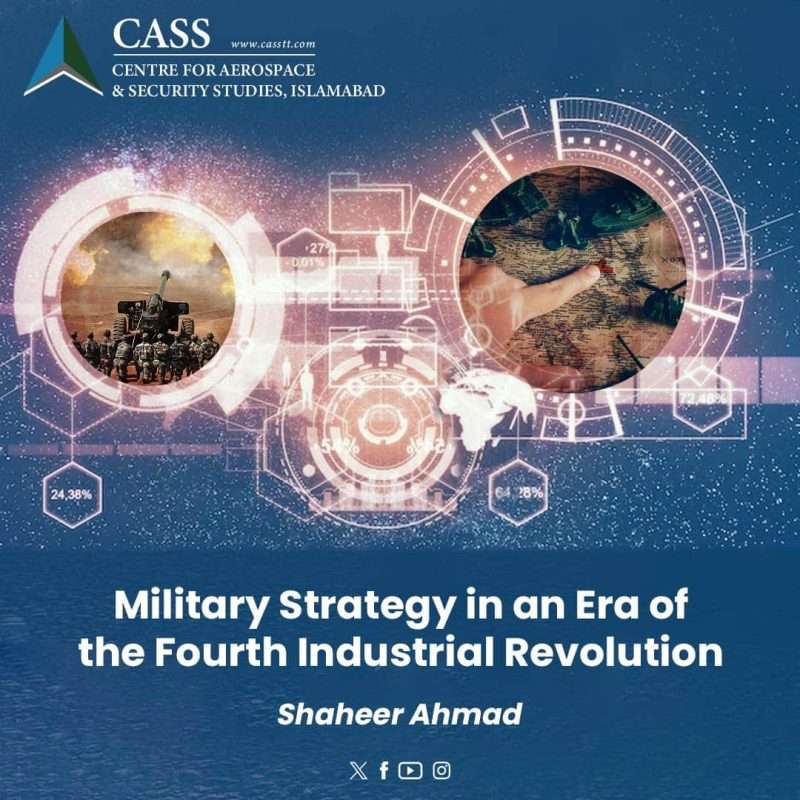
‘The only thing harder than getting a new idea into the military mind is to get an old one out.’ Captain Basil H. Liddlehart’s timeless maxim is pertinent in today’s context of the fourth Industrial Revolution (4IR), where orthodox military strategists are tethered to archaic philosophies of warfare. Despite this entrenched military disposition, the momentous breakthroughs in 4IR technologies such as quantum computing, Artificial Intelligence (AI), hypersonics, and the Internet of Things (IoT), are now catalysing a shift in the blueprints of conventional military strategy.
Traditionally, militaries have been infatuated with legacy battle systems. Tanks, submarines, ships, and missiles have long served as the cornerstone of strategic military thought. However, these foundational elements are now being supplanted by the rise of next-generation computing technologies, where the push-of-a-button capability threatens to dehumanise warfare. While the essence of war, as Clausewitz and others have argued, may remain unchanged, the character of warfare is undergoing a profound transformation. Visuals from the Russia-Ukraine conflict exemplify this transition, where militaries having unmatched firepower found themselves overwhelmed by the relentless precision of drones and AI.
Recognising this emerging threat matrix, militaries worldwide are rapidly realigning their standard operating procedures (SOPs) and force structures to adapt to the evolving landscape. The United States is devoting substantial efforts to developing innovative weapon systems to preserve its military advantage amidst a whirlwind of technological change. Under the Navy’s Conventional Prompt Strike Program, it is developing hypersonic weapons to overpower advanced air defence systems that constitute the formidable fortification of anti-access/area-denial of its competitors. In tandem, it is trying to incubate Directed Energy Weapons (DEWs) particularly high-energy lasers to counter drones, rockets, artillery and mortars. Nonetheless, the US’ strategic mindset exhibits a conservative bias toward legacy battle systems and a preference for precision over mass deployment, causing its military bureaucracy to adopt technological changes at a sluggish pace.
In contrast, China is positioned to seize the ‘first-mover’ advantage by integrating cutting-edge military technologies into its strategic framework ‘National Defence in the New Era’ a vision termed ‘intelligentised warfare.’ Chinese military strategists argue that future conflicts will likely be dominated by ‘algorithmic warfare,’ where AI, quantum technology, cloud computing, and IoT will process vast data streams to accelerate decision-making. This growing reliance on technology aims to streamline operations, gradually phasing out human involvement from critical decision-making cycles. Unlike US weapon acquisition cycles (ten years), absence of bureaucratic logjams allow China to field resource-efficient state-of-the-art combat systems.
Adoption and innovative application of 4IR technologies is evolving from merely a force-multiplier into a doctrinal shift, where non-Western states aim to undermine Western technological superiority. By leveraging cost-effective swarms of advanced systems – characterised by shorter acquisition cycles and flexible force postures – these states are reshaping military dynamics. This shift is evident in the Middle East, where the US was initially slow to respond to UAV threats. The urgency became apparent when forward-deployed carrier strike groups were targeted by drone attacks from Houthi rebels in the Red Sea, exposing vulnerabilities in traditional Western defence strategies. Recently, detonating pagers targetting Hezbollah members illustrated how leveraging end-user technologies can enable asymmetrical operations with enhanced efficiency and impact.
With the 4IR underway, a cluster of challenges confront conventional military planners. Unlike prior military campaigns, there are no post-war assessments, military history playbooks, and precedents on how the war in 4IR will play out. This will make the fog of war denser for the militaries bracing for future conflicts in the East and South China Seas. While technology is a promising feature of modern warfare, absence of innovative war-fighting concepts could fail timeworn operational frameworks, leading to unforeseen circumstances.
To adapt effectively, planners must expand their conceptual horizons, incorporating unconventional approaches to anticipate the evolving nature of warfare. Exploring speculative scenarios from literary and artistic works such as those found in Ghost Fleet, War of the Worlds, Manchurian Candidate, Automated Valor, and Kill Decision, can inspire innovative thinking, complementing analytical frameworks and providing imaginative perspectives on how future wars might unfold.
The clock is ticking, and we stand at the precipice of a profound shift in the character of warfare. This inevitable transformation will upend existing strategic paradigms, doctrinal frameworks, personal combat experiences, and legacy battle systems. To survive and prevail in the first 4IR conflict, militaries must radically reassess and adapt their cognitive frameworks and operational doctrines to align with the demands of this new era.
Shaheer Ahmad is Research Assistant at the Centre for Aerospace and Security Studies (CASS), Islamabad. The article was first published in Modern Diplomacy. He can be reached at [email protected].