Share this event

Facebook
Twitter
LinkedIn

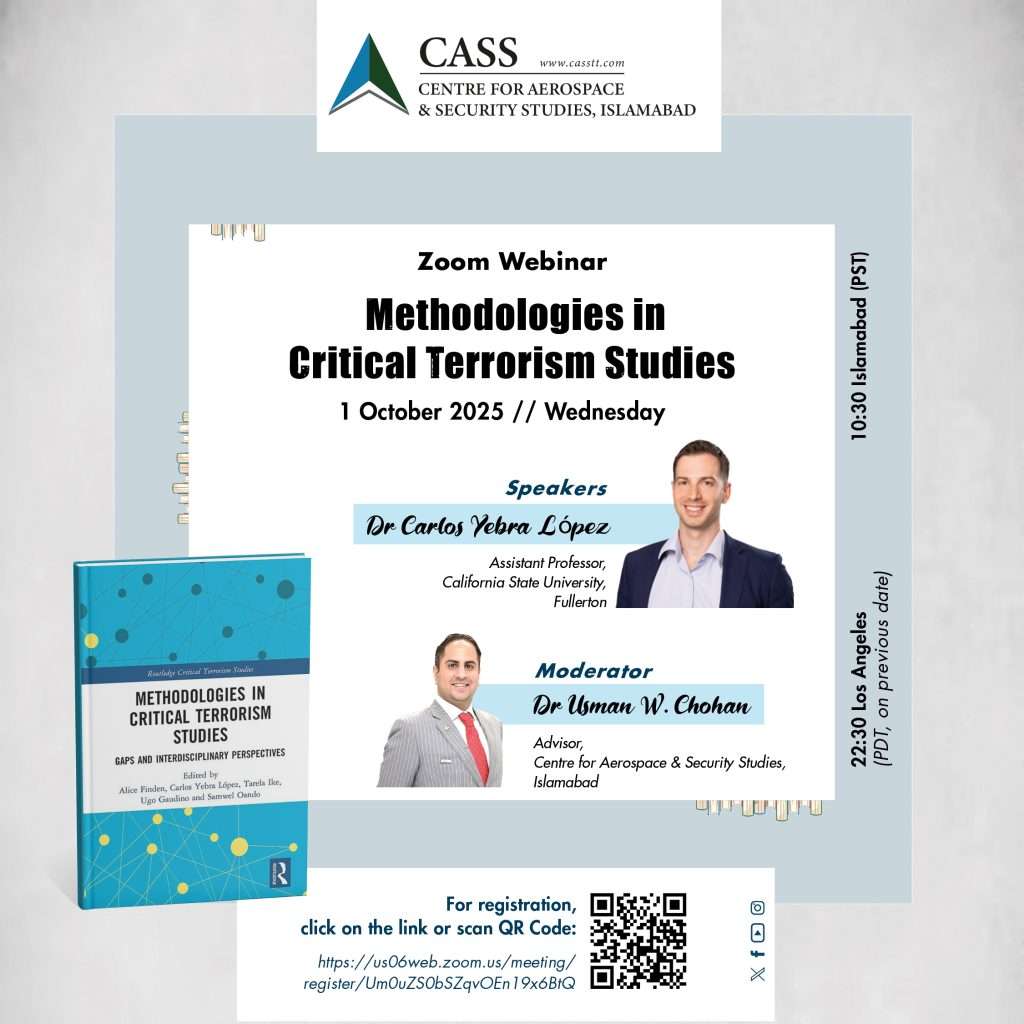
1.         The field of Terrorism Studies has been shaped by narrow definitions, Eurocentric frameworks, and state-led narratives. This has led to a deliberate exclusion of perspectives from the Global South and from the Muslim world.  The ground-breaking work Methodologies in Critical Terrorism Studies, has instead sought to challenge this status quo by bringing together a diverse set of scholars to broaden the intellectual horizons of Critical Terrorism Studies (CTS).

2.         CASS plans a book discussion webinar on 1 October 2025, aiming to inform our audience, in particular CASS researchers, on how to understand and deploy the tools and findings of CTS in their research, which is steeped in traditional & non-traditional security themes and research questions.

3. In that regard, the webinar seeks to ask the invited speaker to address several areas of research interest, as follows:

  1. A background to the evolution of TS, and of CTS as an alternative discourse to interpret violence, non-state actor behavior, terrorism framing, conflict studies, and international relations.

  2. A discussion of the key findings of the edited volume. Key question: how can researchers at CASS, who conduct research pertaining to precisely these themes in both a South Asian as well as international context, draw upon CTS?

What are the pathways forward and research agendas for young researchers aiming to use methodologies in CTS.?
Other Events

THE FUTURE OF THE INDUS WATER TREATY

For more than six decades, the Indus Water Treaty (IWT), signed in 1960 between Pakistan and India, remained as one of the most enduring transboundary water-sharing agreements in the world. Despite multiple wars, political crises, and prolonged periods of bilateral hostility, the treaty largely continued to govern the allocation and management of the waters of the Indus Basin

Read More »

Fiscal Survival or Economic Reform? Decoding Pakistan’s Budget Priorities

Pakistan’s annual budget is more than a fiscal document; it is a reflection of the country’s structural economic constraints, political choices, and shifting development priorities. The tension between fiscal survival and meaningful economic reform has become increasingly pronounced amid rising debt servicing obligations, limited fiscal space, and recurring dependence on external financing. In this context, budget-making often appears reactive—focused on stabilisation and compliance with short-term macroeconomic targets—rather than transformative, aimed at broad-based productivity, institutional reform, and sustainable growth.

Read More »

Nuclear Capability: Balancing Global Security and Energy Needs

Recent global developments—including geopolitical tensions, energy crises, and shifting power dynamics—have intensified discussions around nuclear capability. After the Russia-Ukraine conflict and the US-Israel-Iran war, nations are increasingly evaluating nuclear technology not only as a strategic defense mechanism but also as a reliable and large-scale energy source. These developments have brought nuclear capability back to the forefront of international debate.
The dual-use nature of nuclear capability—serving both military and civilian purposes—makes it a critical area of analysis. The ongoing war on Iran has introduced significant uncertainty into the future of Iran’s nuclear trajectory, particularly regarding

Read More »