
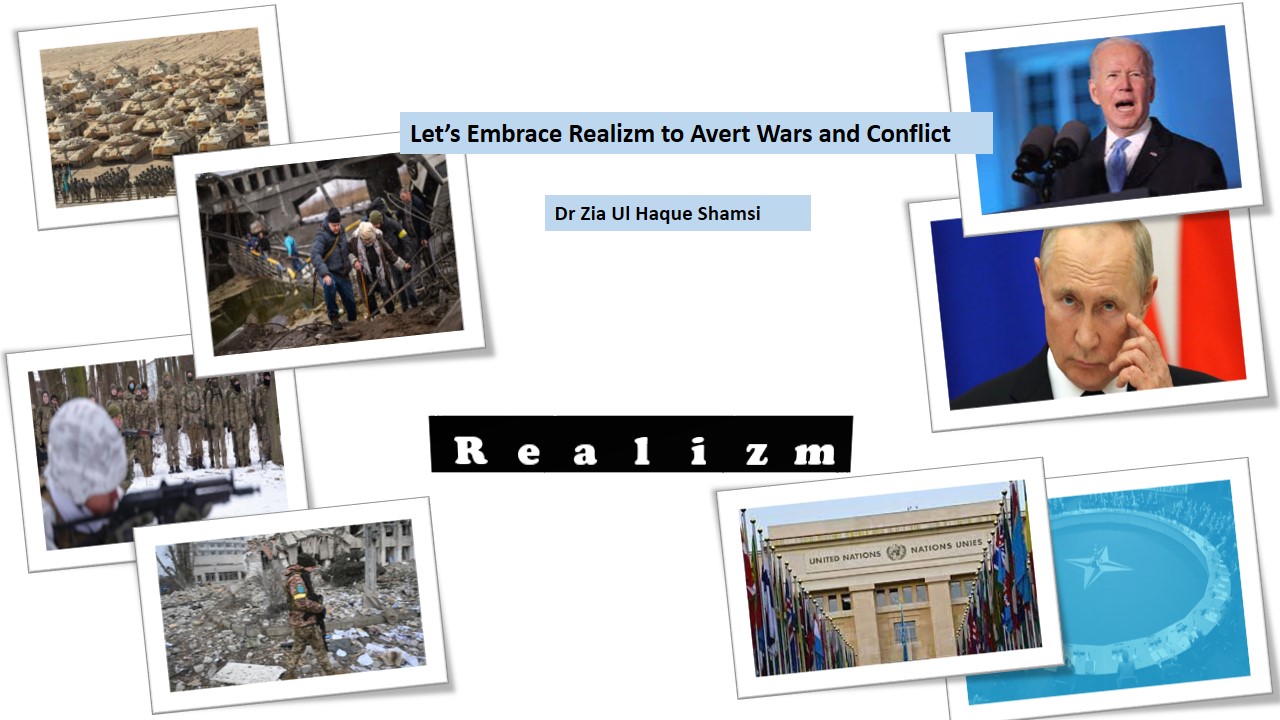
When I first introduced the most referred International Relation’s “Theory of Realism” as “Realizm,” a lot of questions were raised on its veracity and applicability. The sole purpose of offering this new nomenclature was to generate debate and create awareness about the dangers of armed conflicts across the globe. Since Military Industrial Complexes (MICs) in the developed West thrive on wars, I feared an impending conflict soon after the hasty withdrawal of the US and NATO forces from Afghanistan on August 15, 2021.
My fears came true when Russia decided to ensure that North Atlantic Treaty Organization (NATO) troops do not come face-to-face with its forces in the near future because Ukraine was seeking European Union’s as well as NATO membership.
The concept of “Realizm” is aimed at making stakeholders realise the equal importance of territorial integrity and sovereignty for all nations. Whereas, the age-old “Theory of Realism” is all about the power and security of one’s own state. Realism has its roots in the era of Thucydides and Chanakya Kautilya, ably proffered by Niccoli Machiavelli in the Middle Ages, Thomas Hobbes in the Seventeenth Century, and Hans Morgenthau in the Twentieth Century. The latter believed that states do have an intrinsic desire to dominate others, which makes wars and conflicts inevitable. The classical realists insisted that states must acquire the power to ensure their territorial integrity. However, they ignored the same for the relatively smaller and weaker states in the neighbourhood.
“Realism” remained dominant during the Cold War era because it provided the logic for wars and alliances’ non-cooperation and competition among rivals. Realists’ precepts remain focused on power instead of morality. They maintain that universal moral principles cannot be applied to the actions of states, and they must be filtered through the concrete circumstances of time and place.
On the other hand, the term “Realizm” denotes hybrid characteristics of a realist and an idealist or a liberalist. A realizer sees independence and sovereignty of the state as a blessing and, therefore, respects the same for other neighbouring and regional countries. A realizer believes in the coordinated and even development of the region so that the gap between the rich and the poor is not too noticeable. A realizer would strive for equitable distribution of resources in the region to ensure that his state does not become a migrant’s destination. A realizer proposes that conflicts and crises can be resolved through dialogue, provided the stakeholders are sincere and competent. A realizer would propose an incremental and reconciliatory approach to resolve conflicts with its neighbours and without using force against a potential adversary. However, if the use of force is essentially required to resolve a particular dispute, perhaps against a state, which is being run as a protection racket, it must be proportionate and in the shortest possible time, without causing much damage to the populace. A realizer would objectively decide between adequacy and sufficiency to accommodate more humans in the available means. A realizer would insist on regional development on the concept of “Together we rise” to minimize inequality, which would lead to the movement of people in search of better opportunities. A realizer would aim to enhance the capacity and opportunities of the relatively weaker state around it so that people do not move out of their own country of residence for want of safety, security, employment, food, shelter and so forth.’
Unfortunately, the inevitable has happened with Russian forces entering Ukrainian territory to ensure that NATO does not ever consider expanding its borders beyond Moscow’s red line. Not surprisingly, Russia has been slapped with a series of sanctions by the US-led allies around the world. United Nations General Assembly (UNGA) vote on the Ukrainian conflict was overwhelmingly against Russia with 141 countries out of 193 voting for the resolution to condemn the Russian invasion, whereas only 5 voted against it. However, 35 states abstained, mostly from South and Central Asia.
Russia is determined to expand its frontiers to ensure that NATO forces do not come in direct contact with its territorial limits under any circumstances, and therefore, sanctions alone will not be able to tame the Kremlin. Rather, any more punitive or kinetic actions by US-led NATO would certainly lead to horizontal and even vertical expansion of the conflict, perhaps involving other regional forces. Therefore, in my opinion, US-led NATO would have to embrace “realizm” to understand Russia’s genuine security concerns and need not insist on including Ukraine in NATO, which might satisfy Moscow for the time being.
Dr Zia Ul Haque Shamsi is the author of ‘Nuclear Deterrence and Conflict Management Between India and Pakistan’ (2020) and ‘South Asia Needs Hybrid Peace’ (2021). He is presently working as Director at the Centre for Aerospace & Security Studies (CASS), Islamabad, Pakistan. The article was first published in Daily Times. He can be reached at [email protected].
Image Source: Etfa Khurshid MIrza



