
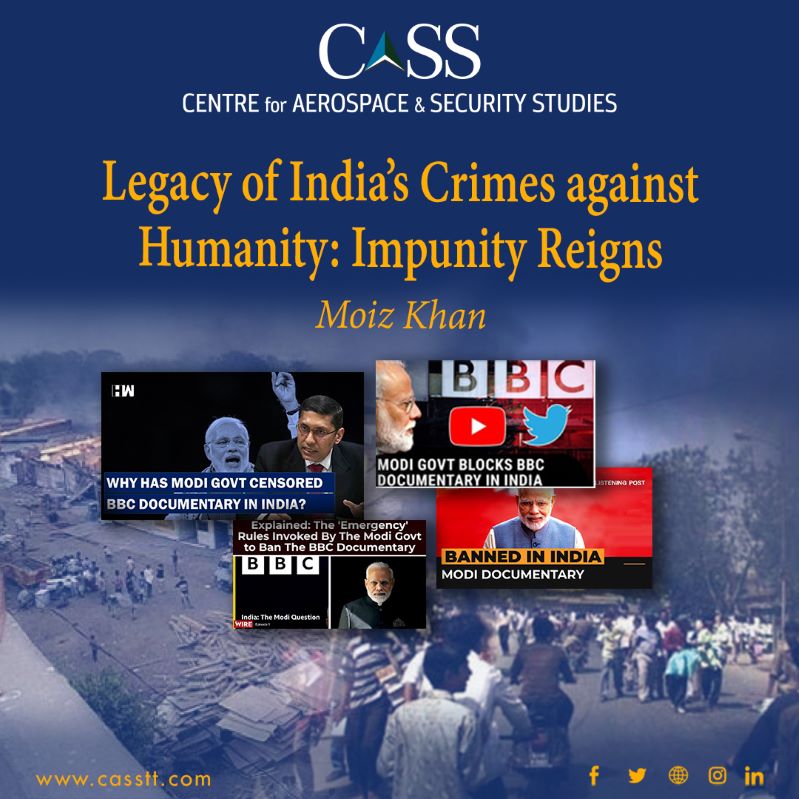
India’s Prime Minister Narendra Modi, recently, invoked emergency laws to prevent screening of a two-part BBC documentary titled, ‘India: The Modi Question’. The documentary drew criticism from the Indian government as it brought Modi’s leadership into question as well as his involvement in the 2002 Gujarat riots. While the Indian government called it a propaganda piece, in an attempt to deflect criticism, the BBC clarified that it was based on an unpublished report of the UK’s Foreign Commonwealth and Development Office that investigated the riots during Modi’s tenure as Chief Minister of Gujarat. Given the global attention this documentary received, it is imperative to examine human rights violations in India within the larger framework of ‘Crimes against Humanity’ (CAH) perpetuated by state-affiliated institutions with impunity.
The term ‘CAH’ initially evolved under international customary law – particularly in various jurisdictions of the International Criminal Court (ICC), and may be clearly understood under the 1998 Rome Statute. Article XII of the Rome Statute defines the term as numerous acts ‘when committed as part of a widespread or systematic attack directed against any civilian population, with knowledge of the attack.’ These acts include apartheid, forced disappearance, forcible transfer of people, enslavement, extermination, torture, persecution, rape, and various others. These acts need not be associated with armed conflicts, implying that these crimes against humanity may also be committed during peacetime. Unfortunately, these crimes have not yet been codified under a separate international instrument.
State or non-state actors, for centuries, have been perpetrating CAH. India, the world’s second-largest population and the so-called largest democracy, remains the prime example. There are numerous recent reports by foreign governments and non-governmental organisations, including the US State Department, Human Rights Watch, and Amnesty International indicating that human rights violations in India have exponentially increased. These human rights violations have been carried out systematically with the involvement of the state or related institutions; therefore, these crimes may conveniently be classified as CAH.
For example, nearly 2000 Muslims were killed as a result of anti-foreigner movement in the state of Assam led by the local Tiwa Hindu community in the 1983 Nellie massacre. There was also involvement of members of the RSS (Rashtriya Swayamsevak Sangh). The authorities, including the Home Ministry and the National Police Commission, did not take action despite alerts. Moreover, then-Prime Minister of India, Indira Gandhi, also did not take any action against the perpetrators. A similar massacre spree happened against the Sikh Community during the 1984 anti-Sikh riots, following the assassination of Indira Gandhi by her Sikh bodyguards.
In the 2002 Gujarat riots, Modi allowed retaliatory violence after some Muslims were blamed for allegedly burning a train carrying Hindu pilgrims. The riots resulted in the deaths of over 2000 people (a figure that to date remains disputed), majority of them Muslims. A government investigation concluded that the fire was accidental. While the United States (US) criticised Modi and imposed travel bans, the United Kingdom released a report citing Modi as directly involved for fuelling a ‘climate of impunity.’
Likewise, a Hindu nationalist group, the Vishnu Hindu Parishad (VHP), carried out attacks against Christians in the 2008 Odisha Massacre, killing nearly 100 people and destroying 395 churches.
Moreover, the Indian security forces have been perpetrating crimes against humanity in Indian Illegally Occupied Jammu and Kashmir (IIOJK) for decades. The committed crimes constitute a ‘structure of violence’, implying the interplay of the armed forces, intelligence agencies, police and other armed groups aimed at subjugating the land and people of the region with institutionalised impunity and violence. In 2019, abrogation of Articles 35A and 370 led to revocation of the special constitutional status of the disputed IIOJK region, and opened doors to change the disputed region’s demography by allowing Indian citizens to permanently settle, buy land, and hold local government jobs in IIOJK. In December 2019, India also passed the Citizenship Law to make religious identity a criteria for granting citizenship. The law is a grave discrimination against Muslims.
The aforementioned few examples depict the legacy of India’s Crimes against Humanity. There is credible evidence that establishes not only complicity of the Indian authorities in human rights violations, but also calls those violations CAH. There are laws designed to support violence, restrain freedom and discriminate against certain groups of people based on religion, caste, and gender. Several perpetrators of CAH enjoy political power or patronage that helps them in evading the justice system. Meanwhile, the Indian legal system lacks comprehensive legislation to address CAH. India does not find itself obligated to legislate on CAH as the country remains reluctant to negotiate on enactment of an international treaty on such crimes. India is also not a party to several other international instruments under international human rights law, including the Rome Statute, Convention against Torture, and Convention for the Protection of all Persons from Enforced Disappearance. India has been a state party to the Genocide Convention, but it has not yet legislated domestic laws as per the Convention.
While the Modi regime remains complicit in provoking and providing patronage to the perpetrators of CAH, the onus falls on political parties, civil society, and the media of India to document, investigate, and publicise such violations. The United Nations (UN) and its bodies need to mandate a fact-finding mission for in-country investigation, monitoring and evidence collection on CAH. Besides the UN, the international community, instead of turning a blind eye, ought to exert diplomatic pressure on India to legislate, prevent and punish such crimes; ratify international instruments; and participate constructively in negotiations on a potential treaty on crimes against humanity.
If the West could impose sanctions on Myanmar for human rights violations, why does the Modi regime (in fact, the Government of India) remain unscathed despite grave crimes against humanity?
Moiz Khan is a Research Assistant at the Centre for Aerospace & Security Studies (CASS), Islamabad, Pakistan. He can be reached at [email protected]



