
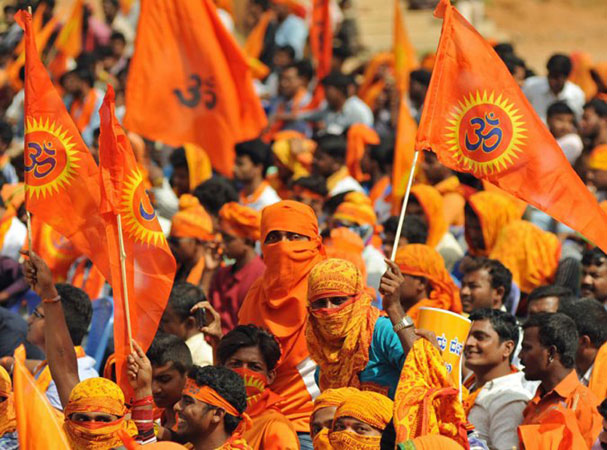
The Bharatiya Janata Party (BJP) government is an ultranationalist regime that has taken the reins of power in India on the basis of a self-proclaimed role to promote Hindutva. This self-professed obligation would bind them to some form of adherence to the basic concepts of the Hinduism, would it not?
One phenomenon that is found in Hindu conceptualizations of the world is the notion of Karmic justice: as you sow, so shall you reap. In the battered Indian economy we see today, there is an undercurrent of Karmic justice that is difficult to miss.
Yet it would add insult to the injury of India’s flailing government that its Karmic retribution is a product entirely of its own doing. The BJP has driven the economy into disastrous circumstances, and whatever poor results are now being reported, the number is certain to be worse, because the BJP has systematically engaged in a program of deception by overstating economic ‘successes’ and understating economic failures.
Indeed, the so-called ‘data system’ used by the BJP government has numerous methodological problems and is susceptible to manipulation, because of which the official annual GDP growth rates of 7-8% since 2011 have wildly overstated actual growth. And now, the high-frequency indicators in India show that exports and imports have together fallen in the current fiscal year. The production of investment goods was also fallen, while the production of consumer goods and real government tax receipts are essentially stagnant.
At the same time, a brutal credit crunch has reduced commercial lending to less than Rs1tn in the first six months of this fiscal year, which is less than one-sixth of its level in the previous fiscal year. To senseless push consumers and firms to live beyond their means is ripe for Karmic judgement!
In essence, the BJP has now brought the bombastically advertised Indian economy into a balance-sheet crisis. Ever since the Global Financial Crisis (2008-09), corporate profitability in has been extremely low in India, which has caused the share of debt owed by sick companies (i.e. those that do not generate enough cash to service interest payments) to balloon to 40%.
With sick companies owing 40% of the overall corporate debt, a contagion is likely to emerge in any country. But in a Bollywood-esque economy that distorts reality to the convenience of the powerful, the farce is allowed to continue and the economic disease festers.
The BJP’s La-la-land approach towards society in general is as clearly reflected in its economic mismanagement. This is, after all, a society that lionizes a pilot like Wing Commander Abhinandhan who tried to be an aggressor but was swiftly shot down by the Pakistan Air Force and handed back as act of mercy. The spirit of deception runs deep in the BJP’s psyche, but the fear of karmic justice does not.
The economic lapses were also failures of the BJP’s own doing. No one from abroad had coerced the BJP into instating the demonetization fiasco which decimated the livelihoods of many poor in India. Nor was it imposed from outside that the BJP needed to constantly exaggerate its economic statistics. It would have been better to grow honestly at 4% than at 7% dishonestly.
Going forward, India does not have the macroeconomic tools to get the economy going. The quickest tool, monetary policy, isn’t effective in India because the Reserve Bank’s rate cuts do not get passed on to regular consumers, instead being horded by the private banks who have stressed balance sheets and a new-found aversion to risk. The other main tool of fiscal policy is also constrained because public sector deficits are ballooning to double-digit levels while interest rates remain higher than growth rates, and primary deficits remain elevated.
If the BJP wishes to fix the Indian economy, it needs to understand that rhetoric will only take it so far. As for its rhetoric on the economy, the BJP must realize that a credit-binge is not the answer for well-distributed and sustainable growth.
As for its rhetoric on Pakistan, it needs to realize that the common man in India is struggling too much to bear any more foreign demons, especially when Pakistan has taken a mature and responsible stance through gestures such as the Kartarpur Corridor and handing over Abhinandhan as a message of peace.
As for its rhetoric about Hindutva, the BJP needs to understand the importance of Karmic justice as a retribution for its deceits. The responsibility of sovereigns in Hinduism is to act with compassion and consideration for the ruled, so that the ruler’s karmic integrity is kept intact. With the unravelling of the Indian economy, the BJP is ensuring that very little of the already flimsy Indian republic shall be left intact.
The writer is the Director for Economics and National Affairs at the Centre for Aerospace and Security Studies (CASS). This article was first published in Daily Times newspaper. He can be reached at [email protected].



