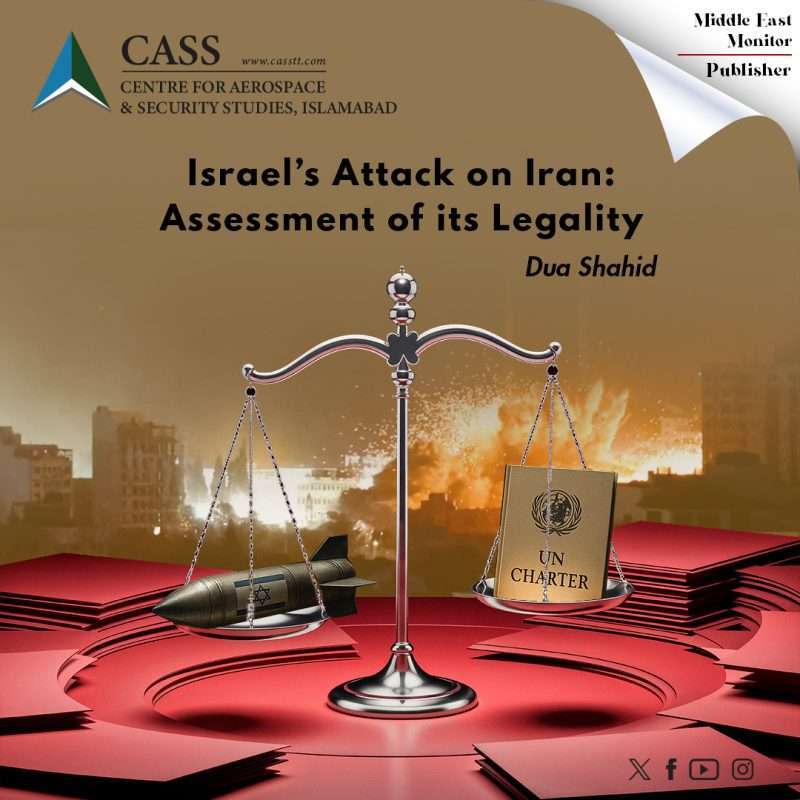
On 13 June, the Israel Defence Forces (IDF) launched ‘Operation Rising Lion’ against the Islamic Republic of Iran, targeting nuclear facilities, missile sites, military leadership, and nuclear scientists. In the first wave, missile strikes were conducted with 200 aircraft and a number of Unmanned Aerial Vehicles (UAVs) to engage over a 100 targets. On the first day alone, IDF’s strikes reportedly killed 78 individuals and injured 329 civilians.
Was this attack lawful under the doctrine of anticipatory self-defence and did it comply with the Law of Armed Conflict (LOAC)?
The legal framework governing a state’s use of force includes jus ad bellum and jus ad bello. Jus ad bellum, derived from Article 2 (4) and 51 of the Charter of the United Nations (UN), permits the ‘use of force’ and ‘self-defence’ against any state in case of an existential or imminent threat. On the other hand, jus ad bello, known as International Humanitarian Law (IHL) or LOAC governs the conduct of conflicting parties during an armed conflict.
Israel justified its targeted military operation against Iran based on the pretext of an existential threat posed by the possible acquisition of nuclear weapons by Tehran. Initial statements by Israeli officials suggested that Iran had significantly advanced its nuclear programme, with the ‘ability to destroy Israel.’ The operation was, hence, projected as an effort to thwart and eliminate this threat and safeguard Israel’s existence.
A day before Israel struck, the International Atomic Energy Agency (IAEA) board declared that Iran was in non-compliance of its non-proliferation obligations and had undeclared nuclear material and activities. IAEA did not suggest that Tehran was engaged in making any nuclear weapons or explosive devices. The anticipatory attack would only be legal if there was clear evidence of a nuclear weapon being built, which, in the case of Iran, was missing. This underscores that, in the absence of any nuclear weapon and associated imminent threat of foreseeable attack, Israel’s use of force on the pretext of self-defence violated international law. The applicability of IHL in this case hinges on two key conditions: whether the threshold of de minimis use of force has been crossed and whether a state of de facto hostilities exists.
Israel’s large-scale operation meets the de minimis condition as it crossed the threshold of limited use of force. Also, the exchange of missiles between Israel and Iran in October 2024 indicates a pre-existing conflict, which fulfils the condition of de facto hostilities. Certainly, the applicability of the IHL is established; it must now be examined whether the strikes violated the basic principles of IHL.
Israel claimed that the strikes targeted legitimate military objectives, i.e., Iran’s nuclear facilities. In reality, the strikes did not adhere to the principle of military necessity as the country’s nuclear programme was not used to cause civilian harm. In addition, the expected presence of nuclear fuel at the facilities at the time of the attack could have posed severe risks. The attack thus violated Article 56 of the Additional Protocol (AP I), as the release of ‘dangerous forces’ from the targeted facilities risked radioactive contamination and posed a serious threat to the environment.
IHL’s Article 48 (AP I) requires that the conflicting parties must distinguish between combatants and non-combatants. Israel targeted 14 nuclear scientists who were not ‘Directly Participating in Hostilities’ (DPH) and were entitled to protection under the IHL. Several experts at the fourth expert meeting on DPH agreed that neither nuclear weapons specialists nor arms industry employees can be classified as combatants regardless of their contributions to the war. So, in this case, the killing of nuclear scientists by Israel constitutes a further violation of jus ad bello.
It is evident that Israel’s use of force constitutes not only an unlawful act of self-defence but also violates the IHL. Israel does not meet the criterion of anticipatory self-defence since no existential threat was imminent. Similarly, targeting nuclear sites and scientists is a violation of IHL, as they were not legitimate military objectives. Therefore, Israel is complicit of war crimes and must face international legal consequences.
Dua Shahid is a Research Assistant at the Centre for Aerospace & Security Studies (CASS), Islamabad, Pakistan. The article was first published in The Middle East Monitor. She can be reached at [email protected]