The erstwhile Soviet Union invaded Afghanistan on 24 December 1979, and remained there until 15 February 1989. In the bargain, Soviet Union ended up losing its political identity and disintegrated for good, perhaps because the invasion was seen as a blatant violation of Afghanistan’s sovereignty. Nearly all nations joined hands led by the United States (US), and its allies, and supported the Afghan Mujahedeen’s resistance. Pakistan not only played the role of a frontline state against Soviet occupation but also became the training, logistics lifeline of the freedom struggle.
On the other hand, the US entered Afghanistan in 2001 following the 9/11 attacks to fight the Global War on Terror (GWOT). This entry was supported and legitimised by global powers and institutions. The US and NATO forces stayed in Afghanistan with full military presence for over 20 years and left on 15 August 2021, only to leave the war-ravaged country again to the same government led by Taliban, which is still not recognised by the international community.
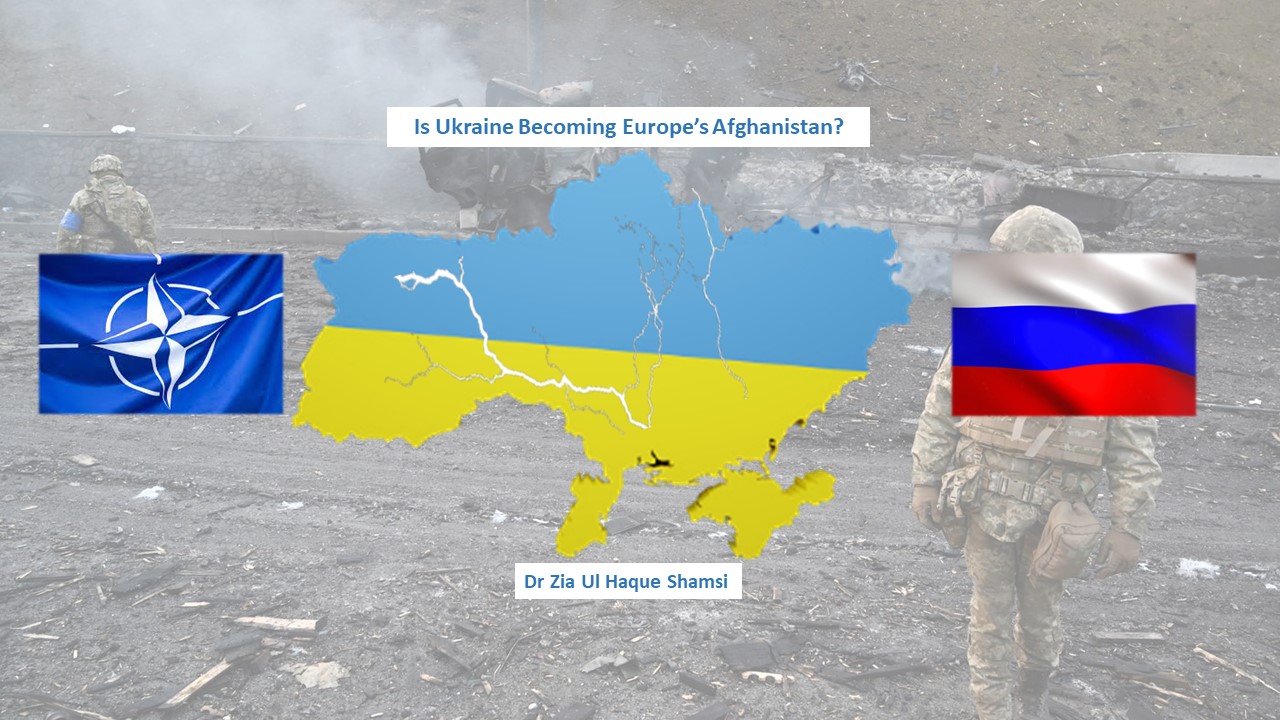
While the US was still looking for an excuse on its failures in Afghanistan, Russia decided to enter Ukraine, in an effort to extend its perimeters to block NATO forces on its doorsteps. For years, the Kremlin had been pushing against NATO expansion, particularly against Ukraine joining the military alliance seen as a genuine security threat. It is evident now that Ukraine was Russia’s red line.
The Russo-Ukrainian war is now entering its third month, with large-scale devastation and casualties. The Western world is supporting Ukraine morally, militarily, and financially. On the other hand, the global economy has been hit hard due to this new war in Europe, primarily because Russia controls energy supplies to a number of European countries. The country remains the biggest exporter of crude oil and earns nearly USD 123 billion a year. Moreover, it is not only a major supplier of just oil and gas, but also wheat, metals, and fertilizers, as well.
The US and other European partners have imposed compelling sanctions on Russia and its major exporting companies due to its imposed war on Ukraine. This has had serious implications for the Russian economy, and hence forced President Putin to insist on receiving Russian Rubles in exchange for gas exports to European countries. After initial reluctance, ‘most of the gas importers have already opened their account in rubles with Gazprom,’ Italian Prime Minister Mario Draghi told a press conference. He said that ‘Germany’s top gas importer had already paid in rubles. Like Italy, Germany is a massive consumer of Russian gas,’ according to a recent Bloomberg report. Another report suggests, that ‘a total of twenty European companies have opened accounts, with another 14 clients asking for the paperwork needed to set them up.’
Moreover, both Russia and Ukraine are the biggest exporters of food grain to a number of countries across the globe. For instance, Egypt was the biggest importer of Ukrainian wheat last year alongside Lebanon, and Pakistan. Ukraine produces about 7% of the world’s wheat as well as sunflowers, corn, soybeans, and barley in large exportable quantities, particularly to North African countries.
Likewise, Russia produces and exports massive quantities of wheat, sugar beets, milk, potatoes, cereals, and chicken. Moreover, several European countries entirely rely on gas from Russia, including North Macedonia, Moldova, Belarus, Norway, Serbia, and Bosnia and Herzegovina.
According to the Observatory of Economic Complexity (OEC) report, ‘the top exports of Russia are Crude Petroleum ($74.4B), Refined Petroleum ($48B), Petroleum Gas ($19.7B), Gold ($18.7B), and Coal Briquettes ($14.5B), exporting mostly to China ($49.3B), United Kingdom ($25.3B), Netherlands ($22.5B), Belarus ($15.8B), and Germany ($14.2B).’ The BBC reports that ‘In 2019, Russia accounted for 41% of the EU’s natural gas imports.’
Historically, a prolonged military campaign usually proves counterproductive for the initiator. Vietnam War for the US, first Afghan war for the Soviets, second Afghan war for the US are ample proof of this argument. Russia must not lose sight of history and avoid prolonging its Ukrainian campaign before it proves to be another Afghanistan for the global power.
Dr Zia Ul Haque Shamsi is the author of ‘Nuclear Deterrence and Conflict Management Between India and Pakistan’ and ‘South Asia Needs Hybrid Peace.’ He is presently working as Director (Peace and Conflict Studies) at the Centre for Aerospace & Security Studies (CASS), Islamabad, Pakistan. He can be contacted at: [email protected]