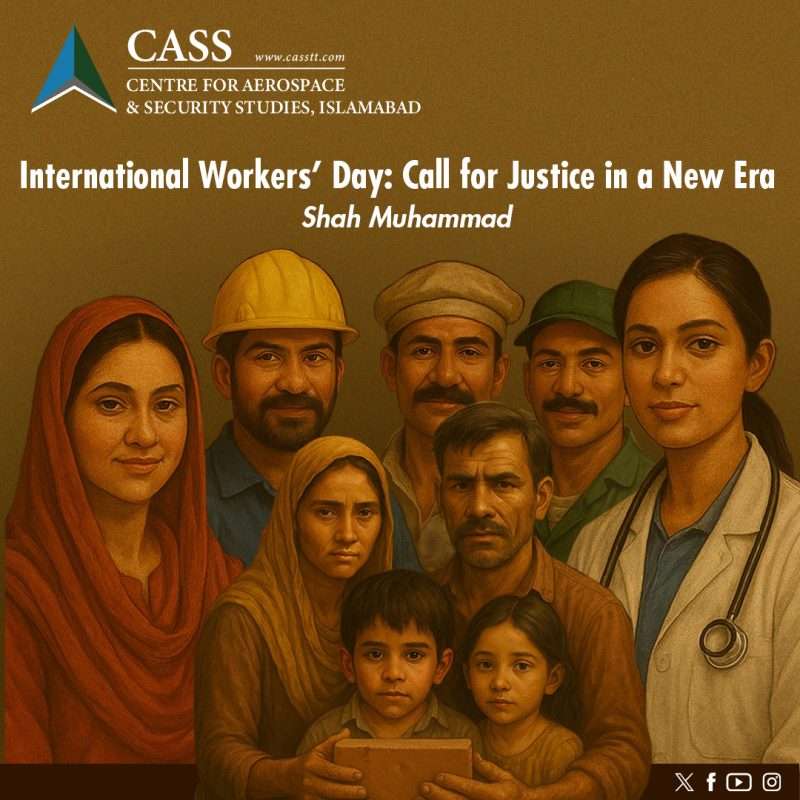
The towering skyscrapers, high-tech gadgets and everyday innovations compel us to wonder: do we truly recognise the blood, sweat, and sacrifice behind our modern way of life? From the agricultural age to the industrial revolution and now the digital era, it is the relentless toil of workers that has shaped the course of human progress. The commemoration of ‘International Workers’ Day’ is more imperative than ever given that workplaces are bracing for significant complexities in the wake of technological advancements and enduring gender bias. It also serves as a timely reminder to engage in thoughtful and compassionate discourse on the persistent challenges of global inequality.
International Workers’ Day traces its origins to the historic struggle for labour rights during what is now known as the Haymarket Massacre. On May 1, 1886, around 300,000 workers across the United States marched to demand an eight-hour workday and dignified working conditions. In the days that followed, a peaceful demonstration in Chicago turned tragic when police opened fire and an unidentified individual detonated a bomb, killing eight civilians and injuring hundreds. Instead of conducting an impartial investigation, the authorities prosecuted and convicted several labour leaders, reflecting the class biases of the era’s justice system. May 1 is thus commemorated globally not only to honour the sacrifices of those who fought for workers’ rights, but also to reflect on ongoing struggles for justice, equity, and fair labour practices today.
Though the world has undergone new phases of progress, its rewards remain concentrated in the hands of a few. According to Oxfam, the richest 1% of the globe has accumulated over twice as much wealth as 6.9 billion people while 3.4 billion people earn a mere USD 5.5 a day. Economic disparities between regions have deepened, as Africa, South Asia, and Latin America remain at the lower end of the global economic spectrum.
Capital, the long dominant factor of production, continues to assert its supremacy over labour. But in today’s high-tech era, technology has also emerged as a new and powerful factor of production, often reinforcing capital’s dominance and enabling more subtle yet pervasive forms of labour exploitation. Unlike the overt extraction of physical labour and raw materials, contemporary technologies commodify human thoughts, behaviours, and emotions, turning them into data streams for commercial profit. This is a manifestation of surveillance capitalism which effectively drives the operations of the Big Tech corporations. Surveillance capitalism has notoriously transformed nearly all digital media users into passive labourers, whose personal data is harvested and commodified as a strategic resource for capital accumulation and power consolidation.
The advent of emerging technologies, especially AI, comes with apprehensions of workplace automation and layoffs of workers across the globe. Around 41% of companies worldwide intend to leverage automation and undercut their workforce. Manual labour is being increasingly replaced by high-skill toil which requires advanced digital literacy. World Economic Forum’s (WEF) Future of Jobs Report 2024 warns that failure to align with high-tech market requirements would lead to mass unemployment across the world. In essence, balancing between technological adoption and workforce retention would be a key challenge for both governments and corporations in the coming years.
Importantly, gender bias is an enduring feature of the economic realm despite the global headways in women’s empowerment. Globally, women own 50% less wealth than men, and their incomes remain, on average, 24% lower than those of their male counterparts. The marginalisation of women is proof of the deeply entrenched patriarchal structures that continue to constrain women’s agency in workplaces. Additionally, women are acutely underrepresented in leadership roles as they constitute a mere 5.4% of CEO positions.
Upholding the rights and dignity of workers would require global as well as national endeavours for social justice. In an increasingly interconnected world, there is a pressing need to establish more platforms, akin to the International Labour Organization, that actively represent and protect workers’ rights across borders. At the national level, workers’ associations should be empowered to serve as dynamic forums for policy dialogue and collective bargaining. It is primarily through collective bargaining that labour can effectively challenge the entrenched dominance of capital. In parallel, governments must strengthen the enforcement of labour laws through independent labour inspections. Violations of minimum wage standards or dignified working conditions should be met with clear punitive measures, including financial penalties and custodial sentences where appropriate.
Automation should be implemented gradually to allow labour markets time to adjust. While 93 million jobs may be lost, 170 million new ones could emerge by 2030. Although the net gain offers hope, preparing for this transition will require coordinated public and private efforts to upskill both current workers and students for an increasingly competitive, tech-driven job market. Women’s empowerment in workplaces would not only require the dismantling of patriarchal structures but also sociocultural initiatives to change the archaic understanding of gender.
1st May should not be just another day of commemoration. It should inspire well-directed policy initiatives and corporate introspection to fundamentally rethink the relationship between labour and capital. Workplaces should be hubs of creativity and joy, not modern ghettos of exploitation and suffocation.
Shah Muhammad is a Research Assistant at the Centre for Aerospace & Security Studies (CASS), Islamabad, Pakistan. He can be reached at: [email protected]