Since the beginning of the Space Age, the prevailing notion was that ‘Space was a common heritage of mankind’, meant for shared progress. Despite getting engaged in a race to dominate this realm, the United States (US) and former Soviet Union also took some initiatives to cooperate in this domain during the Cold War. For instance, on 20 December 1961, the United Nations General Assembly (UNGA) unanimously adopted a resolution on the peaceful uses of outer space with both countries on board. During the period of détente, cooperation in outer space reached a new milestone when both superpowers carried out their first-ever joint manned space mission called ‘Apollo-Soyuz Test Project’ in 1972. In the 1980s, both extended cooperation to their allies and helped them to establish their space agencies. This started an era of ‘Space Diplomacy’, where ‘Space’ became an important instrument of states’ foreign policies.
On 28 January 1998, the US, Russia (former Soviet Union), Japan, Canada, and 11 member states of the European Space Agency (ESA) joined hands to cooperate in space exploration and signed an Inter-Governmental Agreement (IGA) for the establishment of the International Space Station (ISS). ISS is a ‘modular space station in low Earth orbit that facilitates research and development in the fields of astronomy, physics, astrobiology, meteorology, and other areas related to science and technology.’ These states began cooperating in various aspects of the ISS including module launch systems, operations, advanced engineering, data processing labs, flight crew training, communication networks, and ground stations, etc.
For more than two decades, the ISS has been a great manifestation of international cooperation, offering many dividends to mankind. However, in recent times, global power competition on Earth, race to dominate Space, and the participation of private players have adversely impacted international cooperation in this area as well as the ISS program.
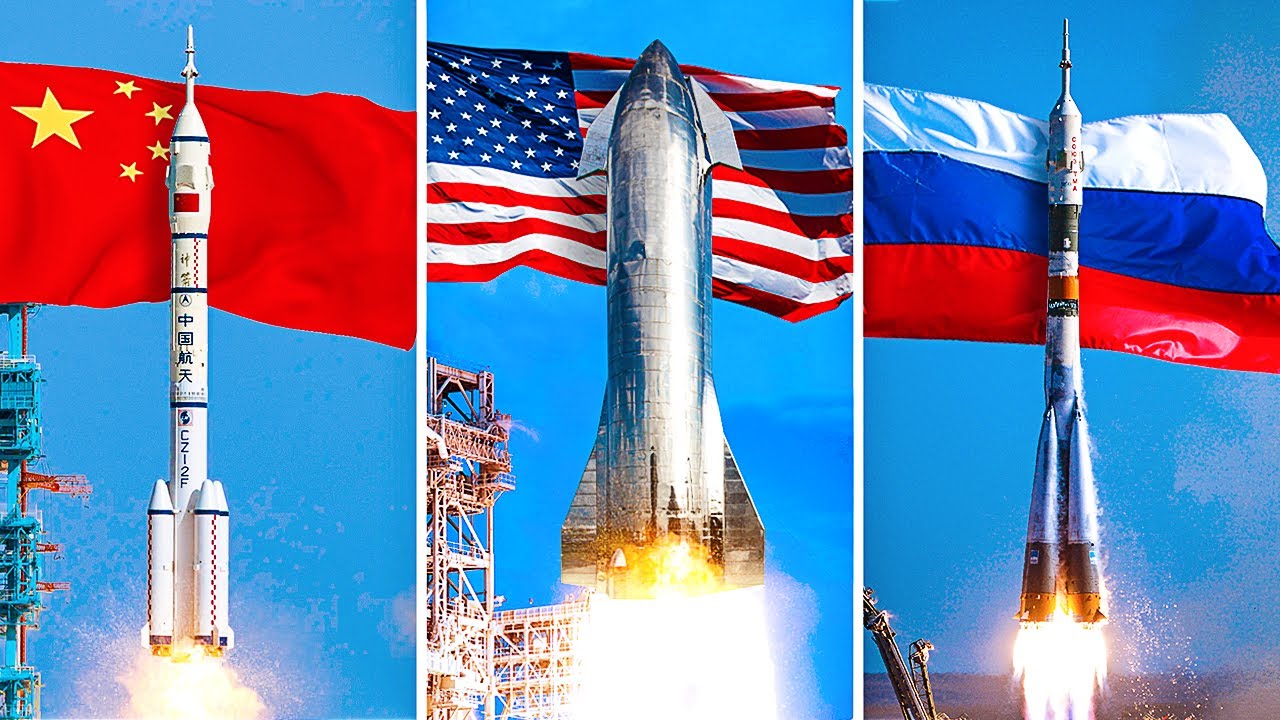
Competition and rivalry between great powers is becoming more intense with the passage of time. The US is trying hard to contain resurgent Russia and rising China by dragging them into regional conflicts and imposing an array of economic and trade sanctions upon them. On the other hand, both Russia and China are challenging the US dominance in every realm of global power competition. This competition has not only minimized the chances of their cooperation on Earth, but also jeopardized their present cooperation and joint ventures in space. Amid these geopolitical tensions, Russia has threatened to leave ISS and confirmed plans to build its own independent space station. According to Dmitry Rogozin, Chief of the Russian space agency Roscosmos, ‘Either we work together, in which case the sanctions are lifted immediately, or we will not work together and we will deploy our own station.’
China was also barred by the US from participating in the ISS program due to concerns that it could use the opportunity to advance its military capabilities. In 2011, the Wolf Amendment made it clear that Chinese firms would no longer be allowed to participate in NASA initiatives. However, China too, has vowed to build its own space station, thrice as big as the ISS, in near future. The China National Space Administration (CNSA) launched the first three modules of the Chinese Space Station (CSS) in April 2021 and plans to fully operationalize it by 2022.
Space cooperation and collaborations are gradually being overshadowed by the race to dominate outer space. Technologically advanced countries are making their endeavors to control access to space for military purposes. This is because militaries across the world are increasingly relying on space-based assets for Intelligence, Surveillance, Reconnaissance (ISR) and their command-and-control systems are dependent on satellite-based communication links. The state which controls this realm will dominate the world as well as any future conflict. Hence, the concept ‘Space is for everyone’ has been replaced by ‘Space is for the strongest.’
Participation of the private sector in space-related technologies has facilitated governments by providing cost-effective solutions to expensive problems in this domain. However, it has also resulted in a decline in the opportunities for states to collaborate. For instance, Russia was providing assistance to the US to send its manned missions to ISS. But now SpaceX, a private tech firm, is providing these services to the US at a lesser cost.
Technology is evolving faster than politics. In future, geopolitics, with the addition of the Astro, will become more complex and less equal, separating the technologically superior from the inferior, and diminishing the possibilities for international cooperation. The advanced space-faring nations need to prioritize international cooperation in space and joint projects like ISS in order to achieve political and programmatic sustainability, monetary efficacy, advancement in research and development, and for space exploration to reap collective benefits and shared growth for humanity.
Abdullah Rehman Butt is researcher at Centre for Aerospace & Security Studies (CASS). He can be reached at [email protected].