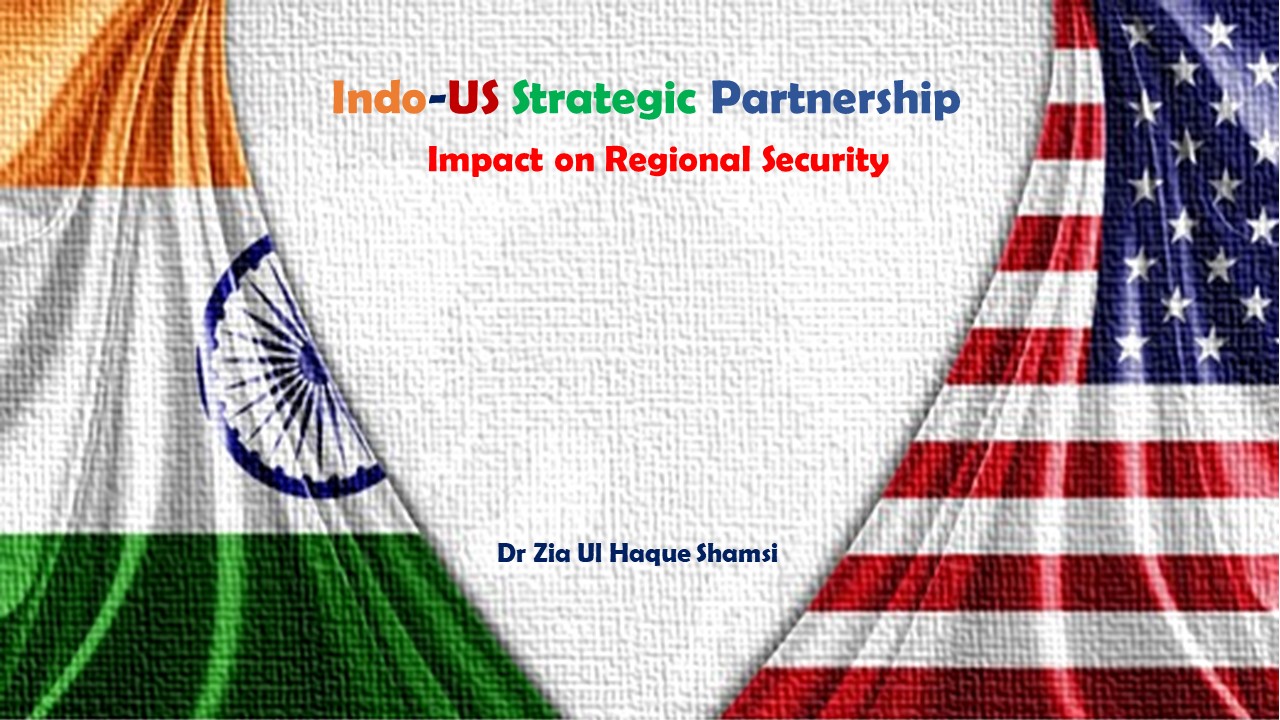
The US is preparing India as a lead nation to challenge China’s rise as a regional power with global ambitions. The US understands that India does not have the necessary wherewithal to contest China either militarily or economically at this time. Therefore, the US is equipping India to fight its new Cold War in the Asia-Pacific region, without realising that Indo-China rivalry may not remain cold due to territorial disputes between them.
The Indo-China rivalry has seen a border war and skirmishes; the latest being in 2020 in the Eastern Ladakh region where India lost over 1000 square kilometres of its territory along the Line of Actual Control (LAC) to China. Whereas, India lost considerable territory in a humiliating defeat in the Aksai Chin region during its first war with China in 1962.
While the US is putting pressure on China in affairs with Taiwan and the South China Sea, it is preparing India for a possible face-off with China as a part of its containment strategy. Through Basic Exchange and Cooperation Agreement (BECA), the US is strengthening India’s capacity to technologically challenge China’s rise as a global power, concurrently developing its capabilities to over-power Pakistan in any future conflict.
India and the US had been engaged in 2+2 Ministerial Talks for the last two decades. These talks were aimed at further expanding the existing deep military cooperation between the two countries. The BECA signed on October 27, 2020, completes the long-drawn process of negotiations, which led to the signing of four different agreements, usually referred to as “Foundational Pacts” between India and the US over 18 years. These include the General Security of Military Information Agreement (GSOMIA), Logistics Exchange Memorandum of Agreement (LEMOA), Communications Compatibility and Security Agreement (COMCASA), besides BECA. With the completion of this process, India has now become a major defence partner of the US.
India had been vying for a long-term strategic partnership with the US to counter China and play a more dominant role in the region. The BECA appears to be more beneficial for India because it would facilitate an exchange of geospatial information. Furthermore, these agreements enable India to purchase or lease certain strategic platforms of the US, which are not available to other countries. Moreover, BECA would bring IAF and USAF even closer with access to high-quality GPS to navigate missiles with real-time intelligence to precisely target the adversary, as India and the US would be able to share high-end technology, sensitive and classified satellite data in real-time. India’s military capability would multiply manifold with real-time access to the US geospatial intelligence with enhanced accuracy of automated systems, weapons, missiles, and armed drones. India gets access to information on maps and satellite images to get topographical and aeronautical data, necessary for navigation and targeting. The BECA is expected to enhance India’s capacity and capability in terms of monitoring, surveillance, satellite reconnaissance, satellite imaging, global positioning, data collection and analytics, precision guidance of missiles to potential targets.
The situation in the Indo-Pacific region is getting complex and uncertain. The US is actively pursuing its strategy of encirclement against China through QUAD (Australia, Japan, India and the US), concurrently preparing India under BECA with high-end technological support to face-off China. China is treading its path carefully and does not intend to engage itself in any military conflict with regional or extra-regional powers. However, China is slowly and gradually retaking its claimed territory from India’s control in the Ladakh region through small military expeditions. The opposition parties in India are critical of Modi government’s inaction on China’s ingress and calling for retaliatory actions to retake the lost territory or tell the truth to the nation. The tragic death of India’s top military commander General Bipin Rawat in a military helicopter crash on 8 December 2021, in Tamil Nadu has further complicated the issue for India. Because General Rawat was the architect of India’s ongoing military reforms. Moreover, he was seen responsible for Balakot against Pakistan in 2019 and Ladakh against China in 2021. In both these events, India had to face embarrassment, but Indian media attempted to create space for the Modi government by creating fake and fabricated claims of victories.
While Indo-US strategic partnership would strengthen India’s military capabilities, it is highly unlikely that India would be able to challenge China’s rise to a level the US expects. Additionally, the rising economic competition between India and China is likely to keep these countries away from any significant kinetic conflict. Also, India is not yet ready to absorb high-end emerging technologies that may change the strategic balance with Pakistan in near future. However, these developments would certainly bring Pakistan and China much closer and that may create a two-front scenario for India to which General Rawat had claimed that it is ready to face. Therefore, the evolving strategic situation in the region is going to remain tense, uncertain, and perhaps also unpleasant.
Dr. Zia Ul Haque Shamsi is Director Peace and Conflict Studies at the Centre for Aerospace & Security Studies (CASS), Islamabad, Pakistan. The article was first published in Daily Times. He can be reached at [email protected].
Image Source: Etfa Khurshid Mirza