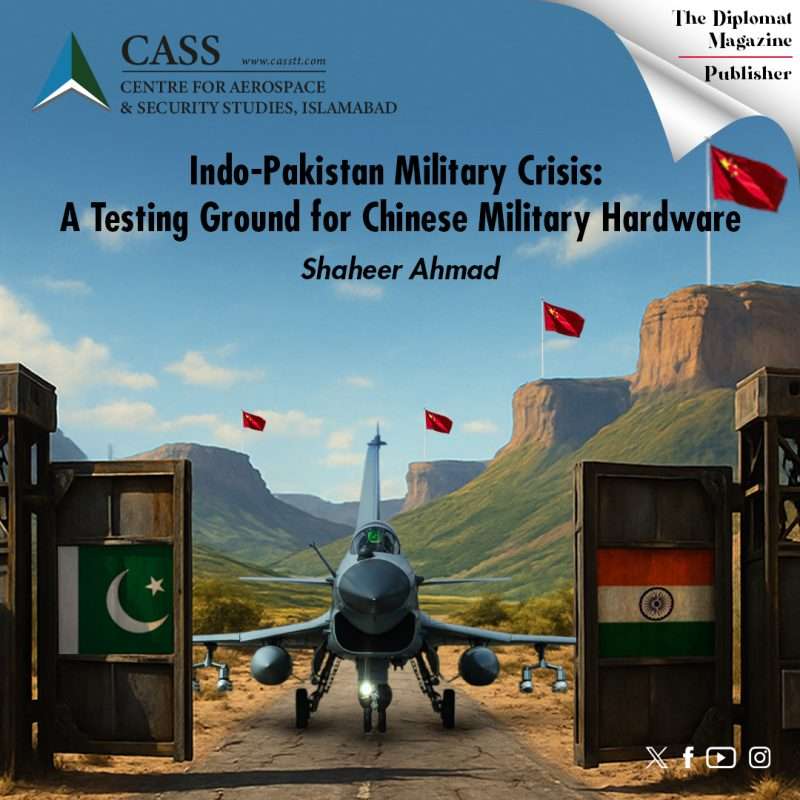
On 7 May, the Indian military launched a series of strikes from standoff ranges against multiple targets in Punjab and Pakistani-administered Kashmir, called ‘Operation Sindoor’. In response, Pakistan claimed to have retaliated by shooting down five Indian jets, notable among them were top-of-the-line French-manufactured Rafale aircraft. Later, the acknowledgement by top French and American officials about the downing of Rafale confirmed the first combat kill of the French-made aircraft. Likewise, the Pakistani military has intercepted 77 kamikaze drones, mainly of Israeli origin. Despite the fog of war, the intense aerial exchange between the regional rivals has underscored the qualitative effectiveness of China’s previously untested inventory.
A cursory look at the crisis shows that Pakistan has mainly relied on Chinese combat planes such as J-10C and JF-17 Thunder aircraft and air defence systems, including HQ-9, to shoot down Indian fighter jets and incoming drones. This reflects a significant presence of Chinese military hardware in Pakistan’s military arsenal. According to Stockholm International Peace Research Institute (SIPRI), China accounts for nearly 82% of Pakistan’s arms imports between 2019-2023. Owing to this robust bilateral defence trade, Pakistan’s claim of shooting down Indian fighter aircraft with Chinese assets remains a trending topic for Chinese policymakers and social media. Reportedly, the shares of AVIC Chengdu Aircraft Co., the manufacturer of J-10C aircraft, saw a sharp hike of 20%, an all-time high in more than two years.
Historically, the conventional disparity between Pakistan and India has prompted the former to counterbalance the latter’s dominance. This realisation became more apparent after the post-Pulwama scenario, when India conducted aerial strikes in Balakot outskirts, followed by a retaliatory riposte by Pakistan, which saw the downing of two Indian fighter jets, the fratricide of a helicopter and a pilot being captured. In aftermath of the episode, both parties poured significant resources into upgrading their military capabilities.
For Pakistan, China appeared as a guaranteed provider of advanced fighter jets, submarines, drones, air defences, radars, missile systems, frigates and satellites. The co-development of JF-17 Thunder, along with the procurement of J-10C Vigorous Dragons, has augmented Pakistan’s operational edge in the region. Concomitantly, Chinese-made HQ-9P, LY-80, FD-2000 and FM-90 constitute Pakistan’s integrated air defence systems, combined with other platforms. Together, these assets form a critical lynchpin of Pakistan’s network-centric warfare capabilities.
In the same context, Pakistan has also benefited from China’s space capabilities by launching satellites from Chinese launch facilities. In 2018, it became the first state to receive access to BeiDou’s military-grade position, navigation and timing data, which increases the precision of missiles, aircraft and ships.
Meanwhile, realising the significance of drones in modern warfare, Pakistan operates numerous Chinese-origin drones such as CH-4 and Wing Loong II, which enhance Pakistan’s intelligence, surveillance and reconnaissance (ISR) capabilities.
This robust partnership has enabled Pakistan to ensure credible deterrence against India’s military advancements. For a long time, the F-16 acquired from the US has been Pakistan’s mainstay. However, the integration of the J-10C and JF-17 Block III with advanced PL-15 BVR is a turning point where Chinese technology is replacing Western weaponry as the operational backbone of Pakistan.
If the current crisis persists, it is likely to see untested Chinese weaponry field-tested, potentially addressing global concerns over their combat viability, such as the use of long-range PL-15 against Indian jets. If confirmed, the development could bolster global perception of China’s military-industrial capabilities. In other words, it would be akin to the Serbia’s downing of the F-117 Nighthawk in terms of optics. Furthermore, Pakistan’s success in downing Indian aircraft demonstrates that China’s military industrial complex has become competitive vis-à-vis its counterparts. In this context, the J-10C and JF-17 are likely to gain market traction reinforcing China’s technological ingenuity and helping dispel doubts about its parity with established defence producers.
The current scenario offers a real-time lens into the performance of Chinese military hardware against Western systems. Although China has expressed ‘unfamiliarity’ about the involvement of Chinese jets, it is cautiously observing the outcome of its weapon systems in actual combat. For a rising military power, which has not been in a major conflict since the Vietnam War, the successful demonstration of its premium military hardware will help it anticipate its performance in future conflicts around the Asia-Pacific.
The offset of hostilities between Pakistan and India has underscored the technological ascendancy of Chinese military hardware. China’s military support to Pakistan makes the latter a key strategic ally in South Asia. It also helps Pakistan remain ahead of the curve in reinforcing deterrence and maintaining operational readiness. Deployment of Chinese combat aircraft demonstrated the battle testing of Chinese weapons in a real-time scenario, enhancing Pakistan’s qualitative position vis-à-vis India.
Shaheer Ahmad is a Research Assistant at the Centre for Aerospace & Security Studies, Islamabad. The article was first published in The Diplomat Magazine. He can be reached at [email protected].