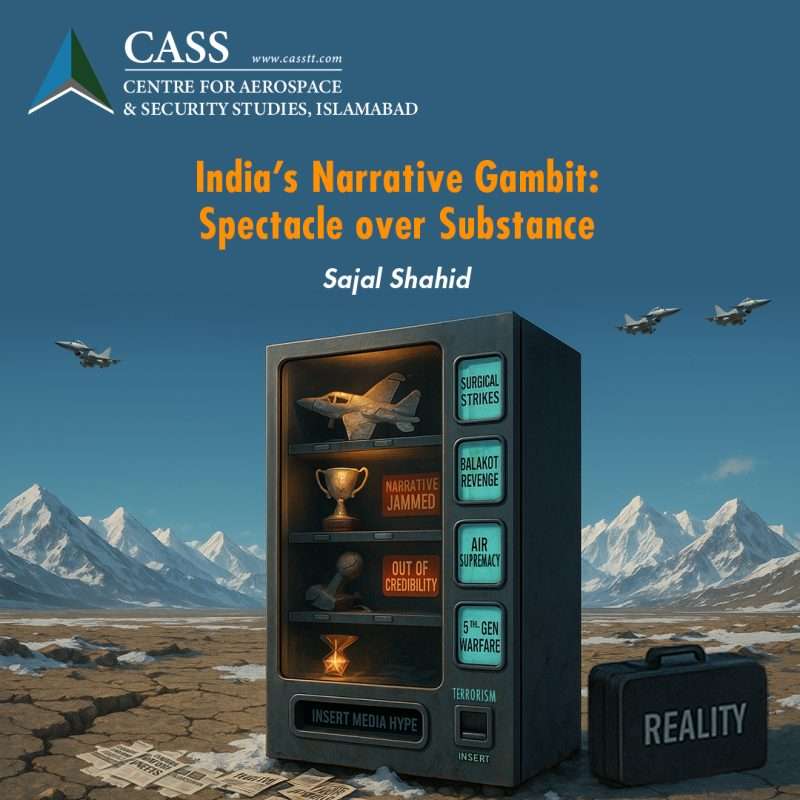
The recent Indo-Pak clashes laid bare India’s nationalist agenda and long-standing mechanisms of narrative control. Its use of exaggerated claims and theatrically bold threats to push forward its image as a decisive and dominant hegemon capable of taking extreme actions unilaterally to ‘punish’ its adversaries. This intense focus on optics to carry forth its narratives, both domestically and internationally, belies an underlying reliance on symbolism to conceal ground realities. It is, hence, important to look at inconsistencies in the narrative pushed by India compared to the facts on ground starting from 2016 and to the present day.
India’s focus on symbolism has become particularly notable in today’s post-Pahalgam environment, as was seen through the host of inflammatory speeches and hardline gestures that quickly followed in the wake of the tragic Pahalgam incident. Increasingly exaggerated statements and threats by the ruling Bharatiya Janata Party’s (BJP) officials such as ‘we will erase Pakistan from the world by December’ and ‘not even a drop of water’ will flow downstream from India, were repeated with zeal and conviction by politicians and media personalities alike, regardless of implausibility. This line of sensationalist posturing continued with the suspension of the Indus Waters Treaty, which was portrayed as a bold move demonstrating India’s dominance over Pakistan, despite the wording of the proclamation not holding any legal weight. This showcases a calculated approach employed by India to over-inflate the magnitude of its decisions, without taking into account the feasibility and consequences of these supposedly tough actions.
This pattern of hardline statements and gestures that hold little significance in reality, featured significantly in Operation Sindoor. Most notably in the circulation of numerous unsubstantiated claims ranging from India downing multiple Pakistani fighter jets, and destroying alleged terrorist camps to farfetched claims such as Karachi port being demolished by Indian missiles. All of which were parroted, not just across social media, but by well-known Indian media sources and military officials. Furthermore, threatening language by the Indian Prime Minister Modi, including statements such as ‘eat your bread quietly, otherwise my bullet is always ready’ and unsubstantiated claims including that of a Pakistan initiated surrender became increasingly frequent. Which when considered alongside India’s refusals to engage in diplomacy regarding long standing issues such as Indian Illegally Occupied Jammu & Kashmir, beyond complete surrender of the territory altogether, point towards India’s clear preference for political grandstanding in lieu of achieving any true outcomes.
This emphasis on showmanship at the cost of the truth, while particularly prominent during recent events, is nothing new for the larger state. In fact, one may even deem it a pattern starting from the alleged 2016 Uri attacks. The incident also followed a similar modus operandi, with India claiming to have conducted numerous ‘surgical strikes’ destroying terrorist launch pads across the border, and celebrating it as a massive win, complete with the release of a Bollywood dramatisation and observance of an annual ‘surgical strike day.’ All without any verification from Pakistan and independent sources regarding the authenticity of these claims.
The 2019 Balakot conflict had the same playbook, with India once again alleging to have not only caused mass damage across the border but of also having shot down a Pakistani F-16 jet, despite evidence from Pakistan and neutral third-party sources, including US senior defence officials, pointing towards the contrary. According to satellite imagery obtained and analysed by Reuters following the supposed ‘surgical strikes’, buildings India claimed to have struck remained standing and undamaged. Yet assertions of a complete and unequivocal victory continued to echo from India’s top officials, resulting in the previously waning popularity of Prime Minister Modi reaching new heights.
Such choreographed strategic gestures, from celebrations over unconfirmed Uri surgical strikes to the bold claims and hardline gestures in 2025, all demonstrate India’s focus on shaping narratives. While undeniably effective in rallying the Indian public and thrusting the Indian narrative into international discourse, this focus on spectacle brings with it its own set of risks. Despite their divergence from reality, these narratives continue to be internalised as truth within India’s domestic sphere, reinforcing inflated and unrealistic expectations. This, in turn, encourages politicians to escalate tensions and stage increasingly dramatic spectacles with each subsequent standoff, in order to appease domestic audiences. The result is a sustained increase in the risk of escalation in an already tense and nuclearised region.
For Pakistan, the central challenge is to resist being drawn into India’s constructed version of events and instead to craft its own narrative, one grounded in reality and supported by credible evidence, to effectively counter disinformation. Although international media has at times cast doubt on India’s claims, it is equally crucial to strengthen indigenous investigative efforts by establishing disinformation monitoring and fact-checking units, and empowering local journalists to report ground realities and counter false narratives. Ultimately, India’s focus on symbolism and spectacle reveals as much as it conceals, namely its sensitivity to domestic pressures and its need to project strength through false and inflated narratives.
Sajal Shahid is a Research Assistant at the Centre for Aerospace & Security Studies (CASS), Islamabad, Pakistan. She can be reached at [email protected].