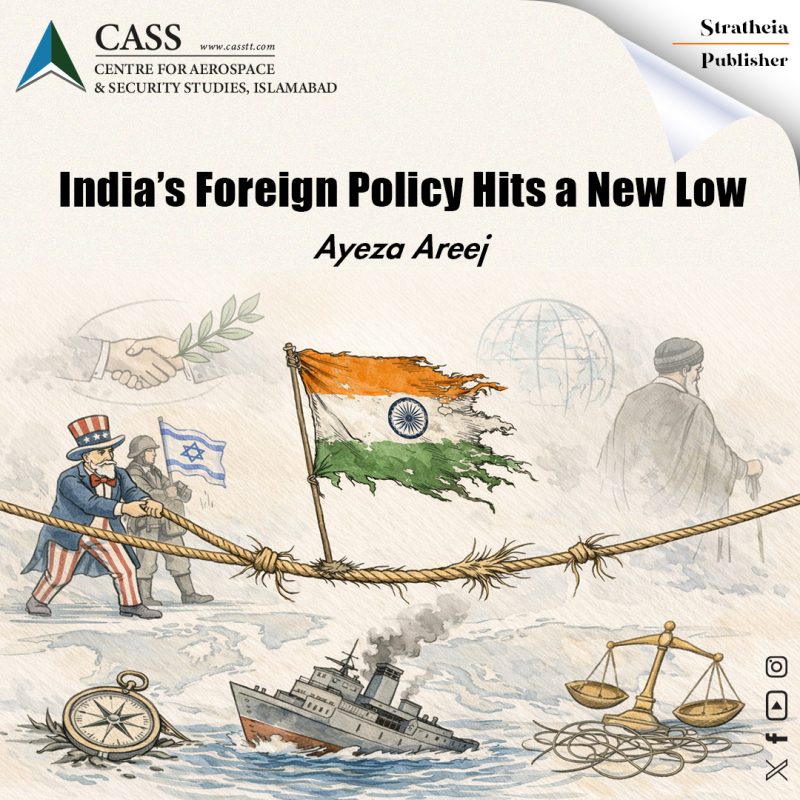
India’s recent diplomatic engagement with Israel marks a striking departure from decades of its carefully balanced foreign policy. Prime Minister Narendra Modi’s visit to Israel on February 25 came against the backdrop of intense global scrutiny on Israeli Prime Minister Benjamin Netanyahu regarding his government’s actions in Gaza and rising regional tensions. The visit signals a shift away from India’s long-standing neutrality and non-alignment, raising serious questions about the country’s foreign policy independence, strategic autonomy, and moral stance on major global issues.
Historically, New Delhi has played a calibrated and neutral role in West Asia. It not only supported Palestinian sovereignty but also interacted with other regional actors. It rejected the 1947 UN plan for the partition of Palestine and recognised the Palestine Liberation Organization (PLO) in 1974. It also officially recognised the Palestinian statehood in 1988, which was a continuation of its long-standing pro-Palestinian policy based on its notion of anti-colonial solidarity and the principles of non-alignment.
Nevertheless, Modi’s recent visit to Israel was quite an exception in the history of Indian diplomatic practice. During the visit, Modi did not mention the current crisis in Gaza, in which over 72,000 Palestinians have been reported killed since October 2023. This omission has been construed as an indication of a change in India’s diplomatic posture and normative position on the matter. The timing of the visit, according to Anwar Alam, a senior fellow at the Policy Perspective Foundation in New Delhi, completely undermines India’s historical pro-Palestine position. He argues that India can still maintain a pragmatic diplomatic approach in its relations with Israel, but it cannot afford to look insensitive to the plight of the Palestinian people or be seen to be siding with an Israeli government that is largely criticised as a colonial and aggressive power.
The visit was not only important for its symbolism but also for its timeliness. Israel is experiencing isolation amid war with Iran. Netanyahu himself is under enormous pressure in Israel due to his controversial judicial reforms, attempts to enlist ultra-Orthodox Jews in the army, and continuing corruption scandals dating back to 2016 that may lead to imprisonment. As the elections are in the offing later this year, Netanyahu has every reason to create the impression of international statesmanship, which demonstrates that Israel is not alone or diplomatically side-lined. The visit thus offers much-needed political cover to Netanyahu and advances India’s strategic interests in the region.
However, the visit has raised a lot of criticism within India and has indicated a strong division of opinion among the people. The trip was largely celebrated by mainstream media, but activists and pro-Palestine organisations denounced it, and their protests were forcefully suppressed. Additionally, the visit has been publicly criticised by the opposition leaders. They described the government’s position on the Palestinian issue as cynical and hypocritical. The Communist Party of India (CPI) claimed that the visit would legitimise Netanyahu’s murderous regime and increase India’s adherence to the Zionist expansionist regime. The criticism was to the extent that a CPI official stated that, ‘War criminal Netanyahu has now announced that India will cooperate on security issues, and Modi is going to Israel to dance and sing to his tunes. This unholy alliance will be an indelible blot on our nation’s soul. Shame!’ The statement shows political polarisation in India due to a shift in its foreign policy.
India’s response to the recent regional events supports these fears and casts grave doubts on its sovereign foreign policy. While New Delhi was swift in denouncing the Iranian attack on the UAE, it remained utterly silent on the American and Israeli military action in Iran despite its historically good relations with Tehran. In addition, India’s energy security policies are overwhelmingly influenced by external forces. Consequently, under the US pressure, India gave up its Russian oil purchase. This was not neutrality, but an abdication of its strategic autonomy.
A clear illustration of this inconsistency is the sinking of the Iranian warship IRIS Dena, which underscores the limitations of New Delhi’s credibility in the region. The Iranian warship, which had just attended the Milan naval exercise in India, was torpedoed by a US submarine, killing over 80 Iranian sailors. The silence has created an impression that India is growing closer to the US and Israel at the expense of Iran, as opposed to its historically balanced non-aligned position. Analysts believe the event highlights the limits of India’s influence in the Indian Ocean and could undermine its self-proclaimed status as a security provider in the region.
By becoming increasingly aligned with the US-Israel bloc, India can lose its credibility at multilateral forums and undermine its relations with Arab states, especially Iran. Modi’s visit to Israel marks a shift away from decades of non-alignment towards ideologically motivated selective alliances. Although the step might produce short-term benefits, it will likely undermine New Delhi’s sphere of influence and the autonomy of its foreign policy, questioning its ability to influence as an independent player in the global arena.
Ayeza Areej is a Research Assistant at the Centre for Aerospace and Security Studies (CASS), Islamabad, Pakistan. The article was first published in Stratheia. She can be reached at [email protected]