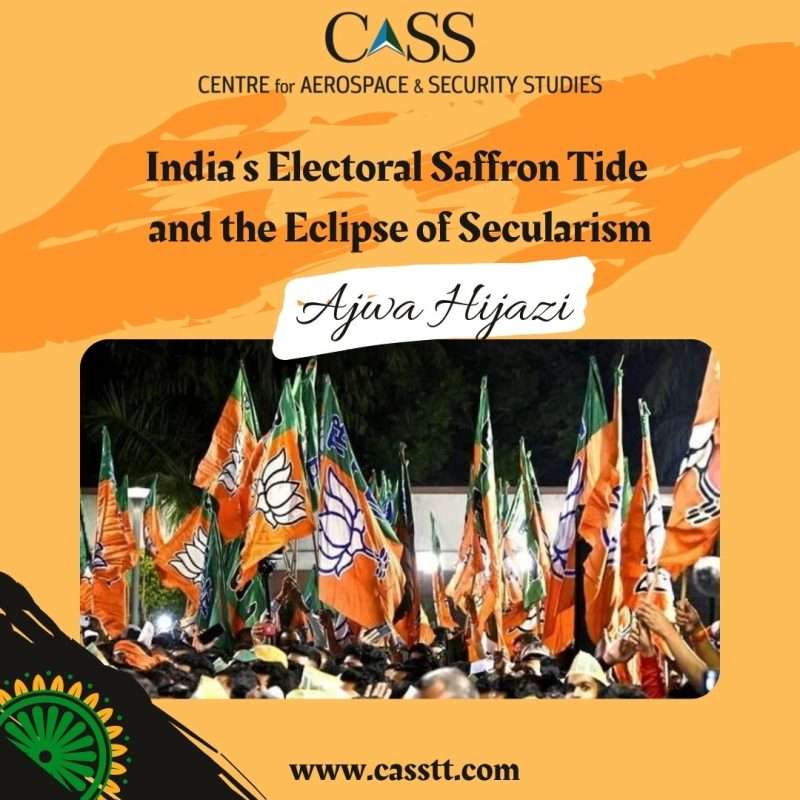
The outgoing year 2023, like most years since 2014, was characterised by India’s further descent into saffronisation. ‘Saffronisation’ refers to power politics employed by the Bharatiya Janata Party (BJP) to mould every aspect of life in India according to the ethos of right-wing Hindutva extremism, which has been the hallmark of this party.
The result of the latest state polls has further manifested the domination of the BJP on the country’s electoral horizon. The political wing of RSS won three heartland states. It has taken Chhattisgarh and Rajasthan back from the Congress and won central Madhya Pradesh for a record fifth time. The result of these polls has revived BJP’s electoral might before the national elections, which was somewhat hazed after its defeat in Karnataka at the hands of Congress a few months ago. Owing to this electoral win, 2023 ended on a high note for the BJP, but overall, the year was another low for ‘secular’ India’s contemporary history. This is because the major policy decisions and actions taken this year by the Modi government focused on maximising its political mileage for the Lok Sabha election scheduled to be held in mid-2024. BJP attempted to touch the cords of its core support base through Hindutva-driven policies.
Since 2014, Indian Muslims have faced systematic suppression of their fundamental rights under Narendra Modi’s government. With 2023 being a pre-election year, the situation intensified as the BJP, in its quest to appease Hindutva-induced majoritarian politics, further suppressed Indian Muslims for electoral gains.
In the first half of 2023, there were 255 documented incidents of hate speech gatherings against Muslims, especially in the states with upcoming polls. Additionally, 80% of such incidents occurred in states being governed by the BJP. Unfortunately, during the first week of August when the state machinery was preparing to host the G20 Summit, a mosque was being burned down by a Hindu mob just an hour away from New Delhi.
Moreover, in April 2023, the BJP implemented significant changes in national-level history textbooks, reflecting their Hindutva ideology. This revision included removal of chapters about Mughal emperors and the Delhi Sultanate, indicative of efforts to reshape historical narratives in educational materials to fit their vision of the past for the nation’s children. Additionally, the Modi-led government has excised sections detailing the 2002 mass killings of Muslims in Gujarat, which occurred while Modi was Chief Minister. Apoorvanand, a professor of Hindi at Delhi University, has described these textbook removals, aimed at downplaying Muslim experiences, as a form of ‘cultural genocide’.
Another politically motivated move came in the middle of 2023, nine months before the next Lok Sabha polls, when the Modi government proposed a Uniform Civil Code (UCC). According to the central government, it aimed to employ a standard set of laws for all, irrespective of religion. But critics termed UCC as BJP’s divisive attempt to bifurcate the communities to consolidate their Hindu vote bank ahead of the 2024 elections. After BJP stirred debate on UCC, pleas were also filed in the Delhi High Court to enact UCC, which the HC turned down on the pretext of it being an issue for the legislature.
As part of its electoral strategy, the government has also been manipulating the country’s legal system. Recently, the Indian Supreme Court validated abrogation of Article 370. Its revocation was BJP’s campaign promise in 2019. The court’s verdict, upholding the Modi government’s decision, has given the BJP a significant boost, allowing them to shift into the final gear of their election campaign, armed with a promise they have successfully fulfilled.
With the BJP at the helm, India has been pushed towards the pits of Hindu extremism. Alarmingly, with Modi poised for a potential third term, the likelihood of further deterioration in conditions for those not adhering to the BJP’s Hindutva ideology is distressingly high.
Although India’s opposition parties have formed a coalition, which has been somewhat predictably named ‘INDIA – Indian National Developmental Inclusive Alliance’, as a strategy to counter the BJP in electoral contests, the result of the recent state polls is a stark depiction of what will transpire in the national elections. Given the opposition’s lack of star power, persuasive narrative, on-ground political mobilisation, and the prevalence of the internal rifts in their ranks, there is a high chance that the BJP will win the next Lok Sabha elections. Should this occur, it would mark a significant shift in Indian politics with a third consecutive term victory, but it would come at the expense of undermining the country’s foundational principles of secularism and inclusivity.
Ajwa Hijazi is a Research Assistant at the Centre for Aerospace & Security Studies (CASS), Islamabad, Pakistan. She can be reached at [email protected].
Design Credit: Mysha Dua Salman