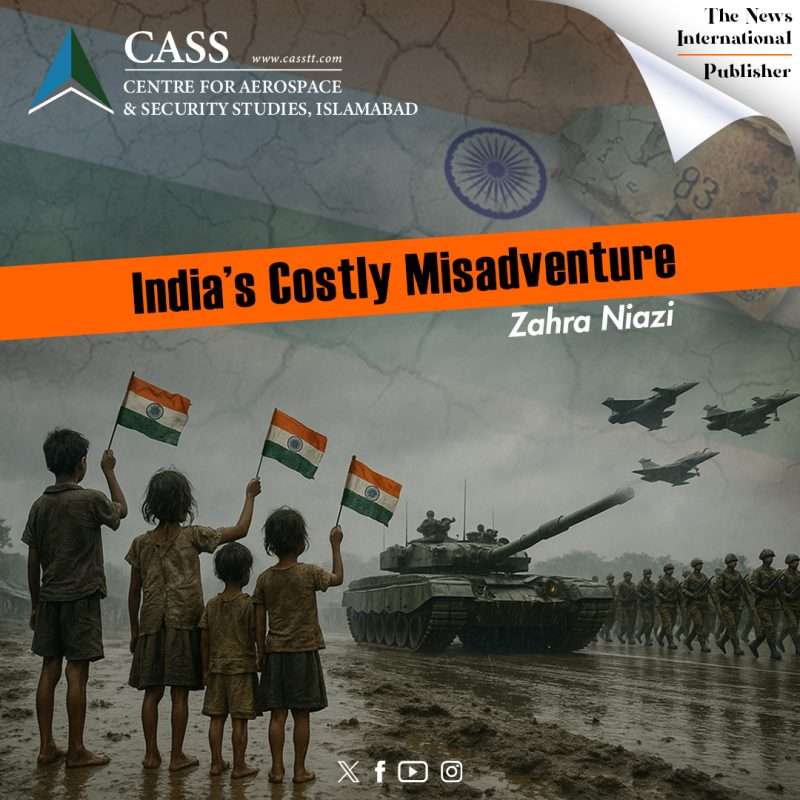
What concrete gains did New Delhi achieve by initiating military escalation against Pakistan?
Among the Indian electorate, there has been a surge in nationalistic fervour. Yet, a consideration of the broader consequences suggests that India’s misadventure was a grave strategic miscalculation. The Modi government emerged diplomatically weakened, with its so-called ‘Hindu pride’ damaged, credibility brought under scrutiny for underestimating Pakistan’s response and military might, operational weaknesses of the Indian military exposed, and, not least, billions of dollars drained from the economy.
A review of the estimated costs and losses resulting from the escalation reveals its far-reaching impact on the Indian economy. Within just two days, the Indian stock market lost an estimated USD 83 billion in market value. USD 83 billion loss exceeds India’s entire defence budget, is more than six times its education allocation, and over seven times the health budget for FY 2025-26. This may also partly explain why, anticipating a likely response from Pakistan, New Delhi proceeded with a second round of strikes inside Pakistani territory, potentially to accelerate the unfolding escalation and a subsequent international intervention for de-escalation.
The cost incurred by the Indian Air Force (IAF), due to equipment losses and operational expenses, amounted to at least USD 1 billion. Likewise, disruption in the services sectors, including logistics (airports and seaports), civil aviation, and New Delhi’s high-profile Indian Premier League (IPL) cricket tournament, resulted in losses exceeding USD 1 billion. The macroeconomic cost for the Indian economy was also significant, with more than USD 3 billion in output lost in four days and over USD 0.5 billion allocated to finance the emergency. Infrastructure repair, humanitarian relief and compensation, and cybersecurity response also inflicted direct costs, though smaller in magnitude individually.
Moreover, military and non-military conflicts involve substantial hidden costs ranging from covert operations to information warfare that are inherently difficult to quantify due to their opaque nature and lack of publicly available data.
For the wealthier demographic, these numbers may seem negligible, but for the masses in India – home to the largest number of people living in poverty, these statistics should matter. Reportedly, the Indian government is already considering increasing taxes to offset the conflict’s financial burden. The masses – many of whom barely make it through the day, have been radicalised into supporting the government’s militant nationalism, often without realising its direct and indirect impact on their socioeconomic conditions.
The costs mentioned above, too, represent only the initial impact, as the broader financial ramifications of the conflict have yet to unfold. India is already the fifth largest military spender in the world, with USD 77.4 billion allocated to defence in the FY 2025-26 budget. The Kargil War in 1999 and Operation Parakram in 2001-2002 led to a 30% increase in overall Indian defence spending between 1999 and 2005. A year after the Pulwama crisis, the Indian defence budget rose by 5.8%. But now, having faced a major military setback during Operation Sindoor, New Delhi will likely pursue a more aggressive military modernisation drive this time. Even before the Operation, India had increased its defence budget for FY 2025-26 by 9.5%. It now reportedly plans another jump of more than 7% in the defence allocation. Given this context, even a 15% increase in the defence outlay next fiscal year would be a conservative estimate. With a defence budget as enormous as India’s, a 15-20% hike also translates into a massive sum. If there isn’t a large increase in the transparent allocations, it is likely that much of the rise is embedded within concealed defence provisions.
Again, the common man will bear the major brunt as the government increases taxes or reduces non-defence expenditures to finance the defence bill. But the narrative in favour of military overdrive (to maintain an excessively aggressive posture against Pakistan) may be too strong for them to question it, let alone recognise.
Beyond defence expenditures, multinational companies might factor in war risk premiums, favouring investment in other emerging markets over India, especially given New Delhi’s repeated belligerent rhetoric. For the Indian population, this would mean job losses, and as fewer industries are established, wages could remain low, and economic prospects could shrink. Moreover, the conflict may entail other long-term costs, such as human capital loss, for instance, due to a potential increase in outward migration as people search for an environment of sustained peace.
Every Indian rupee spent on or lost (directly or indirectly) due to military conflict and sustaining an aggressive military posture is a rupee diverted from lifting over a million of its citizens out of poverty sacrificing human development at the altar of militarised ambition. Yet, as long as the masses continue to endorse or fail to question the government’s militaristic course, they may continue to suffer the social strain these policies bring in the name of national pride. It now falls upon the few remaining rational voices in India to reclaim the narrative space urging the public to critically examine and challenge the government’s belligerent, war-centric policies.
Zahra Niazi is a Research Associate at the Centre for Aerospace & Security Studies (CASS), Islamabad. The article was first published in The News International. She can be reached at: [email protected].