
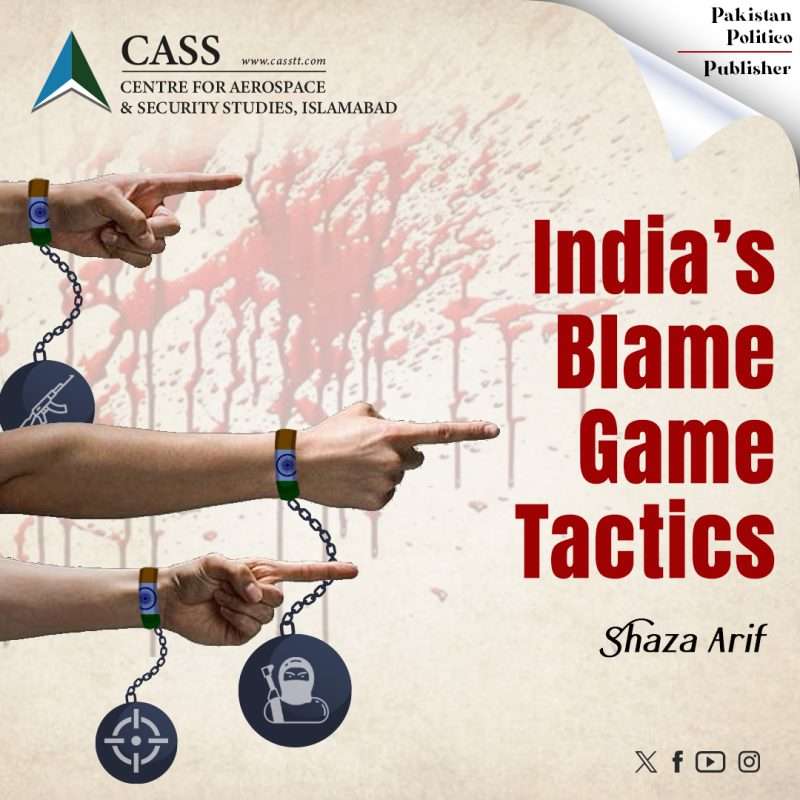
The recent attack in Pahalgam in Indian Illegally Occupied Jammu and Kashmir (IIOJ&K), on 22nd April, claiming 26 lives has triggered a predictable but worrisome sequence of events: a blame-game directed towards Pakistan followed by serious diplomatic actions. The echoes the practice of igniting cross-border tensions ahead of important events for political mileage.
As has become a familiar pattern, shortly after the attack, Indian media and policymakers were quick to direct blame towards Pakistan, a reflexive response that often precedes any substantive investigation. In the aftermath of the attack, both social and electronic media were flooded with anti-Pakistan content. The same echoes resonated from official offices shortly afterwards. This was followed India unilaterally suspending the 1960 Indus Waters Treaty (IWT), expulsion of diplomats and an order for some Pakistani visa holders to leave within 48 hours, amongst other measures.
Historically, India has exhibited a consistent pattern of attributing militant activities to Pakistan. Notable examples include Chittisinghpura massacre (2000), the Twin Peaks crisis (2001-2002), the Samjhauta Express bombing (2007), Mumbai attacks (2008), Pathankot and Uri attacks (2016), Pulwama attack (2019), and the 2023 incidents in Poonch and Rajouri. In each case, accusations against Pakistan emerged swiftly in the absence of verified evidence or conclusive findings.
Pakistan is fairly accustomed to such knee-jerk reactions. This recurring practice tends to surface before critical junctures such as Indian General/ State elections, important visits of foreign high-level officials, or to fulfil vested BJP interests. Much like the Chittisinghpura massacre, which occurred during US President Bill Clinton’s visit to India in 2000, the recent Pahalgam attack coincided with the visit of US Vice President JD Vance. The timing is unlikely to be mere coincidence. Within hours of the incident, India announced suspension of the IWT, a move it had already signaled in September 2024, suggesting a premeditated policy shift under the cover of crisis.
Such an Indian policy helps in achieving several objectives. First, it serves as a diversionary tactic, deflecting public attention from pressing domestic challenges such as economic and governance lapses, and deepening internal fault lines. Second, it provides a convenient pretext for projecting national security concerns on the international stage, thereby rationalising expanded defence acquisitions. Finally, it creates justification for the deployment of additional troops and military assets in IIOJ&K aimed at suppressing Kashmiri dissent and dismantling local resistance movements under the guise of counterterrorism. In this context, just a few days back, it was reported that the CoBRA Battalion would be deployed for counterterrorist operations under the Central Reserve Police Force (CRPF) in IIOJ&K. Such diversionary tactics also shift the attention away from Indian-state sponsored assassinations – most notably in Canada and the United States.
Pahalgam appears to follow the same old script of the past. The tactics are not new; they represent a continuation of long-standing policies, repackaged to fit contemporary contexts. These incidents resulting from calculated neglect have increased, particularly under the BJP-led government. Earlier, leaked WhatsApp conversations also revealed that the Pulwama attack was premeditated and state-managed for political gain.
The tragic number of civilian casualties in Pahalgam may enable expanded military action by India. Pulwama did not yield the results that India had hoped for. It is possible that New Delhi may execute another military misadventure, bringing the region to a state where renewed tensions may unfold. However, it is pertinent to mention that this misadventure will not cease the existing pattern – the cycle is likely to continue to resurface in one form or another in the future as it did in the past. These trends enable the reinforcement of specific national narratives to augment BJP’s political foothold.
Such incidents are also reflective of the unprofessionalism of the Indian Armed Forces and their operational effectiveness despite the substantial deployment of troops and advanced weaponry in the occupied, disputed region. Furthermore, they also negate the image of a global power that India has tried to portray on the world stage. Likewise, they demonstrate lack of maturity of the BJP government which has held the Indian media hostage to its vested agenda.
While Pakistan has previously demonstrated a willingness to engage constructively with India, it now needs to adopt a firmer position in light of increasingly aggressive Indian policies. The government ought to adopt a more proactive and strategic approach in safeguarding its national interests by highlighting India’s notorious activities such as assassination attempts globally, and in Pakistan. Important examples in this context are the Kulbhushan Jadhav episode and India’s involvement in Balochistan. Furthermore, in light of the suspension of the IWT, Pakistan should call upon the World Bank, a signatory of the IWT vis-a-vis India’s unilateral suspension of the treaty. The Foreign Office should also actively engage with states that hold influence or maintain positive relations with both India and Pakistan. This includes permanent members of the UN Security Council as well as key European powers such as Germany, France, and the United Kingdom. Equally important is the role of Middle Eastern countries like the United Arab Emirates and Saudi Arabia whose diplomatic influence in the region can be instrumental. Lastly, Pakistan ought to use its current position as a non-permanent member of the UN Security Council to amplify its diplomatic outreach to strengthen its case.
The Pahalgam incident has reignited Indo-Pak tensions, appearing less an isolated event and more a calculated manoeuvre which Pakistan must counter with strategic resolve and well-thought-out diplomacy to counter any Indian misadventure.
Shaza Arif is a Senior Research Associate at the Centre for Aerospace & Security Studies (CASS), Islamabad. The article was initially published in Pakistan Politico. She can be reached at [email protected].



