
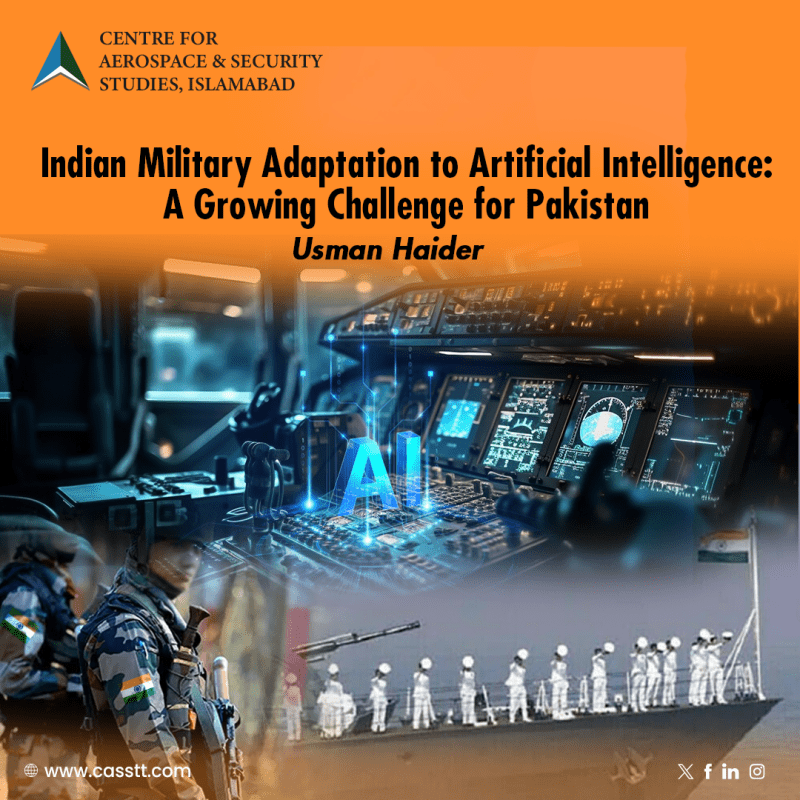
Artificial Intelligence (AI) integration with military weapons has become a compulsion for contemporary militaries to withstand modern battlefield challenges. Grasping this notion, the Indian Military is presently incorporating AI into its combat systems, thus bolstering its capability of precision launching offensive actions. Moreover, India is receiving technological assistance from the United States and France in developing and improving indigenous AI tools for the military. This dual approach raises concerns for regional stability, catalyzed by India’s expanding military capabilities that pose an emerging challenge for Pakistan.
Presently, the Indian tri-services are actively investing in and developing AI-augmented systems. The first is the Indian Air Force (IAF), which became the maiden service to establish an AI centre named ‘Unit for Digitisation Automation, AI and App Networking (UDAAN),’ and it will embed AI technologies with the IAF operational systems.
UDAAN is also utlising AI to train and assess the performance of its junior cadres while flying combat jets and during their time on simulators. The capability will enable the IAF to explore AI’s uncharted avenues and harness its true potential. Besides this, the IAF is developing an AI system to help identify enemy aircraft and also ascertain their intended course of action. These measures aim to facilitate its interceptors in launching an effective counterattack against any incoming hostile force. Moreover, the IAF has ordered 200 extended-range AI-based drone swarms from domestic defence manufacturer Veda Aeronautical.
Besides IAF, the Indian Army is also integrating its operational offensive and defensive systems with AI to augment its warfighting potential. For instance, on the defensive side, it is formulating a roadmap for the rapid mobility of its land forces and their protection from enemy attacks. Whereas on the offensive side, it is deploying AI-enabled systems to identify and neutralise threats promptly. The Indian Army has already inducted AI-driven swarm drones, capable of dodging adversary’s defences and destroy their targets with precision. It also actively employed AI in its recent military exercises to ensure its soldiers become well-acquainted with AI technology. Another example of AI employment was observed in ‘Exercise Dakshin Shakti’ where the entire ISR data was sifted by the AI for the decision-making process to assist the commander.
Meanwhile, the Indian Navy (IN) is also trying to keep pace with the changing conditions. It is adopting AI tools to keep itself ahead of its peers. In this regard, it initiated a project that aims to reduce the magnetic and acoustic signatures of its future platforms with the assistance of AI. This will allow the IN surface and submerged vessels to considerably avoid sonar detection. Moreover, it has been working on around 30 AI projects to deal with predictive maintenance, maritime situational awareness, autonomous systems, decision-making, among others.
Besides developing indigenous AI products, the Indian defence sector also receives additional backing from foreign actors. The central support comes from the US and France, with which India has signed strategic partnerships. India signed the ‘Initiative on Critical and Emerging Technologies (iCET)’ with the US last year to jointly develop an ecosystem that will further enhance the effectiveness of AI tools. Following iCET, another initiative ‘India-U.S. Defense Acceleration Ecosystem (INDUS-X)’, was launched to bolster cooperation between defence manufacturers of both countries. In this regard, Skydio, which specialises in AI-enabled drones, has joined hands with Indian drone manufacturer Aeroarc. This will augment the Indian indigenous sector’s capability to manufacture weapon systems controlled and programmed by AI.
On the other hand, in 2019, India signed a ‘Cybersecurity and Digital Technology’ accord with France, under which both aim to enhance investment in AI and promote domestic AI startups. Additionally, Paris approached New Delhi three months ago to work together in the field of AI pertaining to military projects. These initiatives are in line with the Indo-French ‘Horizon 2047’ initiative, whose primary objective is to make India a technological power by 2047.
India’s ongoing investment in the AI domain depicts that the Indian military is on its path to embracing AI and its sub-technologies. It envisions using AI in future operations to achieve dominance on the battlefield. This integration of AI will enhance the Indian military’s offensive capabilities and while making it easier to evade opponent maneuvers.
The integration effectively addresses the Indian advances in AI technology with regards to its combat systems, Pakistan must accelerate its indigenous development in the AI sector and promptly integrate the technology into its military systems. Further, Pakistan may also consider partnerships with friendly states including China and Türkiye to remain contemporary in the field of AI and maintain its balance vis à vis India.
Usman Haider is a Research Assistant at the Centre for Aerospace & Security Studies (CASS), Islamabad, Pakistan. He can be reached at [email protected].



