
According to the Drone Industry Insights Report, the global drone market size is expected to reach USD 55.8 billion by 2026 at a compound annual growth rate (CAGR) of 7.8%. With the help of Artificial Intelligence (AI), a drone’s ability to perform complex tasks increasingly improves due to consistent improvements in autonomy and collision-avoidance technologies. Hence, investments in drone industries are slated to grow exponentially making it one of the fastest growing industries. Today, a wide range of sectors are harnessing drone technology for purposes as diverse as fighting wars to cleaning oceanic wastes to forecasting weathers.
In the military sphere, drone technology is undergoing rapid proliferation as these inexpensive, combat-ready unmanned systems target the enemy with higher success rates, without jeopardising non-combat human life. This development has set into motion the debate on whether drones are just another tool of warfighting or if they have the potential to revolutionise warfare. This discourse particularly catapulted during the conflict between Azerbaijan and Armenia in 2020 over the Nagorno-Karabakh region. The 44-day war which saw Azerbaijan’s use of drones to strike formidable Armenian forces to impotence is considered the clearest example yet of how unmanned systems are transforming battlefields. More recently, the increasing relevance of unmanned aerial systems became the subject of intense debate given their extensive employment in the Russia-Ukraine War. In this war, UAVs have been employed in a wide variety of roles, including direct combat, ISR missions, guidance for artillery fire, providing air defences and jamming electronic systems on each side. The role that these systems played during this war amassed such criticality that it has come to be termed as the ‘first full-scale drone war’.
While the ever-growing importance of drones in the military sphere remains unchallenged, this technology also offers immense benefits in the civilian sector. The scientific developments are making drones easier to use unveiling their newer capabilities and applications. The lower production cost of these systems allows for their mass manufacturing with more precision, sophistication, and increased compatibility with other systems. Their application in businesses are allowing organisations to create latest operating models. Different industries employ diverse set of drone-powered solutions and functionalities resonating with their unique purposes and missions. Agriculture, search and rescue, waste management, telecommunications, journalism, entertainment, security, transportation, mapping and surveying, and running the last-mile logistical deliveries are all employing drones. As the commercial market for the drones is set to grow at 8.3%, they are proving to be one of the most promising technologies to have emerged from the Fourth Industrial Revolution.
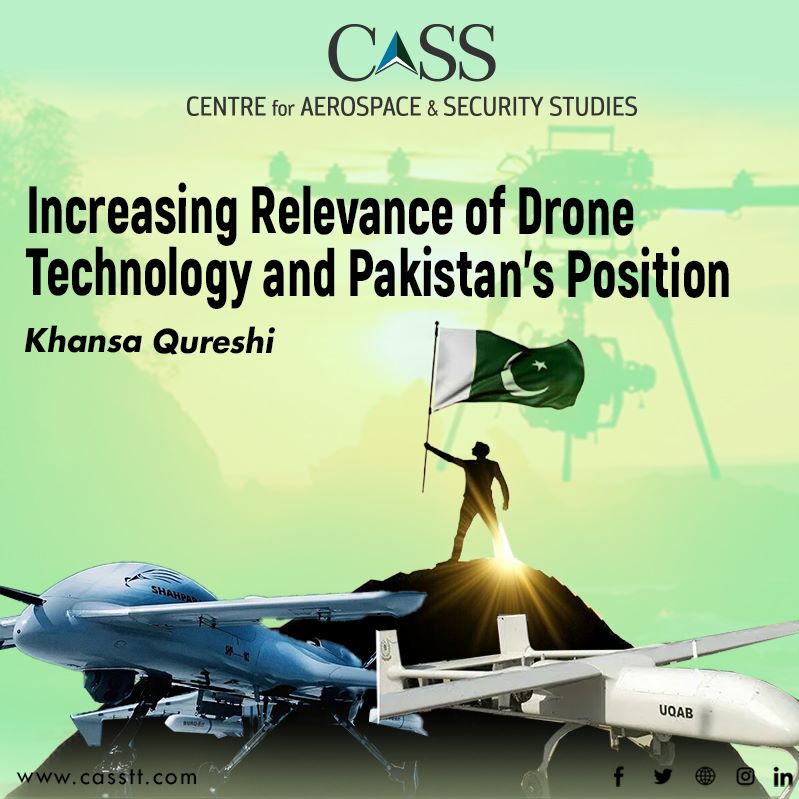
Pakistan too has been enhancing its drone capability over the years. In the military domain, particularly, it was the fourth country after the United States, United Kingdom, and Israel to deploy an armed drone in combat operations in 2015. Over the years, the country has been collaborating with China and most recently, with Turkey for the purchase of unmanned systems such as CH-4 and the much hyped Bayraktar Akinci and TB2 drones, respectively. Moreover, despite systemic and resource constraints, it seems to be on a progressive trajectory given indigenous development of these systems. So far, multiple private as well as state-owned entities have produced well-acclaimed drones for the country’s military inventory, i.e, Buraaq, Uqab, Mukhbar, Ababeel and Shahpar. Recently, the country unveiled Shahpar-II produced by Global Industrial and Defense Solutions (GIDS), a Pakistani state-owned defence conglomerate.
In Pakistan’s case, it should be noted that this technology is not only relevant in regular warfare, but it can also be effectively employed in irregular warfare such as counterinsurgency and counterterrorism operations. Lately, Pakistani forces have been suffering casualties during border fencing, and patrolling, as well as in counterterrorism operations etc. Therefore, remotely controlled unmanned systems can be employed for monitoring the hostile and rugged areas otherwise considered difficult to secure. Moreover, drone technology in civilian sector such as agriculture, construction, disaster management and urban security etc. will help Pakistan reap great benefits.
According to experts, having ‘the best technology and the best minds to manufacture world-class drones indigenously,’ Pakistan also possesses huge export potential in this market. The proper oversight of these systems’ local production can enable the country to capture a USD 600-700 million of its international market share. However, so far, the country has remained unable to fully exploit the benefits of this technology due to several. Issues such as irregularity of export and import policies and the gruesome NOC-acquiring process, failure in formalising proper licensing and authorisation regimes and defining proper laws to regulate this important sector riddle this industry.
Although, the government approved the establishment of the Civil Drone Authority in 2021 mandated with addressing all these lacunae, it is nowhere to be seen so far. Neither does this Authority find any mention on Pakistan Civil Aviation Authority’s website as far as it is navigable. However, this example adequately demonstrates how businesses are conducted in the country, reflecting the signature bureaucratic processes riddled with inefficiency, inaction, inconsideration, and insensitivity towards critical matters.
While security concerns are cited as a reason behind such inefficiencies, it must be realised that we cannot stigmatise futuristic technologies like drones, 3D printers, 5G, and many others in the name of security, resultantly failing to exploit the benefits that they have to offer, suffer financially, and then start wondering why we cannot progress like the rest of the world.
Khansa Qureshi is a Research Assistant at the Centre for Aerospace & Security Studies (CASS), Islamabad, Pakistan. She can be reached at [email protected].



