
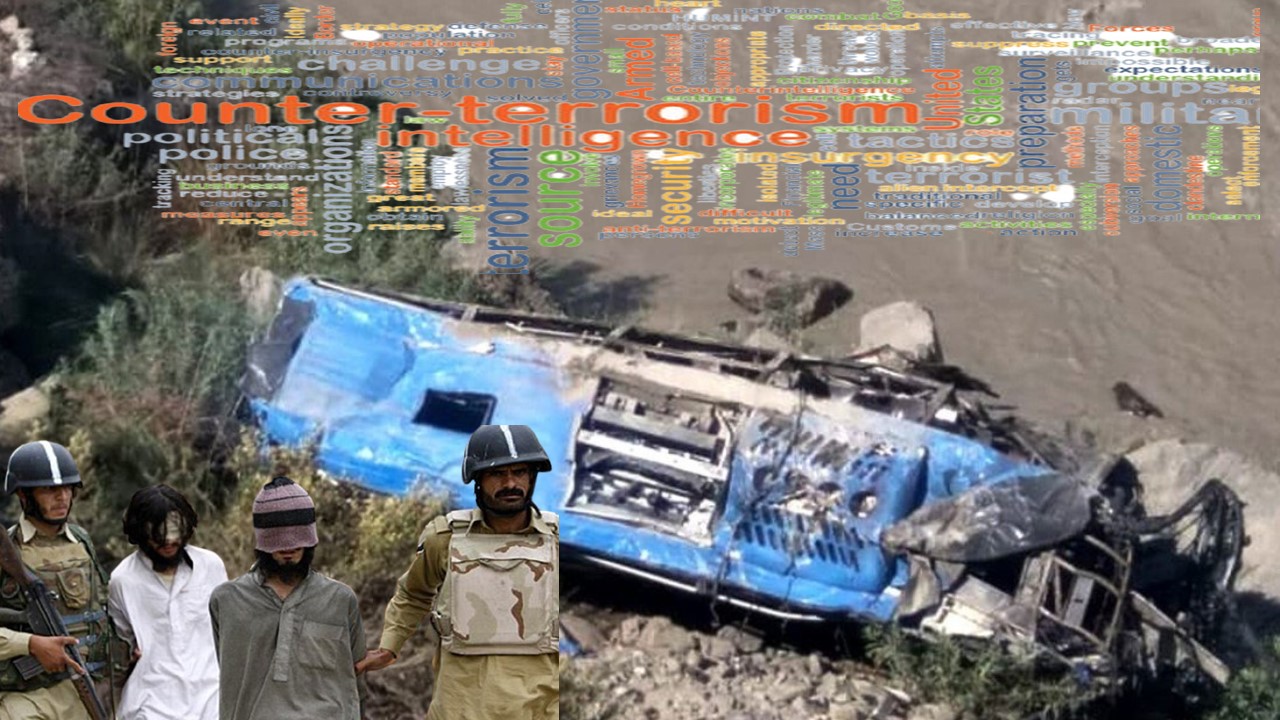
It pains me to write that terrorists have succeeded in their planning, execution, and accomplishment of the stated objectives on a number of occasions. They appeared organized, virtuously committed (even for a wrong cause), and perhaps, better trained. This is not a good sign as it is the sole responsibility of any state to provide safety and security to its citizens and residents. State has to have monopoly of violence over the Non-State Actor (NSA), and having necessary wherewithal the State must not be surprised. State must not fail in preparation and anticipation of NSAs future course of action, particularly in evolving environment which is known for its uncertainty, complexity, and above all its continuity with rapidity.
Pakistan is perhaps the only country which could claim victory against a 15-year long hybrid war imposed upon it by India, as revealed in the Indian Chronicles by European watchdog DisInfoLab. India’s terror networks run by one of its operator, Indian Navy (IN) Commander Kulbhushan Jadhev, was broken and he was captured in March 2016, near the Iranian border and exposed in the International Court of Justice (ICJ).
The terror seems to be returning to Pakistan due to evolving regional scenario, particularly due to potential post-US Afghanistan turmoil. On daily basis, Pakistan is sacrificing its young officers and soldiers in the line of their duties in the most volatile areas bordering Afghanistan and India. The unfortunate occurrence of Dasu bus explosion in which a number of casualties have taken place including ‘Chinese Engineers and Technicians’ is indicative of enemy’s intent of causing harm to China-Pakistan relations in general and CPEC in particular, although Dasu dam project is not financed by the CPEC. Keeping in view the sensitivity of the relationship with China and importance of the project, better preparation, anticipation, and understanding about the evolving environment would help minimize the probabilities of such occurrences in future.
While one must draw pertinent lessons from adverse incidents, we must also move on to avoid the recurrence of such unfortunate and extremely damaging outcomes. Therefore, following may be considered to strengthen existing counter-Terrorism (CT) strategies to deal with evolving complexities, complications, and uncertainties.
- Aim to disrupt NSAs moves through pro-active, and preventive measures.
- Anticipate their next move by exploiting available Artificial Intelligence (AI) tools.
- Identify vulnerable points and personnel and strengthen their security, not by increasing numbers but by technological means.
- Carry out speedy trials of the apprehended terrorists so that some sanctity of deterrence prevails.
- Concentrate more on the sympathizers and facilitators of the extremist elements in the society, and expose them without any doctrinal necessities.
- Watch out for the hybrid mannerism of the terrorists: they do not repeat the place of attack, type of the target, methodology adopted to inflict pain, and any particular model of execution.
- Have your own definition of terrorism even if key global institutions have failed to adopt a universal definition.
- Ensure implementation of National Action Plan (NAP) which was developed after thorough deliberations and consensus.
- Aim to disrupt NSAs moves through pro-active, and preventive measures.
- Anticipate their next move by exploiting available Artificial Intelligence (AI) tools.
- Identify vulnerable points and personnel and strengthen their security, not by increasing numbers but by technological means.
- Carry out speedy trials of the apprehended terrorists so that some sanctity of deterrence prevails.
- Concentrate more on the sympathizers and facilitators of the extremist elements in the society, and expose them without any doctrinal necessities.
- Watch out for the hybrid mannerism of the terrorists: they do not repeat the place of attack, type of the target, methodology adopted to inflict pain, and any particular model of execution.
- Have your own definition of terrorism even if key global institutions have failed to adopt a universal definition.
- Ensure implementation of National Action Plan (NAP) which was developed after thorough deliberations and consensus.
Also, let me propose a working definition of terrorism, which may be debated at the appropriate level, so that a consensus is reached before its adoption.
“A person or persons regardless of gender and politico-religious affiliation, caste or creed, individually or as part of a group, organization, or institution, wilfully causes harm: physically, emotionally, economically, psychologically, environmentally, regardless of the extent of injury or loss, to a peaceful citizen or resident of a state, would fall in the category of having committed an act of terrorism. However, a court of law after due legal process would declare him/her/they as terrorists, liable for punishment according to the laws of the state.”
These isolated incidents of terrorism, though with rising frequency, must not be allowed to demoralize our Law Enforcement Agencies (LEAs) who have laid sacrifices to bring normalcy in our lives. State must not give in and re-double the effort to re-attain the level of psychological ascendency over these NSAs, who are certainly playing in the hands of the enemies of Pakistan.
On part of the government, the efforts must be made to reduce inequality and injustice from the society as to de-incentivize our youth from falling into hands of the terror outfits. I urge the people of Pakistan to remain steadfast behind the State and the LEAs led by Armed Forces of Pakistan at this time when the defeated superpower is leaving the region in turmoil and unfortunately it is Pakistan which will have to face the brunt. But, I am confident that our people have done it before and God Willing do it again.
Dr Zia Ul Haque Shamsi is the author of the book ‘Nuclear Deterrence and Conflict Management between India and Pakistan.’ This article was first published in Daily Times. He is presently working as Director, Centre for Aerospace & Security Studies (CASS).



