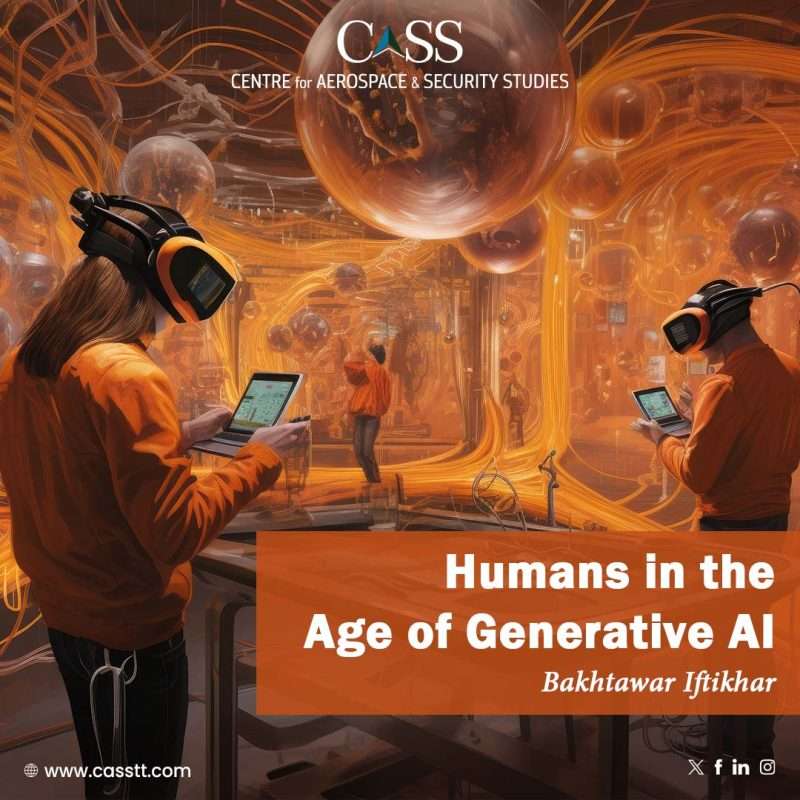
As the fourth Industrial Revolution unfolds, Artificial Intelligence – devouring computational power and big data – is fuelling an ‘AI Spring.’ This article outlines the trends in Generative AI and explores the need to invest in human capital through upskilling/reskilling programmes amid fears of AI replacing humans. It attempts to reframe the conversation and larger vision in a positive light such that primacy remains with humans.
The ‘AI Winters’ around the 1980s appear now to be a distant memory, when the field suffered a lack of interest and funding by investors. Evidently the tide has turned: In 2023, the global generative AI market was valued at USD 43.87 billion and may explode to USD 967.65 billion by 2032. In the next ten years, its value is estimated to breach about USD 1.3 trillion.
The direct outcome of this attention and funding is going to be an improved and more impressive AI. One may expect more advancement in the AI industry as already evident by a surge in Generative AI tools and text-to-anything models. Companies continue to release improved AI tools (text-to-video, text-to-3D etc.) which are revolutionising everything from filmmaking to product design and scientific discovery.
While some view these developments as hallmarks of innovation, others fear a negative disruption brought on by this billion-dollar industry. A common underlying theme is that ‘Humans’ may become irrelevant; their creativity, tarnished; and their skillsets, obsolete. Though there is no consensus on how exactly would AI impact the future of work, Sam Altman – the CEO of OpenAI – holds that AI is most likely going to help automate certain tasks for now before it advances or becomes economically viable enough to replace entire jobs. By 2027, 43% of work tasks will be automated. Progressing into the future, the rate of AI adoption will also most likely increase due to the wide variety of AI products to choose from, costs coming down, coupled with the appeal of buzzwords.
Accordingly, there are ardent calls to adapt to the disruption in the short-run via much-needed reskilling/upskilling programmes. This need is even greater in developing states like Pakistan, where there is already mismatch between graduates’ skills and the labour market. In an old video, the current finance minister can be seen discussing the proof of concept and vision for a technology-driven reskilling revolution, tailored to meet the specific sectors identified as priorities by the state.
However, in the larger context – especially in the discourse surrounding creativity – to think of humans as easily replaceable is to underestimate their value and to deny them agency (though some have more agency/power than others). Humans have inherent value no matter how impressive the machines.
As humans are the primary arbiters of what is considered ‘valuable,’ consumer behaviour will determine the extent to which technological interventions and AI-generated content are acceptable. Consider Christopher Nolan’s Oppenheimer, where the renowned Director’s emphasis on a ‘real’ feel was so great that the movie was shot at real locations and without using digital effects/Computer Generated Imagery (CGI). Thus, even if filmmakers use it to overcome some limitations, they would not use ‘technology to just spin out stuff without people involved,’ as per Shy Kids animation director Patrick Cederberg.
Another example is from when the online platform Medium asked for feedback from audience regarding their views on AI-generated writing, and one particular comment encapsulated a common sentiment – ‘I’m not interested in my paid subscription subsidizing AI. I signed up to pay humans their worth for doing real work.’This indicates that ‘AI may feed our thirst for facts but not for meaning or mystery.’ Moreover, in the words of the renowned AI Expert Stuart Russell: the present world is a product of ‘trillion person-years of teaching and learning and unbroken chain that goes back tens of thousands of generations so if we surrender the management of our civilisation to machines, we lose the incentive to understand it ourselves, or to pass that on as intergenerational wisdom.’
Therefore, humans must remain central to the conversation – which should be framed as humans and machines, instead of humans vs. machines – the primacy given to humans nonetheless. This is not a call to hinder technological advancement, but to invest in human capital even more so as to maintain control. This is even more crucial, for there is a need for human specialists in a variety of fields who are exceptionally good at their craft and have adequate training to understand AI tools, to guide and monitor their effectiveness, verify tall claims and discern how much of the AI hype is exaggeration. It is also these humans who should be in charge of handling any novel and high-stake situations that demand transparency and accountability.
Thus, in conclusion, while technical upskilling/reskilling is necessary to adapt to the changing trends, the long-term future of humanity may best be secured by prioritising the true skills of the future – critical thinking, problem solving, and emotional intelligence which are essentially human attributes that ‘served our ancestors in the prehistoric world, and will enable us to navigate the future with confidence and resilience.’
Bakhtawar Iftikhar is a Research Assistant at the Centre for Aerospace & Security Studies (CASS), Islamabad, Pakistan. She can be reached at [email protected].