
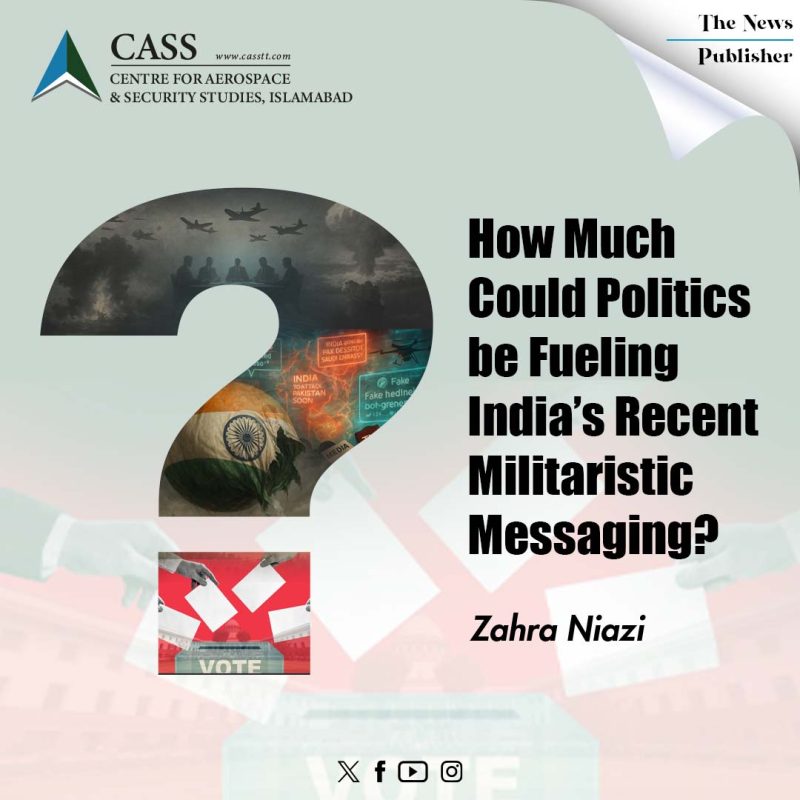
Early October witnessed an intensification of India’s anti-Pakistan discourse and military signalling, initiated by the Defence Minister’s address and reinforced by subsequent speeches from the chiefs of the Army and Air Force.
Central to these addresses were allegations of Pakistan’s involvement in state-sponsored terrorism, portrayal of Operation Sindoor as a swift and successful demonstration of India’s military capability, which dealt a severe blow to Pakistan, warnings about not showing any restraint in a future conflict, and readiness to escalate. The choice of terminology was exceedingly jingoistic, going so far as to invoke erasing Pakistan from history and geography.
Traditionally, Indian military officials have remained measured in their tone, leaving hyperbolic messaging to politicians. A departure from this trend, with service chiefs delivering politically-charged speeches hours after a civilian official’s address along the same lines, suggests that this rhetorical campaign may have been driven as much by domestic politics as by an effort to restore national pride.
In the aftermath of Operation Sindoor, internationally, India’s narrative based on unsubstantiated victory claims collapsed under its own weight, as the facts spoke for themselves. While New Delhi was pushing forward its version of events, authoritative international media platforms were already stating the hard facts. In early August, the Indian Air Chief appeared for the first time to claim that India had shot down five Pakistani fighter jets and one other military aircraft, a claim that failed to gain any international credibility.
It would be naive to assume that, in this age of new media, the Indian population would have remained oblivious to these reports. In this context, the recent counter-messaging delivered by multiple figures of authority perhaps became a political necessity for the Bharatiya Janata Party (BJP) to appease the domestic audience, long accustomed to hearing of India’s military prowess.
However, the timing of the messaging – almost a month before the legislative assembly elections in Bihar – appears to be a calculated move aimed at maximising political gains.
While Bihar is just one state, analysts believe its outcome could trigger a domino effect. A defeat for the BJP in this first election after Operation Sindoor could reshape narratives and alliances leading into 2029. Although the state’s sharp caste divisions and local issues play the dominant role in its elections, the political dynamics on the ground suggest that the BJP may be looking to bet on anything that can provide even a moderate push to its political rating there. This also explains why Modi, after the Pahalgam incident, travelled specifically to Bihar, rather than any other Indian state, to deliver an unusual threat in English to avenge the killings of Pahalgam.
For context, Bihar is the only state in North India where the BJP heavily depends on alliances to form a government. However, the coalition’s leader now faces significant anti-incumbency sentiments about his fitness and age, as he seeks a 10th term as Chief Minister, while a new party, led by a former election planner, has also entered the electoral battle. A recent survey revealed that the main opposition leader was the most preferred choice for the next chief minister, followed by the new political entrant.
The reliance on anti-Pakistan rhetoric gains added importance as surveys show a decline in the ‘long-term support’ for Modi. Against this backdrop, such narratives offer a means to bolster support and deflect attention from the pressing challenges faced by the country.
The tragedy of tying political stakes to jingoism is that leaders may ultimately feel pressured to act on rhetoric, especially when political necessities become most pressing. The emphasis on cross-border terrorism in the recent addresses or accusations against Pakistan of expanding military infrastructure in the Sir Creek area indicates that New Delhi may already be attempting to lay the groundwork for a future misadventure. The Indian Defence Minister, in his address, made an unsubstantiated claim that Pakistan was expanding military infrastructure in the Sir Creek area, stating that any ‘misadventure in the Sir Creek Sector will invite a decisive response,’ hinting at the desire to expand potential flashpoints for confrontation.
In the end, the responsibility lies with the Indian electorate to recognise that nationalism is not synonymous with jingoism, and that the country’s military adventurism is not in their best interest. Even if a small fraction of India’s over USD 77 billion military budget were invested in health and education, the fortunes of millions could have been transformed. It now falls upon the civil society and the few thoughtful voices that remain to help the Indian electorate realise the cost of backing the government’s militaristic course, which encourages leaders to weave jingoism into their political calculus. While change may not happen overnight, it can begin from the grassroots.
Pakistan has always stood ready for mutual dialogue and peace, provided these are genuinely reciprocated. The writer is a Research Associate at the Centre for Aerospace & Security Studies (CASS), Islamabad. The article was first published in The News International. She can be reached at: [email protected].



