After its independence in 1947, India promoted itself as the largest democracy and a secular state in the world. However, since then the deep-rooted violence, extremism and fascism have dominated Indian politics. Madhav Sadashiv Golwalkar, one of the founders of the Rashtriya Swayamsevak Sangh (RSS) had changed the very nature of Indian polity and its statecraft. However, hatred against minorities in general and Muslims in particular was engraved in Indian politics even before partition of the subcontinent. Golwalkar categorically declared Muslims, Christians and Communists a major internal threat to India in his many writings. He also gave the concept of ‘Hindu Rashtra’ in which all laws of the land, governance and economy need to be based on the Hindu way of life.
The RSS indoctrinated elements of violence and extremism dominated Indian society to an extent that the father of the Nation Mahatma Gandhi was brutally assassinated in January 1948 by Nathuram Godse—an RSS associated extremist. Gandhi, being a proponent of peaceful co-existence of communities, was concerned about the basic rights of minorities in India. His assassination was a clear indication that the extremist ideology of RSS was taking strong root in the socio-political fabric of society. Even though RSS was banned in 1948, it led to the formation of Akhil Bharatiya Jana Sangh in 1951, an offshoot of RSS. Later, it was transformed as a mainstream political party, Bharatiya Janata Party (BJP) in 1981 and emerged as a strong political force and gradually grabbed considerable space in Indian politics. Over decades, BJP evolved as an extreme right wing political force. Even though Atal Bihari Vajpayee was a moderate face of the BJP, however, the fact remains that the party strengthened itself as a violent extremist Hindu nationalist force under his rule. Now, under the Narendra Modi’s leadership, the process of ‘hindutvatisation’ is being implemented by BJP as evident from its decisions related to Citizenship (Amendment) Act, abrogation of articles 370 and 35A, changing demography of IIOJK, controversial decision of building a temple in place of the historic Babri Mosque, Delhi riots and farmers’ protests.
BJP would likely continue its legacy of making India a ‘Hindu Rashtra’ in the future as well. For this purpose, it is now investing in Yogi Adityanath as Modi’s successor by making him the appalling face of BJP. He is currently Chief Minister of Uttar Pradesh (UP), the largest state in India in terms of electoral representation in the Lok Sabha (the Indian parliament). He came into power on the basis of anti-Muslim slogans. His hatred towards Muslims is openly shared in his public speeches. For example, he pledged to change the names of ‘Ahmedabad’ city of UP state to ‘Karnavati’ and ‘Hyderabad’ city of Telangna state to ‘Bhagyanagar’ — the two Muslim dominated historic cities. This implies that if Adityanath comes into power at the national level, the drive of demographic changes started in Jammu and Kashmir by the Modi government will be spearheaded by him and he will further pervert the cultural, religious and demographic strength of Muslims. This will ultimately pave the way for the BJP to achieve its long-standing aim of turning India into a totalitarian ‘Hindu Rashtra.’
During the current election campaign in UP, Adityanath also promised to ban cow slaughter in India. The statement depicts his poisonous plan to drag religion into politics and is adding fuel to fire on existing anti-Muslim violent sentiments in India. Likewise, his remarks about the ongoing Karnataka hijab row are of serious concern for the Muslim community. He claimed that no woman wears hijab by choice, such sweeping statements is indicative of his rancorousness towards Muslims of India.
To conclude, if Yogi Adityanath succeeds Prime Minister Modi, the RSS led ideology of the BJP and its sinister plans based on violence, hatred and antagonism towards Muslims will further lead the already fragile Indian society towards fundamentalism. This will ultimately pose a major threat to regional peace and stability, if rogue ideologues like Adityanath are given a chance to rule the so-called largest democracy of the world.
Asad Ullah Khan is a Senior Researcher at Centre for Aerospace & Security Studies (CASS), Islamabad, Pakistan. He can be reached at [email protected]
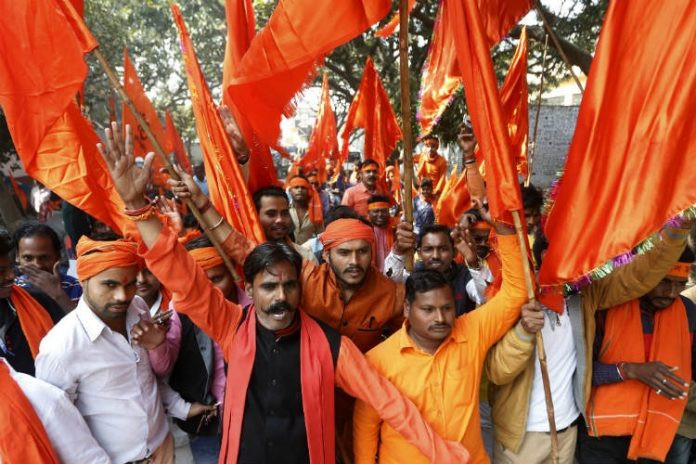
Image Source:Express Tribune. “Violence in Delhi rising as Modi’s party opposes construction of Hajj House” The Express Tribune, 27 Aug 2021. https://tribune.com.pk/story/2317380/violence-in-delhi-rising-as-modis-party-opposes-construction-of-hajj-house