
The two-day Global Strategic Threat and Response (GSTAR) 2022 on ‘Evolving Global Order: Challenges and opportunities’ was organised by the Centre for Aerospace & Security Studies from 19-20 October 2022 in Islamabad, Pakistan. Dr Arif Alvi, President Islamic Republic of Pakistan inaugurated the international conference. He congratulated CASS for organising the second edition of GSTAR and commended the Pakistan Air Force for always being at the cutting edge and producing heroes in the history of Pakistan. The Welcome Address was delivered by Chief of the Air Staff, Air Chief Marshal Zaheer Ahmad Babar Sidhu, NI (M), Pakistan Air Force. On this occasion, the Air Chief announced the formal inauguration of the flagship National Aerospace Science and Technology Park (NASTP). The initiative is aimed at establishing technology parks and Aviation Design and Innovation Center (ADIC) in four major cities of Pakistan (Karachi, Lahore, Rawalpindi & Kamra) to give impetus to the process of indigenisation and technology drive as well as promote industry-academia linkages for innovation-led economic growth of the country. The Concluding Session was presided by Air Marshal Muhammad Zahid Mahmood, HI(M), Vice Chief of the Air Staff, Pakistan Air Force. Air Marshal Farhat Hussain Khan, HI(M), SBt, President, Centre for Aerospace & Security Studies, Islamabad, Pakistan, delivered the Vote of Thanks. 16 papers were presented at this year’s GSTAR by leading international and national scholars representing seven different countries including Canada, China, Germany, Latvia, Pakistan, United Kingdom, and United States of America. GSTAR 2022 was attended by nearly 500 delegates each day. More than 110 print and electronic media covered the full two-day event.
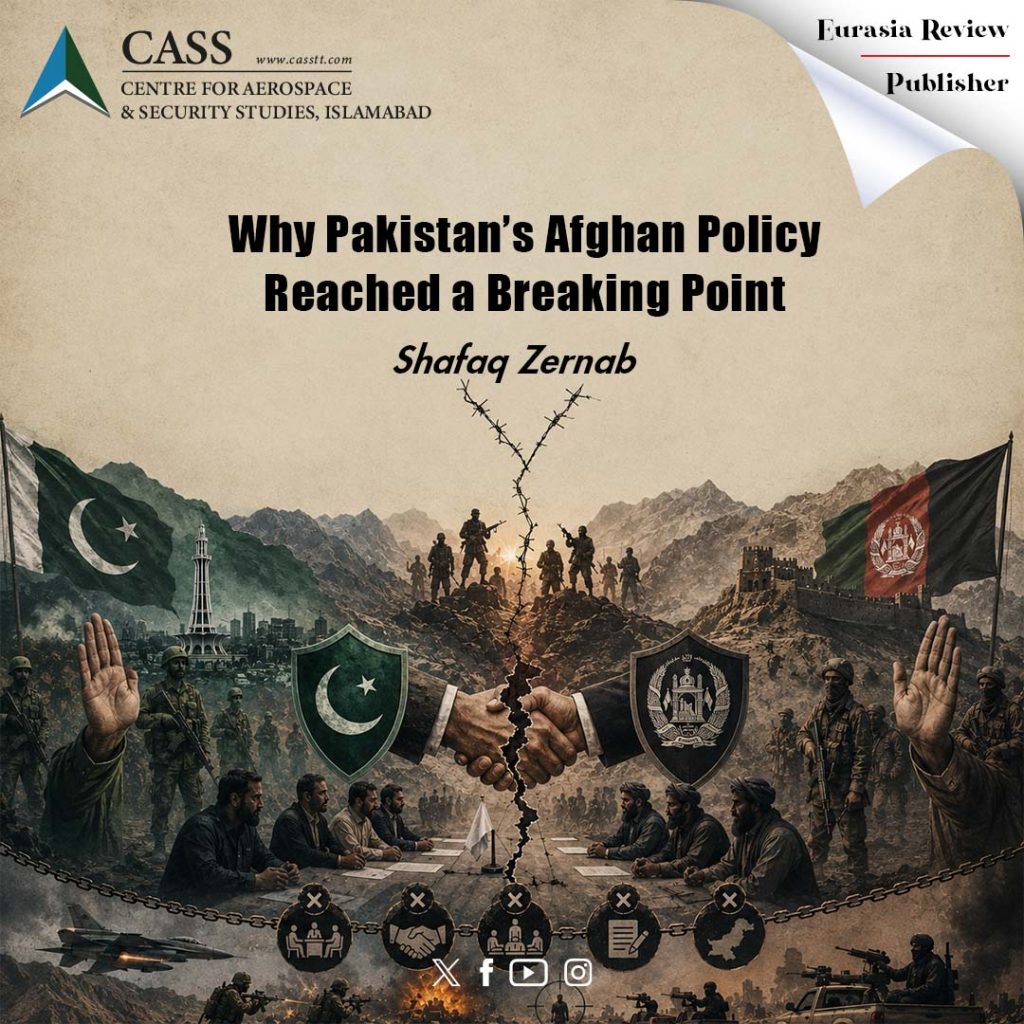
Why Pakistan’s Afghan Policy Reached a Breaking Point
The ongoing war between Pakistan and Afghanistan is the result of a gradually worsening security situation along the Durand Line rather than a sudden strategic shift. The core issue was not the absence of dialogue, but its inability to deliver binding results to the foremost security concern of for Pakistan: the use of Afghan territory by militant groups to attack Pakistan. When Pakistan in response switched to cross-border strikes in February 2026, the state had already gone through several years of attempted accommodation without securing any meaningful restraint from the Tehreek-e-Taliban Pakistan (TTP) by Kabul.


The West: The History of an Idea
The world is witnessing the collapse of the Western order, if not the emergence of an alternative one. The idea of ‘West’ as against the rest is still at the root of contemporary understanding of world politics. Georgios Varouxakis, a remarkable voice on Modernity and Nationalism, has provided the historical origins and modern connotations attached with the idea of ‘West’. In his book ‘The West: The History of an Idea’, Varouxakis has argued that the West is not an eternal entity, rather it is a modern socio-political construct that emerged in the political philosophy of the early 19th century and evolved with the passage of time. The book provides an in-depth historical analysis of the idea to determine the roots of its modern interpretation.
