
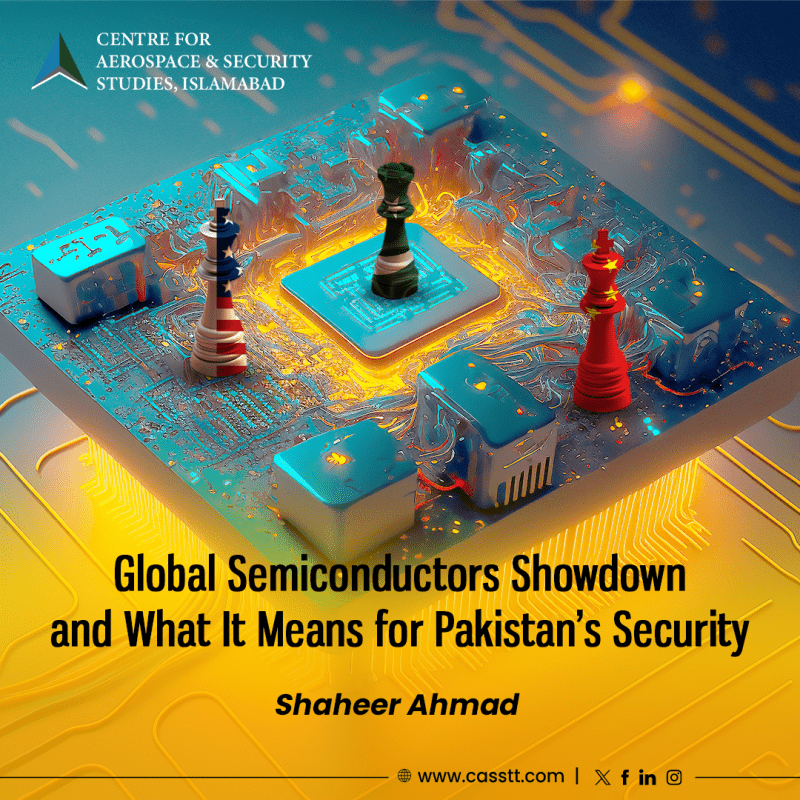
In the escalating theatre of great power competition, semiconductors have emerged as indispensable actors. These tiny components, often smaller than a fingernail, are the backbone of a wide array of applications, from communications and aerospace to automobiles and advanced weapon systems. Their omnipresence underscores their role as catalysts of technological and economic advancement, positioning them at the core of contemporary national security strategies and policy calculus.
Amidst the COVID-19 Pandemic, the global supply chain of semiconductors faced widespread disruptions, affecting 169 sectors, which resulted in price hikes and deferred orders. It was this fear of supply chain disturbance and the subsequent geopolitical tussle, specifically between the United States (US) and China, that brought semiconductors into the global spotlight. Governments are realising the significance of semiconductors as a bargaining chip and source of competitive edge in the global technological landscape. Now more than ever, emerging economies are determined to reduce their external dependency and achieve self-sufficiency in developing and manufacturing semiconductors.
China, the world’s largest consumer of semiconductors, is pushing to challenge the US’ stature as a leading technological hub. Through initiatives like ‘Made in China,’ it aims to reduce its external dependence by enhancing its domestic semiconductor production. It has taken a bold step to enhance semiconductor manufacturing capabilities by pumping USD 47.5 billion into its ‘National Integrated Circuit Industry Fund’. The investment is distributed along the targeted areas of semiconductor production and advanced manufacturing capabilities. This directed effort will help China establish a thriving ecosystem, which will strengthen indigenous production capacity and overcome global supply challenges.
Conversely, the US, which has also realised its susceptibility to global supply chain disruption, is pursuing a de-risking approach to maintain its technological resilience. Despite its prominence in R&D, the US faces formidable challenges in semiconductor manufacturing. In this regard, it is playing out the ‘CHIPS Act’ to tighten export controls on cutting-edge technologies and hinder China’s military modernisation. It has also been working with East Asian actors, including Taiwan, South Korea, and Japan, under the ‘Chip 4’ alliance. Moreover, in 2023, the US inked partnership plans with India on semiconductor supply chain resiliency and diversification, with the Micron company pledging USD 2.75 billion to establish a semiconductor facility in the country. Incidentally, both states are already engaged in the ‘initiative on Critical and Emerging Technology’ (iCET) since 2022.
This global technological bifurcation and growing Indo-US cooperation has formidable security implications for Pakistan. At the moment, domestic semiconductor industry remains underdeveloped due to economic uncertainty, lack of digital infrastructure and slow policy implementation. While a comprehensive ‘National Semiconductor Plan’, put together by industry experts and academia in 2022, exists on paper, it was only recently that the government indicated interest in developing a semiconductor/chip design industry. The latter would need an estimated investment of USD 6-7 billion as well as skilled human resources. Global technological tensions, bloc politics and slogans of ‘chip nationalism’ are also likely to make this a difficult journey for Pakistan.
Difficult but not impossible! After all, Pakistan was the first country in Asia to produce the base material for semiconductors and has the potential to generate USD 4 billion annually in this market. According to one industry expert, what the country needs is a ‘fast-track approach’. For one thing, Pakistan must diversify its strategic partnerships with countries like China, Japan, the Netherlands and South Korea who are leading the board in this domain as well as partnerships with private corporations like Intel, Nvidia and Huawai etc. While semiconductor development requires significant financial resources, Pakistan could also consider focusing on the less expensive testing and packaging phases. These steps could enable development of a nascent industrial base.
Semiconductors are the new battleground in the global power landscape, where India in South Asia, helped by the US, is aggressively pursuing a position as a formidable player in this critical technology. India’s advancements could serve as a foundation for more assertive posturing, posing potential threats to Pakistan’s national security and technological sovereignty. In response, Pakistan ought to strive toward establishing a foothold in the semiconductor market. Maintaining technological parity and safeguarding national security will be crucial as the region confronts this new era of technological competition.
Shaheer Ahmad is a Research Assistant at the Centre for Aerospace & Security Studies (CASS), Islamabad, Pakistan. He can be reached at [email protected]



