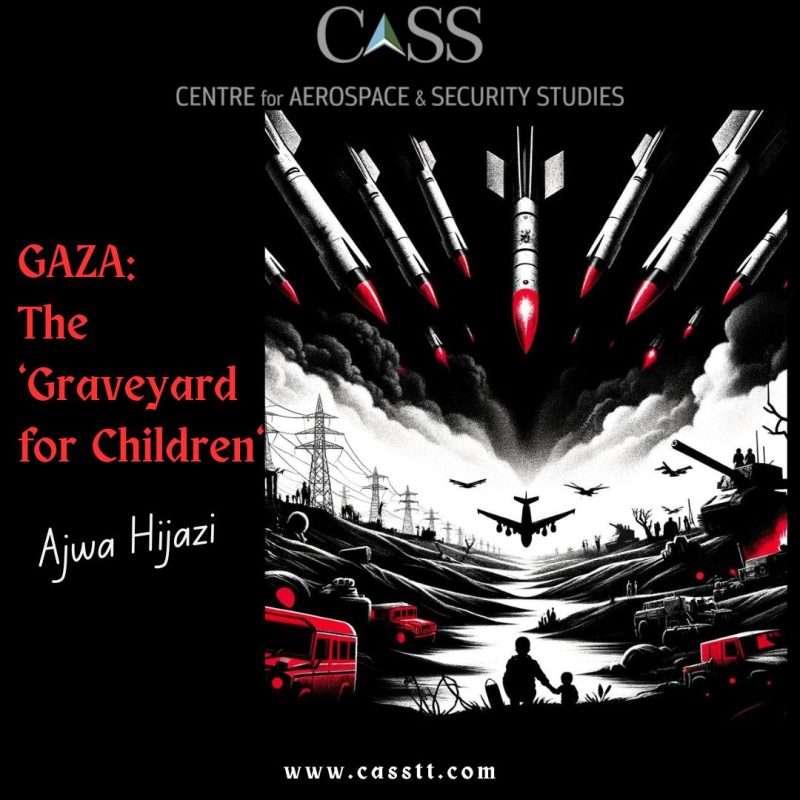
In response to Hamas’s attack on 7th October, 2023, Israel has unleashed a fatal onslaught on the Gaza Strip. In these brutal attacks, Israel is not even sparing innocent children and infants. According to Save the Children, in the last 100 days or so, more than 10,000 children have been killed due to Israeli airstrikes and ground operations. The number of children killed by Israel in merely the first three weeks crossed the ‘annual global death toll of children killed in conflict zones in 2019’. Thousands of children have been missing under the rubble of the destroyed buildings. The past few months have brought forth a bone-chilling reality that children in Gaza are unsafe even in hospitals, safe zones, shelters, etc.; as Israeli airstrikes have bombarded these facilities, too. Owing to Israel’s murderous spree against children, the Executive Director of the United Nations Children’s Fund (UNICEF) stated that Gaza had become the ‘most dangerous place in the world to be alive as a child,’ and the United Nations termed it ‘the graveyard for children’.
UNICEF has stated that the children of Gaza are facing a ‘triple threat’ – Conflict, Malnutrition, and Disease. The children who are somehow miraculously surviving the aerial strikes or gunshots are suffering from inhumane conditions due to a lack of medical facilities and humanitarian aid. There has been a record increase of diarrhea cases among children (under the age of 5) from 48,000 to 71,000 cases in a week (starting 17th December). Regarding nutrition needs, 90% of children under the age of 2 only consume two or fewer food groups, which is detrimental to their health. These glaring figures indicate the horrendous living conditions that have encapsulated the lives of innocent children sitting on the brink of death 24/7.
The cycle of life does not stop in any situation. In the past (approximately) 100 days of Israel’s genocidal assault on Gaza, Palestinian mothers have given birth to 20,000 babies. Unfortunately, these babies face risk to their lives due to several factors. Owing to internal displacement, newborns are kept in cold tents – many unwashed for even a month due to scarcity of water. Moreover, mothers are unable to breastfeed their infants due to a lack of nutrition intake.
Another distressing aspect is the lasting impact of this situation on the mental health of the children growing up in Gaza. Children are showing signs of Post-Traumatic Stress Disorder (PTSD) after losing their parents and family members and also because of being buried alive under the rubble of bombarded buildings for days.
According to Ka Lok Yip, Assistant Professor of Law at Hamad bin Khalifa University, ‘The main source of protection for children in the armed conflict is derived from their status as ‘civilians,’ assuming that they are not taking part in the hostilities’. However, Israel has violated several articles and protocols of the Geneva Convention that protect children during war. In its apparent quest to eliminate Palestinians from Gaza, it is blatantly targeting children, the most vulnerable members of society.
The ongoing bombardment impacting civilians, including the deeply shocking casualties among children, has led to a relatively firmer stance from the West towards Netanyahu, yet the response remains measured despite the gravity of the situation. In fact, in some Western capitals, the word ‘ceasefire’ (comprehensive and long-term suspension of fighting) largely remains taboo, and instead many Western leaders are merely urging Israel for a ‘humanitarian pause’ (a temporary cessation of hostilities).
In the same vein, text of the recent verdict of the International Court of Justice (ICJ) on the ‘Application of the Convention on the Prevention and Punishment of the Crime of Genocide in the Gaza Strip (South Africa v. Israel)’ did not contain the word ‘ceasefire.’ However, ICJ found it ‘plausible’ that Israel is violating the Genocide Convention, and 15 out of 17 judges on the panel only ordered Israel to take emergency measures to stop the act of genocide. While this decision offers a momentary sigh of relief amid the prevailing situation, the likelihood of Israel adhering to it seems grim, considering its persistent rogue behaviour.
Israel’s war hysteria in Gaza is getting out of bounds. The horrifying imagery of dead and injured children, amidst widespread human devastation, should shake our collective human conscience to the core. It is tragic that in the 21st Century, the world is a witness to destruction of such magnitude unfolding in Gaza. The uninterrupted flow of humanitarian aid is vital for meeting the urgent needs of the Palestinian people and their children. As John Donne famously wrote, ‘No man is an island,’ reminding us of our shared humanity and responsibility. To truly safeguard their future, the world must unite with a singular focus: pressuring Israel to declare an immediate ceasefire in Gaza. Failure to do so risks history casting a severe judgment on all who played a role in extending the suffering of Gazans.
Ajwa Hijazi is a Research Assistant at the Centre for Aerospace & Security Studies (CASS), Islamabad, Pakistan. The article was first published in The News International. She can be reached at [email protected].
Design Credit: Mysha Dua Salman