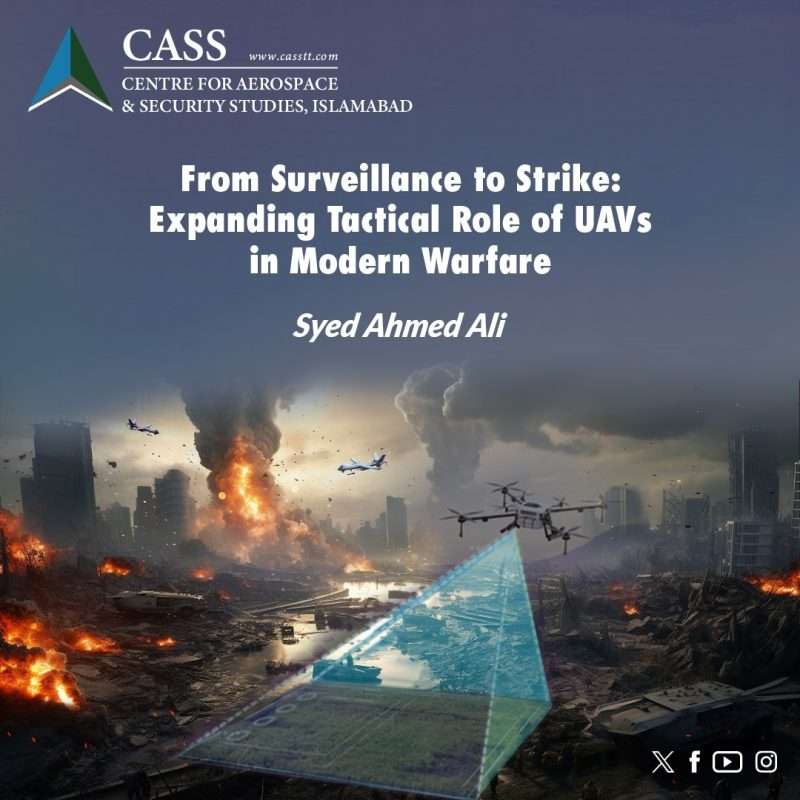
Unmanned Aerial Vehicles (UAVs), commonly known as drones, have come a long way from being deployed as a tactical reconnaissance platform during the Bosnian conflict, to becoming a staple in modern warfare. Drones gained prominence, particularly during the War on Terror, where the United States utilised the MQ-9 Predator as its preferred tactical strike platform. Modern drones have been increasingly fitted with deadly munitions and sophisticated technology to conduct more complex tactical operations. As a result of technological advancements, drones can conduct diverse operations such as precision strikes, disruption of enemy communication, and logistical support. The low cost and scalability of drone production means that drones can now be deployed in mass numbers. This has driven a trend in contemporary conflict, where the tactical role of drones has expanded, often overlapping the combat roles of conventional platforms like aircraft and artillery.
The Nagorno-Karabakh conflict marked the first instance in which drones were deployed at scale and employed as primary front-line assets. Azerbaijani forces notably utilised Turkish Bayraktar TB2 UAVs and Israeli-manufactured loitering munitions in their operations. During the conflict, drones carried out effective strikes against Armenian T-72 main battle tanks and S-300 air defence systems, demonstrating their tactical value in neutralising high-value targets. The Russo-Ukrainian conflict is another example where mass deployment of drones has been observed. However, unlike the Nagorno-Karabakh conflict, both Russia and Ukraine possess advanced drone and counter-drone capabilities. This has contributed to a protracted war of attrition, in which traditional manoeuvre warfare has become largely unfeasible. Surveillance drones provide real-time targeting data, exposing any massed troop movements to immediate artillery strikes. Consequently, both sides rely on entrenched positions, inflicting sustained losses through long-range artillery and first-person view (FPV) drone attacks. The conflict is characterised by indirect fire, dispersed unit formations, limited mobility, and incremental territorial gains.
Mass mobilisation and sophistication of drone technology have led to the expansion of unmanned platforms which may tactically displace conventional platforms. For example, the role of reconnaissance which has traditionally been played by observation helicopters (OH) and aircraft, is now being exclusively done through UAVs. The United States (US) has even tasked a specialised Marine Corps Attack Drone Team (MCADT), which will serve as a centre for expertise in FPV drone operations. Russia has introduced innovative fibre-optic drones that are resistant to jamming and capable of navigating confined spaces and buildings. These drones serve as effective alternatives to artillery when there is no direct line of sight and targets are fortified behind concrete or other hard materials. They can bypass such defences and deliver payloads with precision, maximising damage. These advancements have increased demand for drones, whose expanding tactical role increasingly mirrors that of conventional military units.
State and non-state actors prefer to use UAVs over conventional units as they provide several key advantages. First, drones reduce the risk of losing human pilots; which is crucial when there are limited trained personnel. Second, drones are relatively easy to maintain and manufacture. For state actors, this allows scalability. For non-state actors, it can lower the threshold of acquiring a rudimentary air force, which was previously limited by infrastructure and sophisticated technical equipment. Third, UAVs offer an asymmetric capability, enabling the destruction of high-value targets at a fraction of the cost of conventional systems.
However, the low-cost of drones comes at the expense of capabilities which restricts them from conducting technically sophisticated operations. Most combat drones have limited payload capacity, inferior sensors, sensitivity to bad weather, slower speed, and noisy engines. This greatly exposes these drones to enemy air defences and limits their operational performance. For example, a report indicates that 60 to 80 percent of Ukrainian FPV drones failed to reach their target and were more effective against infantry than armoured vehicles. This statistic changes drastically, however, when FPV drones are paired with artillery which can immobilise or destroy armoured targets like tanks. To increase the firepower of drones, more technically superior drones are required like the Bayraktar TB2. But, these types of drones while capable of engaging armoured targets, are more vulnerable to enemy air defence systems than FPV drones, due to their larger size and smaller numbers.
While evaluating the strengths and limitations of drone warfare, it becomes evident that UAVs cannot fully replace conventional combat units. Although FPV drones may offer greater accuracy, they lack the firepower and sustained impact of traditional artillery. Similarly, despite their cost-efficiency, UAVs are unable to operate effectively in highly contested airspace in the same manner as conventional aircraft. This leads to two key conclusions regarding drone technology. First, drones have not supplanted conventional platforms; rather, their role on the modern battlefield has evolved into a more specialised function. Second, drones serve as force multipliers, enhancing the effectiveness of conventional tactical platforms by improving situational awareness, line of sight, and target precision. These insights underscore that contemporary warfare increasingly relies on a synergistic combination of asymmetric and conventional capabilities to address evolving complexities of the battlefield. Therefore, it is likely that middle powers like Pakistan may deploy drones to enhance their asymmetrical capabilities against larger adversaries. Looking ahead, the integration of autonomous systems and AI-driven targeting may further redefine the tactical balance in regional theatres.
Syed Ahmed Ali is a Research Assistant at the Centre for Aerospace & Security Studies (CASS), in Islamabad, Pakistan. He can be reached at [email protected]