Although there has been considerable discussion about the potential for Pakistan to develop its ‘blue economy’ (i.e. the economy based around its marine and coastal endowments), the current output of Pakistan’s blue economy is estimated at only USD 1 billion, a paltry 0.4% of national GDP. This is a miniscule amount when also seen in a global context, where the total international blue economy contributes around USD 2.3 trillion annually, with 90% of global trade occurring via sea and 0.5 billion peoples’ jobs linked to fishing and fisheries. Indeed, robust estimates suggest that, were Pakistan to prioritise and earnestly develop its blue economy, the potential would be of over USD 100 billion in blue economy output (30% of current total national GDP). With its significant coastline, the country can enjoy the economic scale-up of several sectors including fisheries, shipping, tourism, tidal energy, and more. This excludes the offshore oil drilling and extraction that is increasingly receiving attention in light of Pakistan’s energy requirements and possible large-scale discoveries.
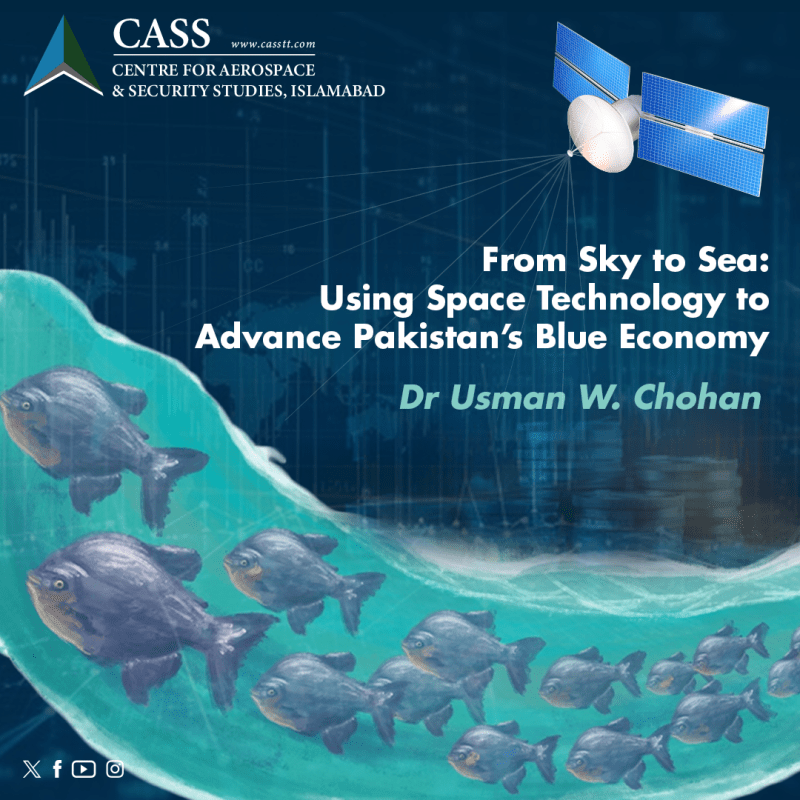
There are many ways in which Pakistan can expand its blue economy, including through the expansion of Gwadar as regional hub, the introduction of large scale (but sustainable) fishing, deepening the draft of its ports, greater connectivity with central Asia to gain a stake in their economic advancement via sea, professional marine tourism, and much more. However, in the list of recommendations for expanding the blue economy, one avenue that goes unmentioned is that of a synergy between the space economy and the blue economy. The space economy, as is being researched at CASS, offers promising avenues of growth in many sectors of Pakistan, and the blue economy is no exception. The key areas where the space economy synergises with the blue economy include shipping & trade oversight, port & industry optimisation, and resource mapping.
Shipping and trade oversight involves the use of satellites to proactively monitor the flows of ships and their cargo across the sea and upon arrival on land. At present, 95% of Pakistan’s trade occurs via the sea, and it is thus the commercial nucleus of Pakistan which requires nurturing and investment. Ensuring better movement of cargo in Pakistan’s coastal area and onto its port facilities will provide significant benefits, and satellites can play a crucial role in enhancing this element of the blue economy by improving navigation, communication, and surveillance in the shipping industry. With such technology usage, ships can navigate oceans with precision, ensuring safer and more efficient routes. Furthermore, satellite communication enables global connectivity, essential for emergency situations and ship-to-shore interactions; and in addition, satellites can provide better real-time monitoring of ships and ocean conditions, optimising fuel use and supporting law enforcement in combating illegal activities.
In a similar vein, satellites can play a crucial role in optimising port operations and boosting industrial efficiency in Pakistan’s blue economy. By providing real-time Earth observation data, satellites can enable ports to monitor and manage critical activities, ensuring safer and more efficient operations, while high-resolution satellite imagery can assist in planning and managing port infrastructure, reducing bottlenecks, and improving logistics coordination. Additionally, satellite-derived bathymetry can be used to map water depths and underwater structures, enhancing navigational accuracy without the need for expensive local surveys. This technological advantage can help ports like Karachi and Bin Qasim improve their handling capacity and reduce the risk of accidents or environmental damage.
Improved satellite tracking of industrial fishing vessels can also significantly enhance Pakistan’s blue economy by ensuring better oversight of fishing activities in its coastal waters. With an estimated 75% of the world’s industrial fishing vessels not publicly tracked (mostly in South Asia, including Pakistan, and Africa), satellite monitoring can help reduce illegal, unreported, and unregulated (IUU) fishing, which depletes fish stocks and undermines sustainability. Enhanced tracking will enable Pakistan to safeguard its fisheries resources, ensure compliance with regulations, and improve long-term yields.
Finally, Pakistan’s blue economy can significantly benefit from space economy’s satellite value through advanced coastal resource mapping, particularly in monitoring fish populations and in locating oil reserves. Satellites can track fish migration patterns and water temperature changes, providing critical data for sustainable fishing practices that optimise yields without depleting stocks. In terms of oil reserves, satellites can detect offshore oil deposits through advanced imaging techniques, aiding exploration and extraction efforts while minimising environmental risks. Both fish populations and oil reserves are crucial resources for Pakistan’s economy—fish providing food security and livelihoods, while oil reserves offer energy security and economic growth. By leveraging satellite technology for resource mapping, Pakistan can maximise the potential of these vital assets, boosting its blue economy while preserving long-term ecological health.
As such, there are specific use cases where the space economy and the blue economy synergise. Much of the budding conversation about the blue economy in Pakistan points to its vast potential, perhaps 100 times larger than what it now is. There are many factors that will go into that developmental agenda, taking the blue economy from 0.3% of GDP to perhaps 30% of current equivalent GDP. By the same token, as with many economic sectors that would benefit from the space economy, the blue economy is no exception, and the areas of shipping & trade oversight, port & industry optimisation, and resource mapping give a sound indication of an excellent synergy between space and the sea.
Dr Usman W. Chohan is Advisor (Economic Affairs and National Development) at the Centre for Aerospace & Security Studies, Islamabad, Pakistan. He can be reached at [email protected]