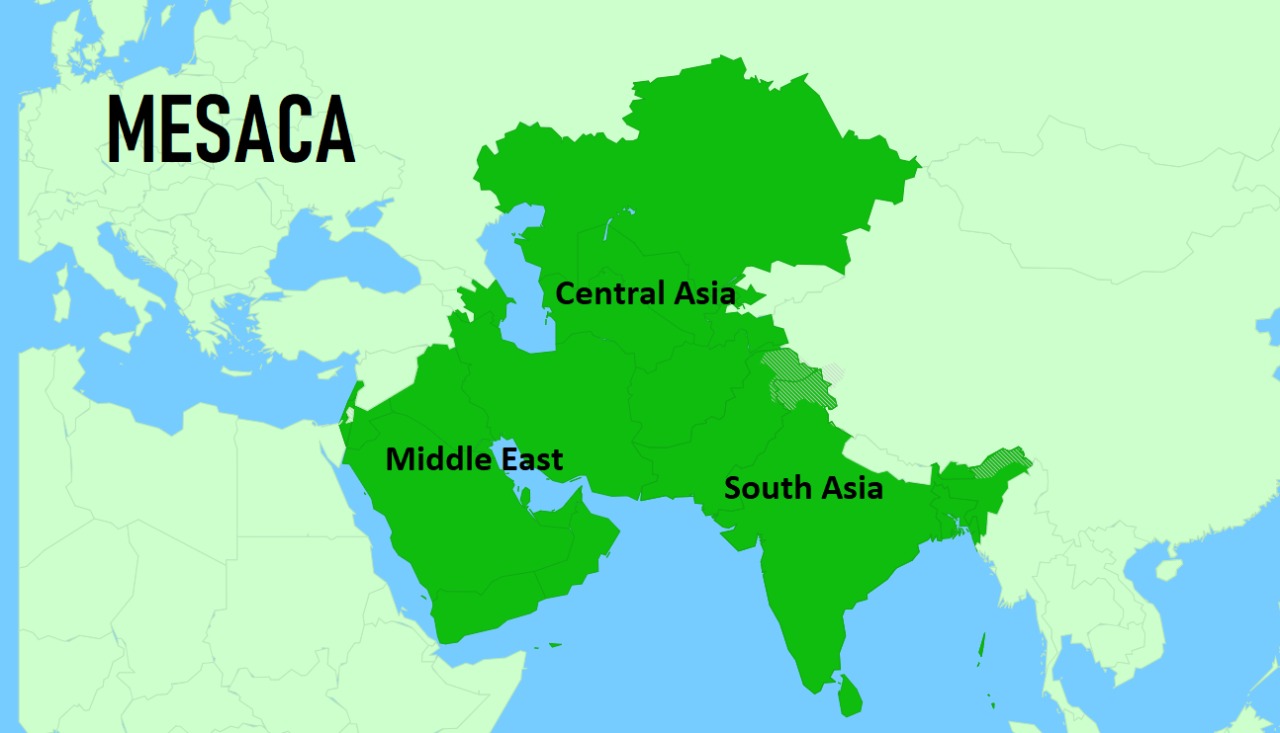
Let me first explain the acronym, MESACA. It stands for “Middle East-South Asia-Central Asia.” Expanding regional connectivity between MESACA can prove to be a game-changer, particularly for the relatively poor performing states. It is important to mention that Iran and few West Asian countries have been included as a part of MESACA due to their geographical location.
MESACA is comprised of geographical regions; spanning from the western tip of the Asian part of Turkey to the Gulf of Aden in the South, moving eastward till Bay of Bengal, and up north touching the southern boundaries of Russia. The regional boundaries, as explained above, are home to nearly half of the world’s population, with huge reserves of hydrocarbons, glacial mountains, important international Sea Lines of Communications (SLOCs), including the much-desired warm water ports, vast expanse of agricultural lands, and relatively favourable climatic conditions.
The historic bonds between these regional states date back to the pre-historic era of trade and travel well before their religious linkages made them inseparable. However, the entire region suffered immensely on account of colonialism even after the state boundaries had been defined in Europe following the conclusion of the Treaty of Westphalia.
South Asia can have its own SAARC Highway as and when India decides to become part of the project.
In the fast-evolving global order, regional connectivity of the MESACA region becomes even more important due to its proximity with a resurgent Russia and ever-rising China. The Pakistani port of Gwadar, being developed by China as part of the China-Pakistan Economic Corridor (CPEC), which is a flagship project of China’s Belt and Road Initiative (BRI), connects all three regions through the shortest possible logistics lines.
China’s ever-expanding capacity of exporting goods and services to the rest of the world starts from its west and following the land route in Pakistan reaches the Gwadar Port in the shortest possible time. From Gwadar, the sea route can be used to reach the Middle East, Africa, and the ASEAN region. Likewise, Russia and the Central Asian Republics (CARs) can route via Afghanistan to the coveted warm water port of Gwadar for the dispatch and reception of goods and services respectively. South Asia can have its own SAARC Highway as and when India decides to become part of the project, which would be far more beneficial for the latter than any other country of the region. The SARRC Highway may be built from the western tip of Afghanistan, going through Pakistan and entering into India via the traditional Grand Trunk (GT) Road till the eastern tip of Bangladesh into Myanmar.
Likewise, goods and services from Africa and the Middle East, including hydrocarbons, can find a passage through Gwadar Port all the way up to China, India, and Bangladesh, which are some of the largest consumer markets. Speedy logistics means relatively cheaper goods and services for the future of MESACA and the world.
MESACA is comprised of some of the very important regional states. The Kingdom of Saudi Arabia (KSA) is rich in oil and is home to the holiest places for Muslims. Iran is another important state which connects the Middle East with South Asia and is one of the largest gas producers in the world. Pakistan is the second-largest Islamic state and a nuclear weapon state in the region. India is the second-largest country in the world with nuclear capability and global ambitions. It is one of the largest producers of goods and services, with expertise in information technology. It is also one of the largest consumer societies due to its billion-plus population. Likewise, some of the CARs are extremely rich in minerals and natural resources. Historical richness notwithstanding, CARs can act as a bridge between South Asia, Russia and Europe. Turkmenistan is one of the largest gas producers and can supply desperately needed energy to Afghanistan, Pakistan and India. Final negotiations with the new Taliban-led Afghan government on the 1,814km Turkmenistan-Afghanistan-Pakistan-India (TAPI) is in the final stages. Once concluded, Turkmenistan would supply the most economical energy to these energy-starved countries.
MESACA has immense potential, both as a producer as well as a consumer. Interconnectedness of people from MESACA through history, culture and geography with China and Russia—global players in their own right—can prove to be a massive game-changer in the coming decades.
Dr Zia Ul Haque Shamsi is the author of ‘Nuclear Deterrence and Conflict Management Between India and Pakistan’ (2020) and ‘South Asia Needs Hybrid Peace’ (2021). He is presently working as Director at the Centre for Aerospace & Security Studies (CASS), Islamabad, Pakistan. The article was first published in Daily Times. He can be reached at [email protected].