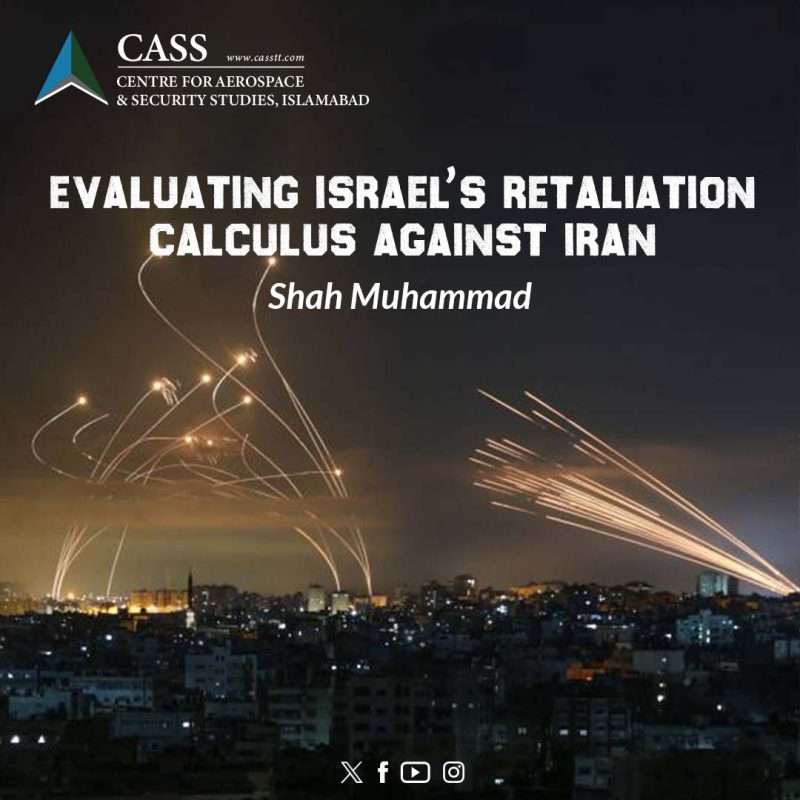
Israel’s protracted assault on Gaza risks morphing into a wider Middle Eastern crisis after Iran launched around 200 ballistic missiles on various sites in Israel. It is being deemed as Iran’s kinetic response to Israeli assassinations of top leadership of Tehran-backed Hamas and Hezbollah. The world is currently on edge, anticipating the scale and nature of Israeli retaliation that would further determine the escalation ladder in the region. In his first response after the Iranian attack, Israel’s Prime Minister Netanyahu asserted that Iran ‘will pay for it,’ while the his ambassador to the United Nations declared that Tel Aviv has a ‘lot of options’ in terms of retaliatory strikes.
Israel’s retaliation against Iran could be either a limited counterattack aimed at inflicting calculated damage upon Tehran or a large-scale military operation culminating in an all-out war. If history is any guide, Israel has prioritised limited operations against specific targets more often than a full-scale and costly military confrontation to secure its strategic and geopolitical ends in the region. Thus, its response towards Iran is likely to be proportionate and limited, aimed at infrastructural or human targets. Selection of targets would likely be key to determining the nature of the limited counterattack by the Israeli Defense Forces (IDF). Potential targets in Iran may be critical infrastructure characterised by (but not limited to) nuclear sites, oil facilities, military bases or command and control centres.
A strike on Iran’s nuclear sites could be a highly challenging and costly endeavour. Given the distance between Israel and Iran coupled with Tehran’s air defence guarding its nuclear infrastructure, IDF would require around 100 aircraft – bombers and fighter jets – to successfully conduct such a strike. Iran would retaliate quite strongly to such an operation and might declare a full-blown war against Tel Aviv.
That leaves the IDF with the choice to launch strikes against urban centres or military bases. It may strike Iran’s ballistic missile production lines and Iranian Revolutionary Guard Corps (IRGC) assets to significantly weaken Tehran’s tactical capability. This kind of strike would also dampen Iran’s military support to Hezbollah and Hamas which are already under heavy bombardment by IDF. The strike on Iran’s military assets may either be launched through ballistic missiles or Israel’s aerial feet of combat aircraft. For air-to-ground assault, Israel’s F-35 stealth aircraft could be a likely choice while F-15 may be used for air cover.
Alternatively, IDF may be deliberating assassination of a prominent political or military figure in Tehran in order to shatter the morale of politico-military leadership and the Iranian nation as a whole. IDF has already proved its capability in this regard in view of the precision targeting of Ismail Haniyeh and Hassan Nasrallah. The retaliatory strike may also target infrastructural and human targets simultaneously.
It would be safe to argue that Israel would likely hit military assets or urban centres in Iran as a significant yet calculated reprisal to re-establish its deterrence. Human target/s appear less probable because a high-value assassination in Iran might pave the way for a full-blown conflict. The degree of proportionate reprisal is likely to be carefully assessed by the IDF so as not to exceed the threshold of limited counterattack.
An all-out war is less likely on the Middle Eastern horizon as admitted by Israel’s Ambassador to the UN that ‘we don’t want to see full war with Iran.’ Another constraining factor in this regard is the glaring rupture in continued Western support for Israel. Notably, French President Emmanuel Macron has called for halting arms supplies to Tel Aviv. A few other Western countries could also follow suit in order to limit the scale and intensity of Israel’s retaliation against Iran.
The scale and extent of Israeli reprisal would have significant implications for the geopolitical and economic contours of the region. An intensive counterstrike might lead to an unending retaliatory cycle between Israel and Iran, materialising the eventuality of a full-fledged conflict. Additionally, the crisis could disrupt global oil markets and substantially raise oil prices, endangering economic stability of nations across the world. Exacerbating tensions also undermine the credibility of multilateral institutions which have not been able to de-escalate the situation to preserve regional and international stability.
Lastly, it is imperative for both parties to pull the plug on the unending cycle of escalation and make endeavours for a ceasefire in both Lebanon and Gaza. During his recent visit to Syria, Iran’s Foreign Minister stressed the exigency of a ceasefire in both warring zones. Washington may also rein in the Israeli onslaught to preclude likelihood of a regional conflict. The UN must also persist in its efforts to secure de-escalation and ceasefire, while actively paving the way for a lasting resolution to the protracted Middle Eastern conflicts through robust and effective multilateral cooperation.
Shah Muhammad is a Research Assistant at the Centre for Aerospace & Security Studies (CASS) in Islamabad, Pakistan. He can be reached at: [email protected]