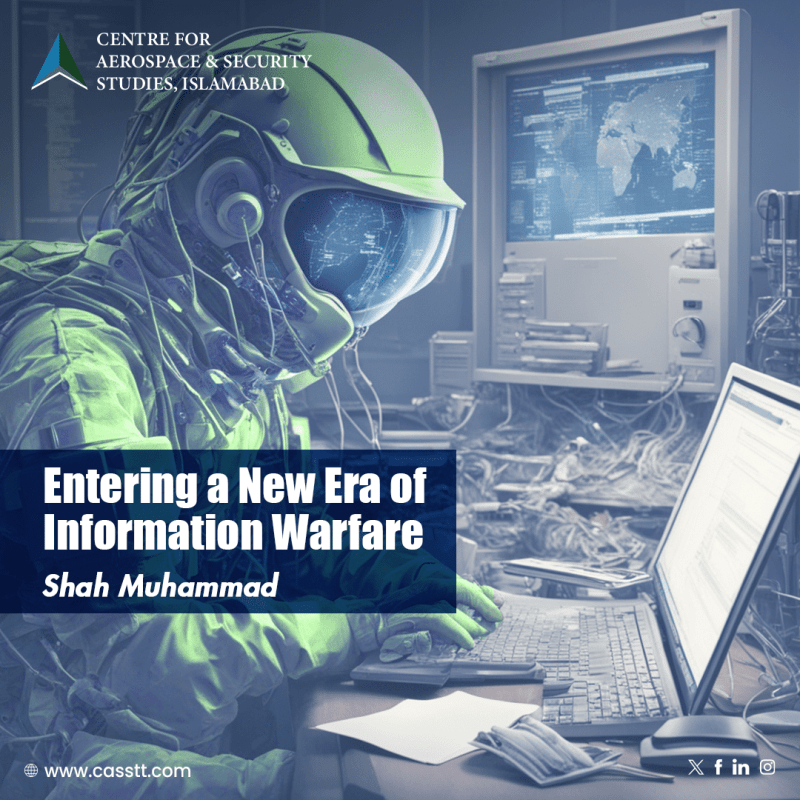
The traditional recourse to kinetic combat capabilities may no longer be adequate in a technological era increasingly dominated by non-kinetic modalities of warfare. Information warfare, an emerging mode of hostile engagement, includes actions taken to deny, exploit, corrupt, or destroy an enemy’s information and its functions while protecting our own and leveraging our military information functions. With information-based Revolutions in Military Affairs (RMA) underway, it is crucial to analyse the evolving dynamics of information warfare in the context of technology and military strategy.
Deceptive information campaigns have been used for decades to undermine enemies on the battlefield. In Operation Fortitude, the Allied powers in WWII successfully deceived the Germans regarding the actual place and time of the invasion. Consequently, the Germans were caught off guard when the actual invasion occurred in Normandy in 1944. However, the information domain was traditionally viewed as merely a channel for transporting data, with little strategic significance. RMA over the years is reflective of technological advancements that underpin information warfare.
One of the leading emerging technologies which has changed the dynamics of RMA is quantum technology in the context of quantum warfare. Quantum computers possess enormous computation and processing power, making them a potent instrument for penetrating the sensitive and classified information channels of the adversary. In addition, deepfake technology is another facet of information warfare that taps into Artificial Intelligence (AI) to generate fake and misleading visuals that blur the line between fiction and reality. States also tap into big data to enhance surveillance which is processed and analysed through AI systems. These technologies may be used in synergy to generate a collective capability in information warfare.
Military developments across the world are indicative of doctrinal and strategic responses to the evolving realm of information warfare. In 2017, the US military revised its Doctrine for the Armed Forces, formally including ‘information’ as the seventh joint function. The original six joint functions were intelligence, fires, command and control, protection, movement and manoeuvre, and sustainment. In addition, the U.S. Air Force in 2022 came up with an information warfare strategy that stressed the need for cementing information as the key to all military operations. The salient areas of ISR, electromagnetic operations, cyber and influence operations were placed under the overarching umbrella of information warfare. These US doctrinal and strategic initiatives are likely to have been undertaken in response to the rising non-kinetic capabilities of other competitors such as China.
The documents attributed to the Chinese People’s Liberation Army (PLA) are reflective of the ‘information first’ approach wherein the PLA deems information dominance imperative for subsequent air and naval superiority in the battlefield. In this regard, Xi Jinping established the Information Support Force (ISF) which he sees as pivotal for gaining dominance in modern wars by leveraging what was termed as ‘network information system.’ It could be inferred that Beijing might be planning to spearhead information campaigns to train its personnel and influence adversaries in the context of geopolitical hotspots in South China Sea and East Asia.
The complexities of information warfare demand analytical scrutiny. Firstly, the absence of a clear, quantifiable definition of ‘information security’ complicates its understanding among senior commanders, hindering the effective integration of this concept into tactical operations. Secondly, while future wars are likely to be fought predominantly in cognitive and information domains, military personnel are not adequately trained to preclude the vulnerabilities in this regard. Quantum computers could exacerbate these vulnerabilities by rapidly penetrating encrypted data flows and disrupting cyber defences. The inability to cope with cyber threats could lead to turbulence in command-and-control systems. Lastly, a deepfake attack could instigate mass hysteria, chaos and unrest among the personnel, given that it has the ability to confuse fact with the fiction.
These challenges can be addressed through a series of tangible measures. Commanders need to achieve a clear and objective understanding of information warfare. This will likely require collaboration between military leaders, cyber experts, and policymakers to effectively use information as a strategic asset in various operations. Moreover, developing comprehensive training modules at the academy level followed by exercises with allied foreign militaries may be undertaken for information warfare-specific operations. For example, the US is imparting training to its airmen to fight disinformation campaigns and crafting quantum-resistant protocols that could be emulated by other countries for cementing cyber defences in the context of quantum warfare.
To conclude, addressing the perils of information warfare requires innovative technological solutions and robust defence mechanisms. Beyond the military sphere, collaboration with civilian sectors, including academia, industry, and cyber security experts, is also crucial. By fostering cross-disciplinary partnerships and leveraging diverse perspectives, we can develop comprehensive strategies to mitigate the risks of information warfare. Ultimately, the operational wisdom of commanders, combined with the strategic foresight of policymakers and the expertise of non-military stakeholders, will be essential for overcoming these complex challenges.
Shah Muhammad is a Research Assistant at the Centre for Aerospace & Security Studies (CASS) in Islamabad, Pakistan. He can be reached at [email protected].