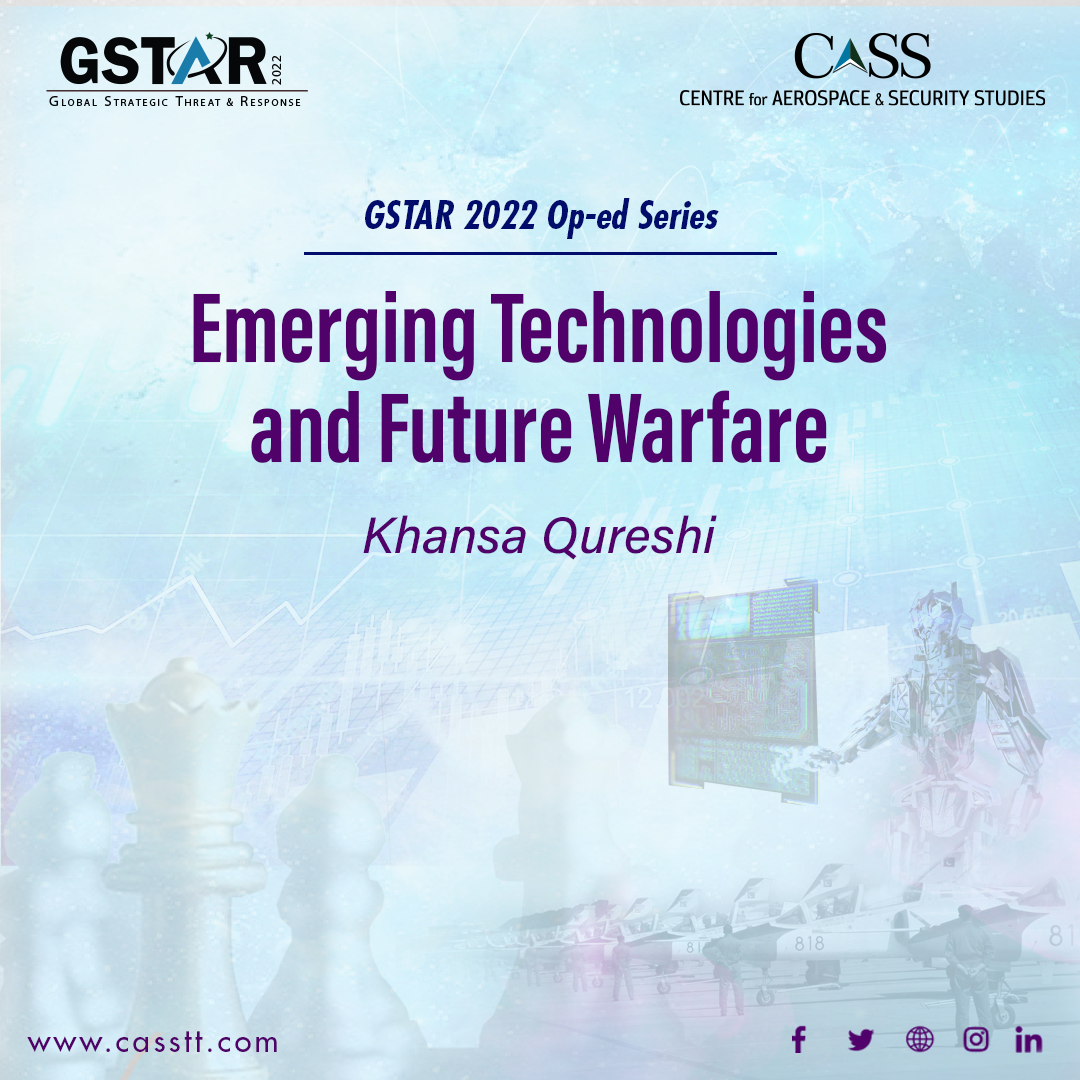
Technological advancements have brought about revolutionary changes in every walk of life on Earth. Technologies like Artificial Intelligence (AI), cyber, Internet of Things (IoT), virtual reality, satellite communications, robotics, and biometrics, etc., with rapidly enhancing characteristics and widening scopes have resulted in the formation of hundreds of newer systems. Resultantly, these systems have impacted life on Earth – and beyond as well. On the one hand, these technologies have awed humans with the great strides that they have made to heal and help human life. But on the other, the same technologies when applied in military domains have the potential to unleash destruction and devastation on an unprecedented level. The ever-broadening role of these technologies in conflicts is heralding a gradual but a certain change in the nature and character of warfare.
Currently, the ongoing war between Russia and Ukraine is considered to be one of the most ‘technologically advanced war’ ever. For the first few months, Russia – the invading party – prevailed in the war and conquered huge swathes of Ukrainian territories. However, due to the flow of highly advanced Western weapon systems, along with aid in space and satellite communications, internet services, and assistance in cyber and AI domain that Ukraine has managed to turn the tide of war in its favour over the last few weeks. This unfurling of events indicates that new technologies are actually being deployed in the battlefield, exposing humans to devastating consequences.
As wars are increasingly becoming more technology-driven, entailing greater levels of destruction in smaller periods of time, they are also becoming equally scarier. The deployment of Lethal Autonomous Weapons Systems (LAWS), which is considered to be the future of war, is one such system causing serious concerns. While these systems are considered the ultimate precision weapons, with the potential to eliminate ‘human-error’ in war fighting, they are also branded as an absolute disaster. That’s because these systems when deployed can enhance the chance of machine-led errors that are much more lethal in nature given they are devoid of human emotions and reasoning. The problems may even be compounded by biases in algorithms.
Similarly in the strategic domain, advancement in technologies rendering increased lethality and accuracy to weapon systems can also incentivise nations to rethink their nuclear postures, encouraging them to strike first against their enemy for escalation dominance. This is a particularly precarious situation in the South Asian context with enduring rivalry between two nuclear-armed states, with India openly toying with the idea of violating Pakistan’s sovereignty on various occasions. The Balakot strike in 2019, and the BrahMos incident in March 2022 are two undisputed facts in this regard. Furthermore, technological sophistication of arsenal that India has been acquiring by entering into various military alliances also has the potential to force an arms race, increasing crisis instability in the region.
Moreover, while these advancements are altering the character of war, they are also increasingly blurring the lines between war and peace. The utilisation of cyber and AI technologies to launch an attack on enemy’s critical infrastructure aimed at crippling it even for a day or few hours can have huge economic consequences for the targeted nation.
Being a peace-loving nation, progressing through peaceful means is the lynchpin of Pakistan’s development strategy. However, it is also true that surviving in a hostile environment requires a nation to always keep its guard up. Therefore, to understand the impact of emerging technologies and their proliferation on Pakistan’s security outlook, the Centre for Aerospace & Security Studies (CASS), is set to convene a session titled ‘Emerging Technologies and Future Warfare,’ during its upcoming ‘Global Strategic Threat and Response’ (GSTAR) Conference. The Conference which is a two-day flagship event organised biennially will take place from 19-20 October this year. The subject session, to be held on the second day of the conference will see a group of national and international experts sharing views on emerging technologies, their militarisation in South Asian context, and their impact on strategic stability. The speakers from military, strategic, and diplomatic backgrounds hailing from Pakistan, United Kingdom, Italy, and China will discuss at length as to how the impact of these technologies on the nature of warfare will render unprecedented consequences for states’ military, diplomatic, as well economic outlook.
Inequitable development and the ability to acquire these technologies making them an exclusive privilege also hurts the interests of developing nations like Pakistan – another area of discussion at the GSTAR 2022. Besides, prospects of banning some of these technologies that are prone to operational biases will also be discussed. Along with the military domain, the Conference will also set into motion the debate to invest in these technologies to reap their benefits in the economic, health, agriculture sectors, as well as climate change.
In essence, this wholesome exercise will contribute towards giving policy recommendations to Pakistan’s policymakers, on how to remain abreast of the changes rapidly happening in military, strategic, economic, and geopolitical spheres all over the world. It will also put across Pakistan’s stance in the global discourse on the development and acquisition of these technologies. Therefore, the session is an important and timely endeavour to brainstorm ideas for Pakistan to harness the benefits of these technologies in both military and civilian spheres.
Khansa Qureshi is a researcher at the Centre for Aerospace & Security Studies (CASS), Islamabad, Pakistan. She can be reached at [email protected]