
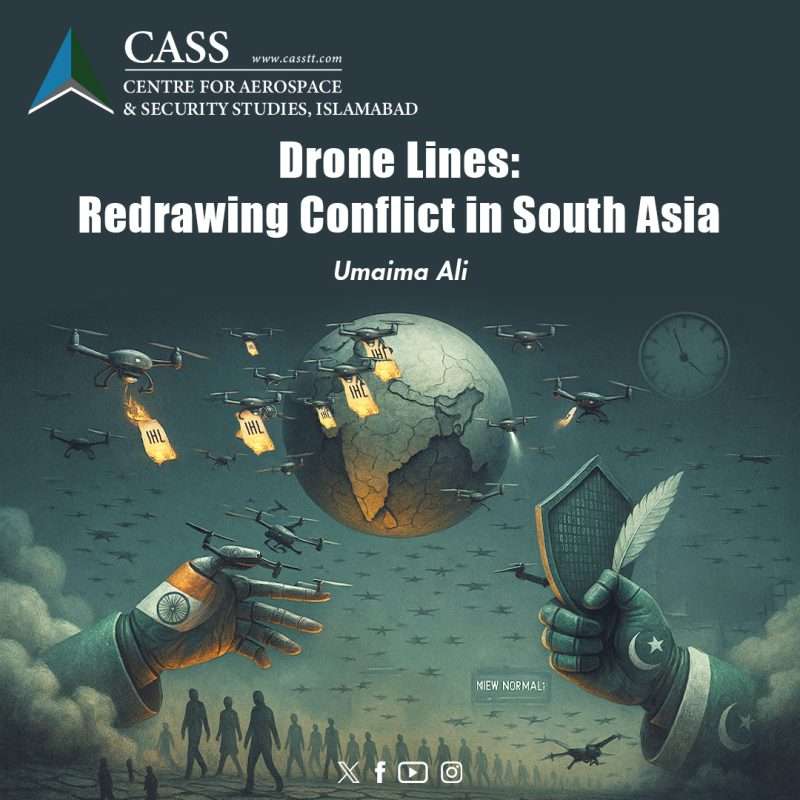
A senior advisor on South Asia at the United States Institute of Peace offers a dangerous proposition. According to him, ‘Rounds of missile and drone attacks could be more routine features of India-Pakistan hostility, just like artillery fire has become a familiar fact of life along the Line of Control.’ This insight indicates a broader transformation of conflict in the region, increasingly shaped by emerging technologies. It reflects the ongoing evolution of fifth-generation air warfare — a concept that continues to evolve. Drones intensify the contest between detection systems and stealth technologies, reshaping the offence-defence balance in airspace conflicts. In South Asia, drone warfare has evolved as both a tactical tool and a psychological weapon.
On 7 May 2025, following an air attack by India, the Pakistan Air Force (PAF) shot down six Indian fighter jets, a drone, and several quadcopters — an unprecedented feat in aerial warfare. With Indian Air Force (IAF) options neutralised, the following day, 8 May, India escalated the confrontation with a series of drone strikes that killed civilians and damaged a military facility near Lahore. In response, Pakistan neutralised 77 drones by using a combination of ‘soft kill’ and ‘hard kill’ methods. Pakistani forces used conventional weapons, and intercepted drones at lower altitudes, showcasing tactical discipline over expenditure. That same day, India accused Pakistan of launching drones and missiles at numerous Indian cities, including New Delhi, Indian-occupied Jammu, Pathankot, and Udhampur. These allegations aimed at deflecting attention from India’s drone escalation and justifying its aggression.
Despite not achieving strategic and military objectives, India switched to drone escalation due to several reasons. First, as an analyst at FINRA in Washington noted that India decided to use suicide drones for the rest of the conflict against Pakistan to prevent the loss of any further aircraft, and the risk of losing pilots, an outcome that drew severe criticism. Already facing global scrutiny over the downing of six fighter jets including three Rafale, India was eager to avoid additional domestic backlash. To channel public demand for revenge against its longstanding adversary, India resorted to ‘Cold Start swamp drones doctrine.’
Secondly, drones lack the diplomatic and symbolic weight of manned aircraft, offering a safer, yet potent, option to India. According to Chi Cheng, a policy researcher based in Washington, states might hesitate to send troops across a border, but not a fleet of drones. This ease of deployment has facilitated use-of-force decisions that avoid political, supervisory, and legal accountability. The absence of accountability mechanisms affords military planners greater strategic latitude, enabling decisions that might otherwise face institutional or public scrutiny. Proponents of drone warfare argue that it is morally defensible, citing its potential to enhance troop safety and minimise civilian casualties relative to conventional airstrikes.
In addition, cost-efficiency also played a critical role in India’s decision to escalate with drones. For example, Indian Harop drones, of Israeli origin costs approximately USD 0.7 million enabling prolonged operations with reduced financial strain. This price point undercuts traditional manned or missile-based strike options, allowing forces to sustain operations without prohibitive expenditure. Moreover, Harop offers scalable and low-risk strike capability in areas protected by modern surface-to-air missile (SAM) systems. In modern conflicts like the Russia-Ukraine war, drones costing as low as USD 1,500 were used by soldiers in trenches to survey the battlefield. The comparatively low political and financial costs associated with drone operations often circumvent rigorous public and institutional scrutiny. As American political scientist P. W. Singer cautioned in 2009, this detachment risks transforming war into a remote and sanitised spectacle, diminishing societal engagement with the ethical and strategic consequences of armed conflict. This growing reliance on drones becomes alarming in South Asia, where India and Pakistan, both sharing a contiguous border, could trigger a cycle of provocation and retaliation with far-reaching consequences.
Finally, India’s escalation in drone deployments appeared intended to cultivate psychological pressure by instilling fear among civilian populations. However, the ploy failed as the public reaction in Pakistan was marked more by amusement than anxiety, with residents in cities remaining unfazed by the drones overhead.
Such attacks on the civilian population highlight the violation of International Humanitarian Law (IHL) by India. Pakistan’s earlier calls for United Nations intervention highlight that the legal and humanitarian frameworks governing drone use remain in flux. Most drone strikes are typically assessed under the IHL framework, particularly the ‘law of hostilities’. The law mandates a clear distinction between combatants and civilians. By tactically and psychologically targeting the civilian population, India’s drone strikes violated legal protections under the IHL.
Despite India’s intentions and the tactical appeal of drone warfare, the use of drones cannot be normalised in South Asia. Both India and Pakistan are nuclear-armed states, and drone use risks violating sovereign airspace, actions that can be interpreted as acts of war. In nuclear South Asia, such escalation heightens the risk of miscalculation, potentially leading to total war.
Given India’s potential intentions to employ drone strikes under the garb of any false flag operation in future, Pakistan must adopt a proactive approach to unmanned warfare. As a strategic imperative, Pakistan has already developed a comprehensive doctrine on unmanned warfare, centred on the indigenous production and strategic deployment of drones, complemented by advanced countermeasures capable of neutralising hostile systems through both soft- and hard-kill capabilities. Beyond military preparedness, Pakistan should also lead diplomatic initiatives to establish regional norms and legal frameworks for drone use to mitigate escalatory risks and ensure accountability in future Indo-Pak conflicts.
Umaima Ali is a Research Assistant at the Centre for Aerospace & Security Studies (CASS), Islamabad. She can be reached at [email protected].



