Whether democracy is a precondition for development is a debate that continues to stimulate scholarly reflection till the present day. While this intellectual reflection is praiseworthy, the discussion could have been settled long ago when Amartya Sen redefined the concept of ‘development’ as ‘freedom’– a notion that strongly resonates with the human spirit.
The mainstream debate on development and democracy is often caught between two major schools of thought– the ‘development state camp’ and the ‘democratic governance camp.’ For the former camp, democracy is not a necessary condition for development. Economic transformation and rapid growth require centralised decision-making, a capable and autonomous bureaucracy, massive investment, and a commitment to development. The proponents of this camp draw on the development successes of countries such as Taiwan, Hong Kong, China, and Vietnam to validate their standpoint. The ‘democratic governance camp,’ on the other hand, accentuates the importance of a democratic system for delivering economic and social benefits for citizens. Its proponents build on a large body of empirical evidence, such as the studies concluding a strong causal relationship between accountability and higher levels of per capita income or accountability and service delivery, among others.
At face value, both the arguments have their appeal. However, what they overlook is the broader connotation of development that aligns with human beings’ innate yearning for freedom to flourish, actively shape their lives, live according to their values, and express their personality for their own and societal well-being. Provide a person with every comfort in confinement, yet their heart will still yearn for free rein. This is why research has repeatedly shown that factors such as perceived autonomy, locus of control, or freedom of choice predict life satisfaction better than other known factors, such as employment or health, and once basic needs are fulfilled, additional income may not lead to more happiness. At the country level as well, higher levels of freedom have been found to correlate positively with populations’ happiness levels. This substantial evidence contradicts the outdated notion that individuals often flee from freedom because of the weighty self-responsibility it entails.
Amartya Sen, one of the greatest development thinkers of our time, has done a commendable service of humanising the concept of ‘development,’ redefining it as ‘freedom’ or ‘the process of expanding human freedoms.’ For Sen, ‘freedom is both an end and a means of development.’ Eliminating sources of ‘unfreedom’ allows human beings to lead lives they have reason to value. At the same time, such an environment empowers people to contribute to uplifting their communities, leading to broader societal and economic progress. He defined the major sources of unfreedom as systematic social deprivation; overactivity and intolerance of repressive states; tyranny; neglect of public facilities; and poor economic opportunities that must be removed to foster development. The growth of individual incomes or the Gross National Product (GNP) is an important but only one of the many sources of expanding human freedoms.
Moreover, Sen distinguished between two distinct but equally essential aspects of freedom – the opportunity and the process aspects. The opportunity aspect is concerned with the availability of options and alternatives, while the process aspect involves the ability to influence the choice process. For instance, it would be a violation of the opportunity aspect if a person is obliged to do something they wouldn’t do if plausible alternatives were available, while it would be a violation of the process aspect if a person is forced to do something without freedom of choice.
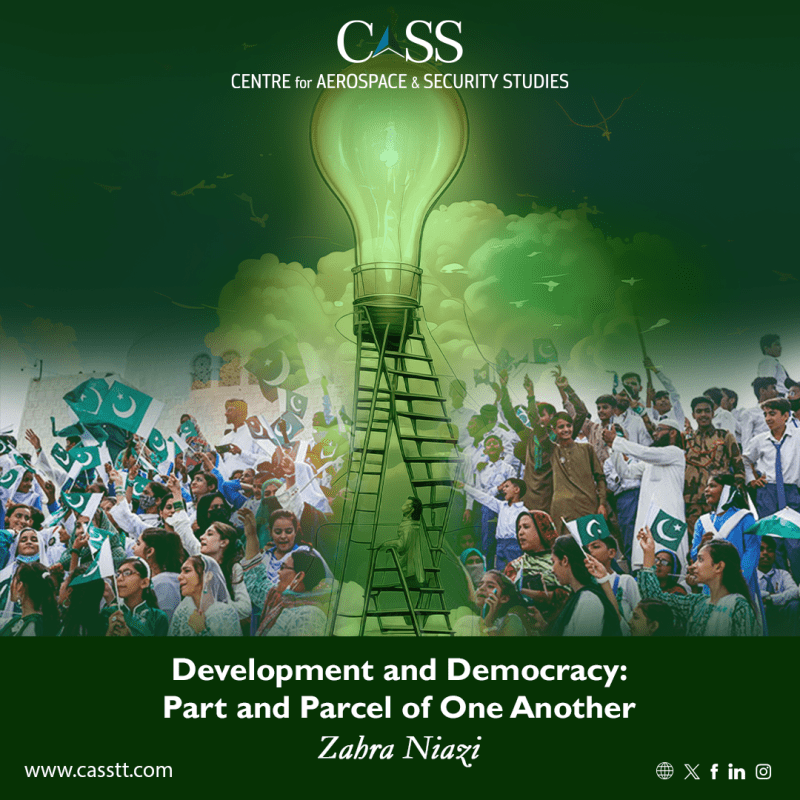
Endorsing this noble perspective propounded by Sen, development can be seen as part and parcel of democracy and vice versa. Put differently, if democracy is a society of free men and women, then, as a corollary, development, as conceptualised by Sen, is an integral component of democracy.
Nevertheless, some justified restraints to freedom are allowed, even in Sen’s dictionary. For instance, he stresses the importance of free markets to generate wealth but acknowledges the need for government intervention to correct market failures. Likewise, scholars and practitioners have highlighted many other justified limits to freedom, such as for safety and public health purposes, national security, or respect for others’ rights. However, the scope, magnitude, and duration of these justified limits to freedom should not exceed what is necessary.
All this brings us to the conclusion that the fundamental question guiding our discourse on development and democracy should not be whether or not democracy is a precondition for development but how we advance free and prosperous societies. Greatest prosperity can only follow when individuals are not hindered or limited in their pursuits. A society of free men and women where people are individually and collectively gratified, is more likely to be peaceful, and more creative to foster the innovation required for sustainable progress.
Zahra Niazi is a Research Assistant at the Centre for Aerospace & Security Studies (CASS), Islamabad, Pakistan. She can be reached at [email protected].