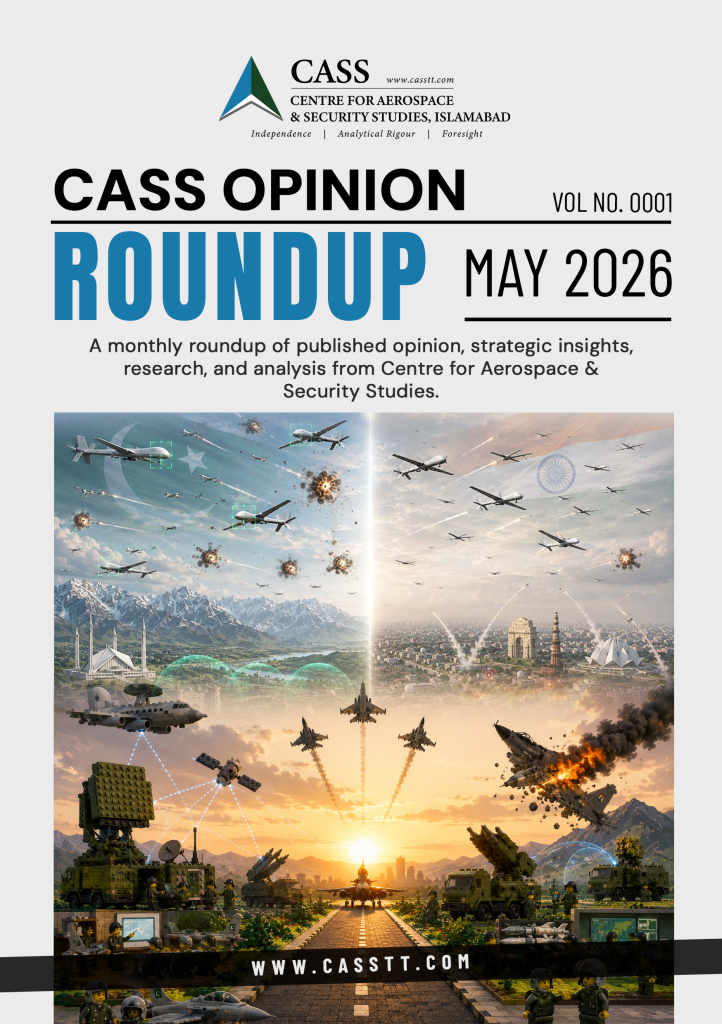
The recent air combat between India and Pakistan (7–10 May) was dominated by discussions on the role of beyond-visual-range (BVR) engagements and electronic warfare capabilities. These capabilities, while individually important, need to be integrated into a robust air defence system network that can protect the airspace of Pakistan. Air defence deters adversaries by imposing prohibitive costs and protects critical infrastructure through the interception of missiles. It is no exaggeration to say that Pakistan’s air defence system was a silent guardian during the conflict, whose deterrence of denial safeguarded the country from devastating losses.
Pakistan’s air defence has a complex, integrated radar system that comprises medium-range radar systems, such as the YLC-18 and YLC-2. Besides stationary ground radars, Pakistan has a mobile TPS-77 radar and an Airborne Early Warning (AEW) Radar system like the ZDK-03 Karakorum Eagle. These systems provide Pakistan with situational awareness that is capable of conducting electronic warfare (EW) against conventional and unconventional targets.
The strength of the Pakistani radar system was demonstrated during Operation Sindoor on 7th of May, where the air defence system was able to track over 70 Indian aircraft. In response, the Pakistani Air Force (PAF) alerted its Combat Air Patrol (CAP) and scrambled its jets, and mobilized its 40 aircraft in under 2 minutes. Despite numerical superiority, Pakistan shot down 6 enemy aircraft, including Indian Rafale jets. Pakistan achieved this by deploying network-centric warfare and multi-domain operations, where combat roles were divided into three groups. The first group locked onto enemy aircraft using ground-based radars, such as YLC-18 radar systems. The second group launched long-range BVR missiles like the PL-15 within Pakistani airspace against the designated target. And the last group, which consisted of AEW&C like the Saab 2000 Eyerie, provides geospatial awareness of various threats in the airspace. This integration of different systems allowed the Pakistan Air Force (PAF) to seamlessly transfer information from one platform to another. The PAF not only secured its own data links and communication systems but also disrupted the enemy’s information infrastructure. Pakistan deployed platforms like Bombardier Global 6000, which used cyber and electronic warfare that disrupted the enemy from completing their kill chains. The combined effect was that the Indian Air Force (IAF) radar and communications were jammed, significantly degrading their situational awareness. The IAF, unable to target Pakistan’s aircraft and facing the loss of six of its aircraft, retreated back to its air bases.
After the devastating loss, suffered on 7th of May, India resorted to using drone warfare to target Pakistan’s critical infrastructure, as a low risk option. Pakistan’s air defence response was flexible, where drones that loitered in less population dense areas were targeted with soft kill methods such as electronic warfare. Whereas, the drones that entered in urban areas were targeted with short range air defence systems (SHORAD), which consists of auto cannons and anti-aircraft guns. In total Pakistan had reportedly shot down a total of 77 drones, which includes the Israeli-made Heron-1, quadcopters, and loitering munitions. On 10th May, India attacked Murid, Rafiqi and Nur Khan air bases. The Pakistan air defence had a two pronged response. The first response was using ‘soft kill’ methods against Indian missiles, where Pakistan used techniques like GPS spoofing, jamming and other electronic and cyber-attacks. This increased the margin of error and in many instances the missiles either missed their targets completely or fell into Indian territory. The second response was ‘hard kill’, which was conducted through Pakistan’s HIMAD (High to Medium Air Defence, HQ-9) and LOMAD (Low-to-Medium Air Defence, HQ-16), which intercepted Indian missiles. Throughout the 4 day conflict, the Pakistani air defence system had intercepted a majority of missiles, safeguarding its critical infrastructure, proving its effectiveness. Pakistani air defence acted not only as a shield against missiles, but was also instrumental in re-establishing strategic deterrence against Indian aircraft.
Air defence systems have long been recognised by the international community as a necessity in modern warfare; however, these systems have certain limitations that must be addressed. The first major limitation relates to hypersonic technology; the speed of these missiles makes it difficult for radar systems to track their movement and intercept their trajectory. The Houthis have conducted successful missile strikes on Israel’s airports, penetrating through the Iron Dome system. The second major issue is Drone swarm saturation, which is a common tactic used in the Russo-Ukrainian war, where the Russian S-400 has been overwhelmed by Ukrainian drones. The importance of air defence systems cannot be understated, as can be seen in the recent Iranian-Israeli war, where the Iranian air defence system failed. The Israeli Air Force (IAF) conducted decapitation and strategic bombing strategies. This resulted in the elimination of the Iranian military leadership and the bombing of vital infrastructure.
Despite these threats, Pakistan’s air defence system has largely performed well, due to its layered system. Pakistan has a range of HIMAD, LOMAD, and SHORAD platforms that can effectively engage with conventional and unconventional threats simultaneously. Pakistani air defence systems are flexible, as they are equipped with cyber and electronic capabilities that enable “soft kills”. Pakistan requires continuous investment of resources to develop indigenous and modern air defence systems that are capable of integrating emerging technologies.
Syed Ahmed Ali is a Research Assistant at the Centre for Aerospace & Security Studies (CASS) in Islamabad, Pakistan. He can be reached at [email protected].