
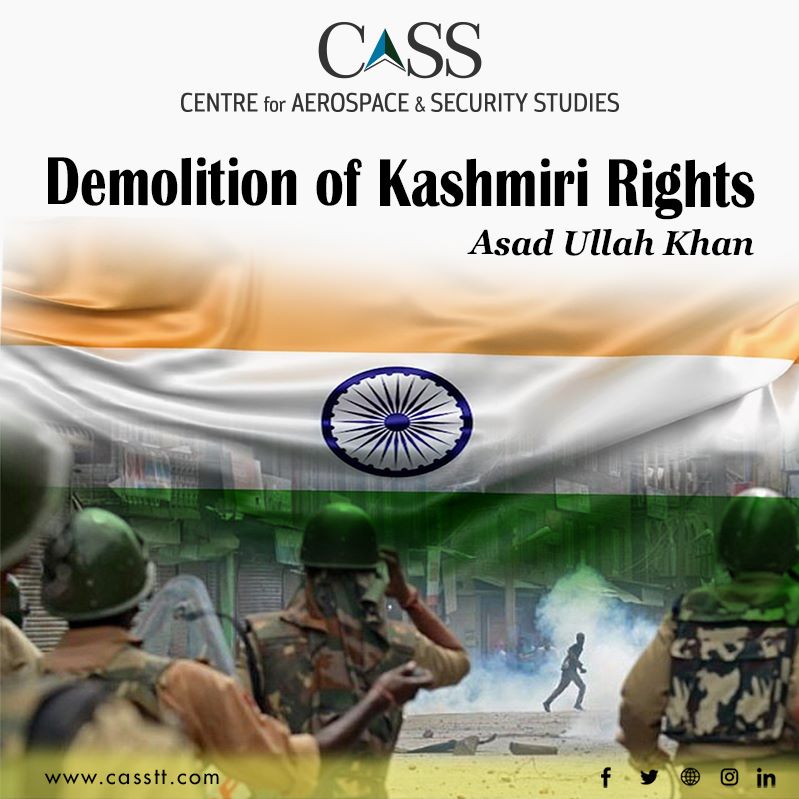
The abrogation of Articles 370 and 35-A on 5 August 2019 was perhaps the first step taken by India in order to systematically strip off the autonomous status of Indian Illegally Occupied Jammu & Kashmir (IIOJK). Subsequently the Hindutva-led government of Bharatiya Janata Party (BJP) has been involved in changing the demography, culture, and history of Muslims in IIOJK through lawfare. In the same context, in its recent move, the BJP government started demolishing residential and commercial properties in the Valley from 4th February, 2023 without giving any prior warnings to the residents. The operation was carried out in the areas of Srinagar where according to the recent population data of 2023, Muslim population is around 95%. The ongoing drive of demolition is a violation of basic human rights in the Valley, especially when such activities are used as a weapon to deprive people of their economic, social and cultural rights.
To alter the situation on ground, the Government of India changed the laws into its favour in order to give legitimacy to its otherwise illegal actions. This was initiated in October 2020 through two draconian orders – Jammu and Kashmir Reorganization (Adaptation of Central Laws) Order, and the Jammu and Kashmir Reorganization (Adaptation of State Laws) Order passed to repeal 12 existing land laws that were protecting the rights of the local Kashmiri residents since decades. The laws that were amended included the Tenancy Act, Common Lands Regulations, and laws related to the transfer of agricultural land for non-agricultural purposes.
The current demolition of residential and commercial property, under the protection of new laws, will drastically affect the Kashmiri population financially, socially, and psychologically. IIOJK is already enduring communications blackout, deployment of additional Indian troops, detention of political leaders, forced disappearances, among others, which have led to a widespread disruption of daily life in the region. As per the new rules and regulations of the tenancy, the Indian government would not be renewing the current leases on the hotel ownerships in the Valley rather they will sell them in open auction to the highest bidder. This process would negatively impact the livelihood of the locals as the Muslim majority areas were generating revenues from tourism and agriculture in IIOJK. This is a classic example of first paralysing the will of the people economically, and then forcing them to surrender their basic rights to the occupation forces.
Almost all major Indian political parties have protested against this ‘anti-people’ encroachment drive. According to Mehbooba Mufti, chief of the Indian People’s Democratic Party, the Modi government is exploiting the religious and social fault line of Kashmiri society and taking political advantage of it.
The Indian government has also been silencing journalists and media groups in the Valley. According to the Press Freedom Index, India was ranked 150th among 180 countries for the year 2022. This is the lowest ranking ever given to India. The current restrictions on journalists is preventing them from portraying the true picture of Indian atrocities in IIOJK. Such steps are nothing less than systematic deprivation of Kashmiri people from their fundamental rights in their own homeland.
India has tried to project in the international community that the situation in IIOJK has normalised after its illegal annexation of August 2019. However, the Hindutva mindset, in the form of the BJP government’s actions, is now facing condemnation on the international front as Amnesty International has recently demanded that India should stop the economic, social, cultural, and demographic bulldozing of the Kashmiri identity in the Valley.
The Indian government should realise that violating basic human rights and suppressing the emotional feelings of innocent Kashmiri people would only further fuel and strengthen their right of self-determination.
Asad Ullah Khan is a Senior Research Associate at the Centre for Aerospace & Security Studies (CASS), Islamabad, Pakistan. He can be reached at [email protected].



