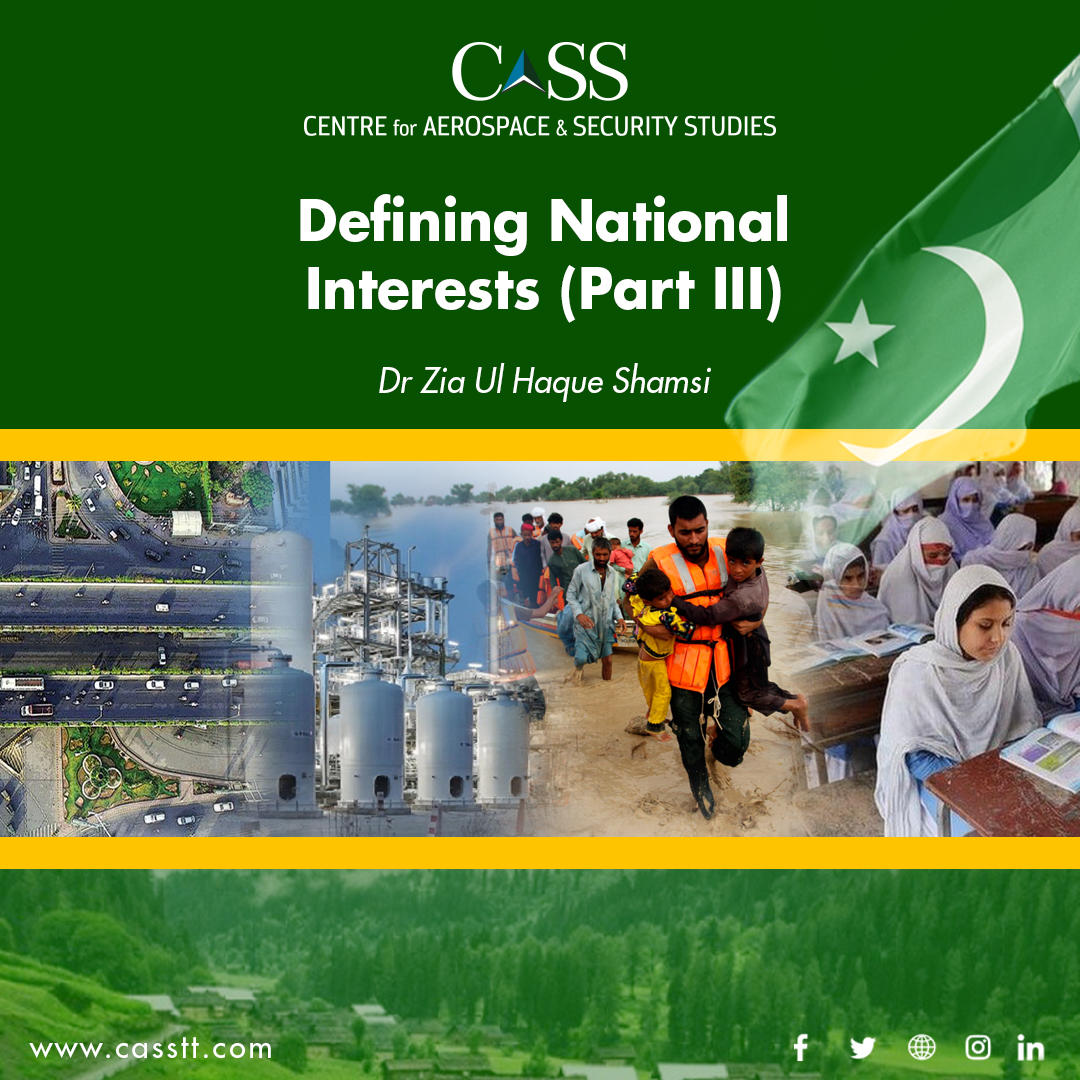
This is the third and the last part of the series on “Defining National Interests” with the first two published in Daily Times on August 15 and 22, respectively. Having defined the National Values first, I had insisted that, “Non-adherence to the fundamental values that are professed and practiced by all religions is one of the most pressing cause of societal degeneration in Pakistan.”
Part I dealt with the survival or the vital national interests, based on the national purpose and core national values. These interests included territorial integrity and sovereignty, economic development, and adherence to core national values, to ensure national integration in a multi-ethnic society, like Pakistan.
Whereas, the most important national interests included human security to ensure the well-being of its people, which is extremely critical for the progress and development of any state. Likewise, Human Resource Development (HRD) was placed under the most important national interest, primarily because Pakistan has a young population and at least 63 per cent of people are below the age of 35 years. If educated and trained on modern lines, these young minds can prove to be game changers in the country’s development.
Moving forward to another most important national interest, it is proposed that a foreign policy of productive engagement could be more prudent for Pakistan. In fact, Pakistan’s strategic location makes it extremely relevant for all stakeholders within the region and beyond. Moreover, Pakistan is grappling with several conflicts with its nuclear neighbour India and perhaps it is time to move beyond conflict management to conflict resolution on all fronts, including that of Jammu and Kashmir (J&K).
The lack of universal education, climate change, and political stability was also placed on the list of the most important national interests. However, without a potent judicial system and good governance, nothing would improve the situation. There is consensus that lack of judicial reforms, improper implementation of existing laws, and poor governance are the causes of uncertainty, and societal degeneration.
The other important national interests may include agricultural and industrial development, capacity building for a knowledge-based economy, women empowerment, human rights, fulfilment of international obligations, development of sporting infrastructure for the youth, and specific programmes for skill development of the people from relatively less developed areas.
People might raise the question that why J&K and minimum nuclear deterrence has not been figured out as the survival or the vital national interest or even on the list of most important interests. People’s concerns are not without reason, but I intend to place J&K as the National Aim.
Pakistan has had a number of wars and conflicts with India over J&K, and the people of South Asia have suffered immensely due to this dispute. The people of J&K have laid enormous sacrifices to earn their right to self-determination, but India continues to deny that and has engaged in gross violation of human rights over the decades. Pakistan has made every effort to convince India to resolve the dispute in line with United Nations Resolutions, but it ignores calls from the international community as well as international organizations.
As per Quaid’s direction, J&K is the jugular vein of Pakistan and hence cannot be ignored. Pakistan is committed to supporting the people of J&K with all available means till they earn their right to self-determination as promised to them through numerous UN Resolutions.
Pakistan’s nuclear capability is the guarantor of its physical security against a five times larger adversary, India. Therefore, it must not be seen as exclusive to Pakistan’s survival or the vital interest of territorial integrity and sovereignty. This is one reason, I would place it as the most important national objective, instead of interest.
Before I conclude the series on Defining National Interests, let me once list these interests in a logical sequence. First the national values: Unity, Faith, and Discipline as directed by Quaid. However, proposed additions include Tolerance, Equality, and Social Justice.
The survival or the vital interests may include territorial integrity and the sovereignty of the state, economic development, and the well-being of the citizenry so that people remain committed to the defined national interests. Whereas, the most important national interests may include: human security through Human Resource Development (HRD), for which universal education would be the main pillar. Political stability and climate change are also extremely important to accomplish other vital interests.
Over the years, rising extremism has been a cause of serious concern for society. This is one reason tolerance has been proposed to include as part of core national values. This may greatly help in the much-needed national integration and provincial harmony.
Through the series of these articles on this important subject, an effort is made to initiate a debate among the academics and practitioners to find the middle ground, so that the lost opportunities are retaken and the next 25 years are better than the last 75 years, In Sha Allah.
(Concluded)
Dr Zia Ul Haque Shamsi is the author of ‘Nuclear Deterrence and Conflict Management between India and Pakistan’ and ‘South Asia Needs Hybrid Peace.’ He is presently working as Director (Peace and Conflict Studies) at the Centre for Aerospace & Security Studies (CASS), Islamabad, Pakistan. The article was first published in Daily Times. He can be contacted at: [email protected]
Image Credit: Online Sources